
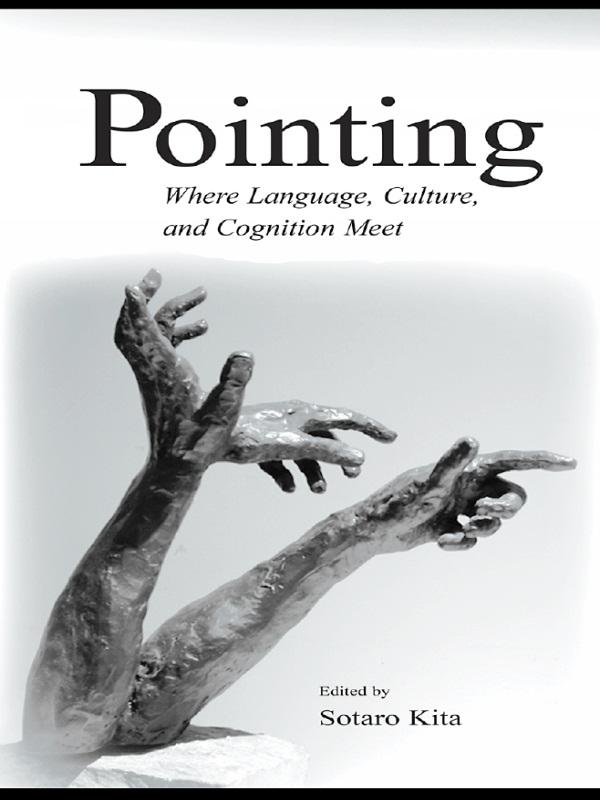
Pointing has captured the interest of scholars from various fields who study communication. However, ideas and findings have been scattered across diverse publications in different disciplines, and opportunities for interdisciplinary exchange have been very limited. The editor's aim is to provide an arena for such exchange by bringing together papers on pointing gestures from disciplines, such as developmental psychology, psycholinguistics, sign-language linguistics, linguistic anthropology, conversational analysis, and primatology.
Questions raised by the editors include:
*Do chimpanzees produce and comprehend pointing gestures in the same way as humans?
*What are cross-cultural variations of pointing gestures?
*In what sense are pointing gestures human universal?
*What is the relationship between the development of pointing and language in children?
*What linguistic roles do pointing gestures play in signed language?
*Why do speakers sometimes point to seemingly empty space in front of them during conversation?
*How do pointing gestures contribute to the unfolding of face-to-face interaction that involves objects in the environment?
*What are the semiotic processes that relate what is pointed at and what is actually "meant" by the pointing gesture (the relationship between the two are often not as simple as one might think)?
*Do pointing gestures facilitate the production of accompanying speech?
The volume can be used as a required text in a course on gestural communication with multidisciplinary perspectives. It can also be used as a supplemental text in an advanced undergraduate or graduate course on interpersonal communication, cross-cultural communication, language development, and psychology of language.
Zahle einfach mit Karte, Klarna, Apple Pay oder Google Pay. Nicht zufrieden? Du hast immer ein 14-tägiges Widerrufsrecht. Lies mehr in unseren AGB. Hast du Fragen, schreib uns eine E-Mail an hello@memmo.org.
Memmo macht das Lernen einfacher – wo auch immer du bist. Bei uns findest du deine Kursbücher und smarte Lerntools an einem Ort: Zusammenfassungen, Quizzes, Podcasts und Lernkarten. Und Ted, dein Lernbuddy, beantwortet alles, was du wissen möchtest. Über 50.000 Studierende lernen bereits hier – gemacht, damit du schneller lernst und weniger Stress hast.