
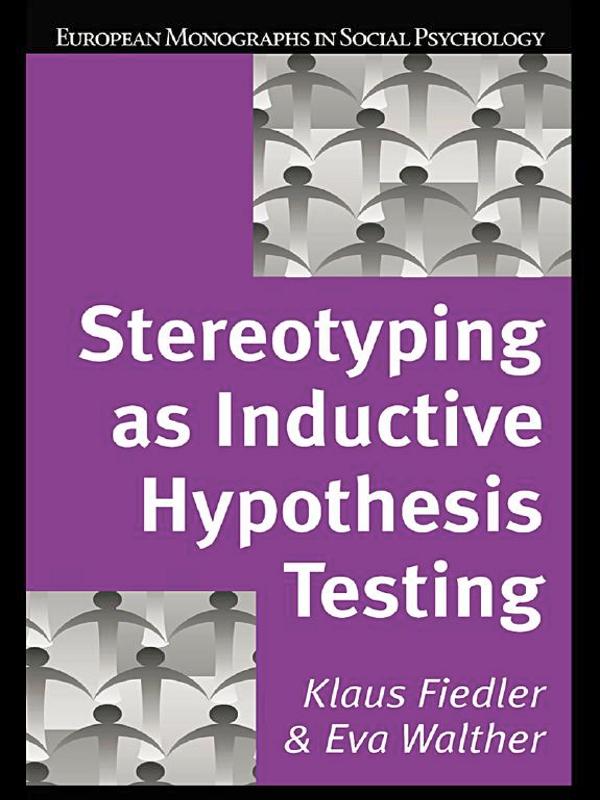
Traditional social hypotheses have a built-in tendency to verify themselves and so involuntarily resist attempts at stereotype change or correction. This is the insight demonstrated and discussed as the start point for an alternative approach to the problem of stereotyping and hypothesis testing. Stereotyping as Inductive Hypothesis Testing explicates the proposition that many stereotypes originate not so much in individual brains, but in the stimulus environment that interacts with and constitutes the social individual. This cognitive-ecological approach is then used to analyse the different aspects of language, sign systems and communication that can implicitly govern hypothesis testing procedures and lead to circular or reinforcing outcomes. The authors describe factors in tests such as judgment, memory and expectation and go on to suggest viable ecological learning approaches to them. An original research project based on a classroom situation is used to demonstrate and verify findings. The cognitive-ecological approach is then contextualised in relation to both the traditional approaches it can replace and the contemporary statistical sampling practices it can improve. Written with a profound understanding of the link between theoretical rigour and good empirical research practice this monograph will be invaluable to anyone with an interest in stereotyping or who wishes to enhance the reliability and self-awareness of their research methods.
Zahle einfach mit Karte, Klarna, Apple Pay oder Google Pay. Nicht zufrieden? Du hast immer ein 14-tägiges Widerrufsrecht. Lies mehr in unseren AGB. Hast du Fragen, schreib uns eine E-Mail an hello@memmo.org.
Memmo macht das Lernen einfacher – wo auch immer du bist. Bei uns findest du deine Kursbücher und smarte Lerntools an einem Ort: Zusammenfassungen, Quizzes, Podcasts und Lernkarten. Und Ted, dein Lernbuddy, beantwortet alles, was du wissen möchtest. Über 50.000 Studierende lernen bereits hier – gemacht, damit du schneller lernst und weniger Stress hast.