
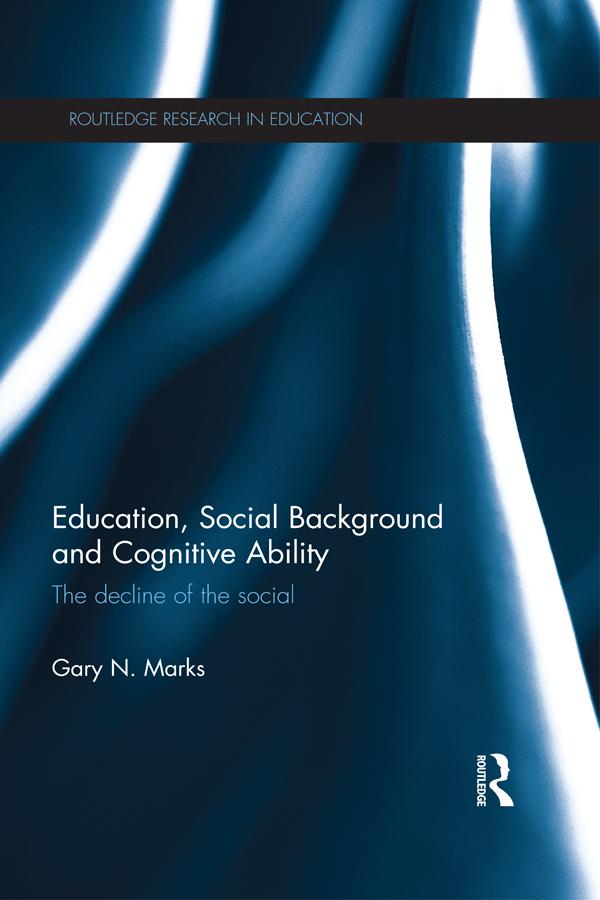
Are socioeconomic inequalities in education declining? Is socioeconomic background becoming less important for people’s occupational class or status? How important is cognitive ability for education and later occupational outcomes? How do countries differ in the importance of socioeconomic background for education and work?
Gary N. Marks argues that in western industrialized countries, pervasive views that socioeconomic background (or class background) has strong and unchanging relationships with education and later socioeconomic outcomes, resistant to policy and social change, are unfounded. Marks provides a large amount of evidence from many countries showing that the influence of socioeconomic background for education is moderate and most often declining, and socioeconomic background has only very weak impacts on adults’ occupation and earnings after taking into account education and cognitive ability.
Furthermore, Marks shows that cognitive ability is a more powerful influence than socioeconomic background for educational outcomes, and that in addition to its indirect effects through education has a direct effect on occupation and earnings. Its effects cannot be dismissed as simply another aspect of socioeconomic background, nor do the usual criticisms of ‘cognitive ability’ apply. The declining effects for socioeconomic background and the importance of cognitive ability support several of the contentions of modernization theory.
The book contributes to a variety of debates within sociology: quantitative and qualitative approaches, explanatory and non-explanatory theory, the relationship between theory and empirical research, the role of political ideology in research, sociology as a social science, and sociology’s contribution to knowledge about contemporary societies. It will appeal to professionals in the fields of education and sociology as well as postgraduate students and academics involved in the debate.
Zahle einfach mit Karte, Klarna, Apple Pay oder Google Pay. Nicht zufrieden? Du hast immer ein 14-tägiges Widerrufsrecht. Lies mehr in unseren AGB. Hast du Fragen, schreib uns eine E-Mail an hello@memmo.org.
Memmo macht das Lernen einfacher – wo auch immer du bist. Bei uns findest du deine Kursbücher und smarte Lerntools an einem Ort: Zusammenfassungen, Quizzes, Podcasts und Lernkarten. Und Ted, dein Lernbuddy, beantwortet alles, was du wissen möchtest. Über 50.000 Studierende lernen bereits hier – gemacht, damit du schneller lernst und weniger Stress hast.