
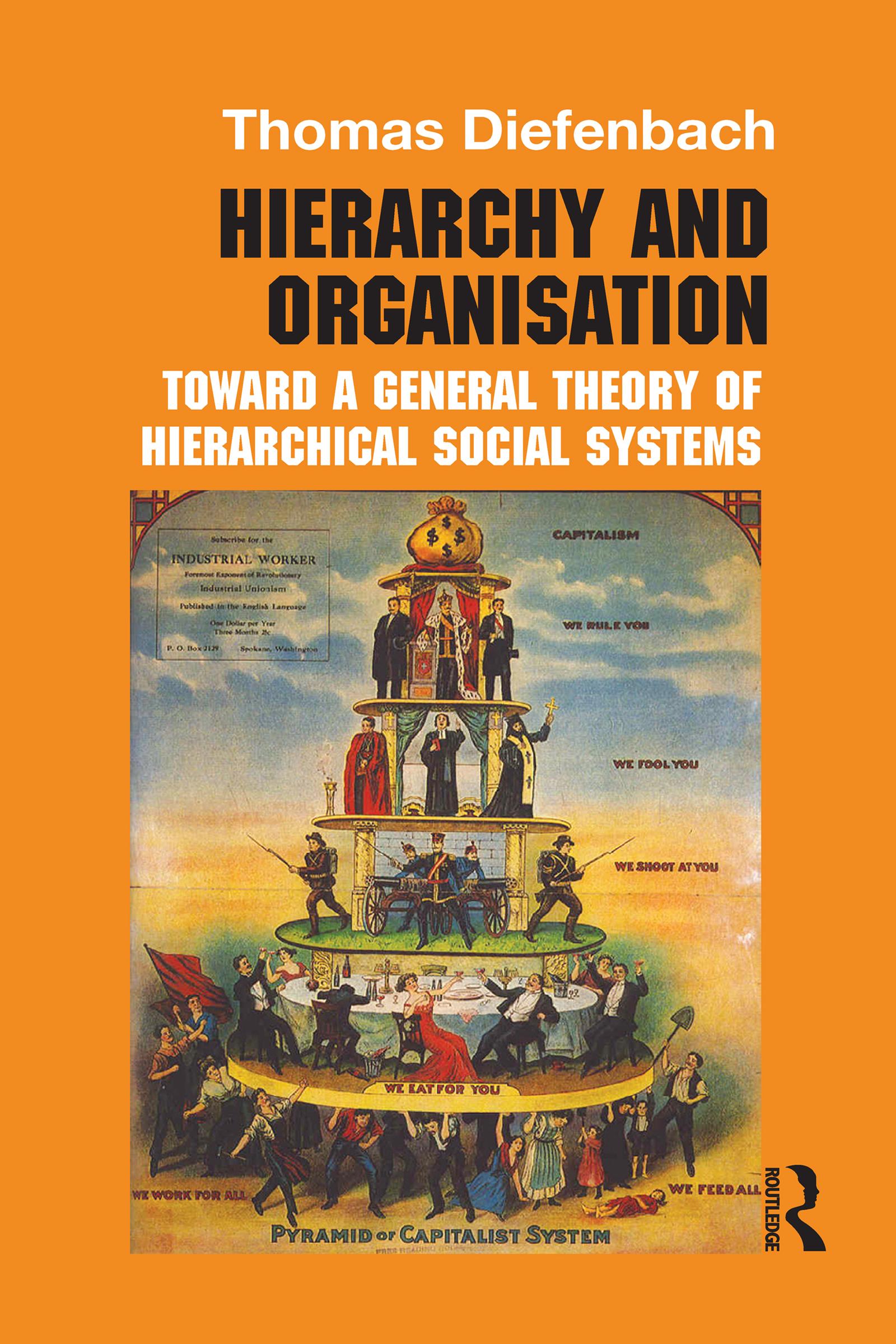
Most people take the conditions they work and live in as a given, believing it to be normal that societies are stratified and that organisations are hierarchical. Many even think that this is the way it should be - and are neither willing nor able to think that it could be otherwise. This book raises the awareness of hierarchy, its complexity and longevity. It focuses on a single but fundamental problem of social systems such as dyads, groups, organisations and whole societies: Why and how does hierarchical social order persist over time? In order to investigate the question, author Thomas Diefenbach develops a general theory of the persistence of hierarchical social order. This theory interrogates the problem of the persistence of hierarchical social order from very different angles, in multi-dimensional and interdisciplinary ways. Even more crucially, it traces the very causes of the phenomenon, the reasons and interests behind hierarchy as well as the various mechanisms which keep it going.
This is the first time such a theory is attempted. With the help of the theory developed in this book, it is possible to interrogate systematically, comprehensively and in detail how mindsets and behaviours as well as societal and organisational structures enable the continuation of hierarchy
Zahle einfach mit Karte, Klarna, Apple Pay oder Google Pay. Nicht zufrieden? Du hast immer ein 14-tägiges Widerrufsrecht. Lies mehr in unseren AGB. Hast du Fragen, schreib uns eine E-Mail an hello@memmo.org.
Memmo macht das Lernen einfacher – wo auch immer du bist. Bei uns findest du deine Kursbücher und smarte Lerntools an einem Ort: Zusammenfassungen, Quizzes, Podcasts und Lernkarten. Und Ted, dein Lernbuddy, beantwortet alles, was du wissen möchtest. Über 50.000 Studierende lernen bereits hier – gemacht, damit du schneller lernst und weniger Stress hast.