
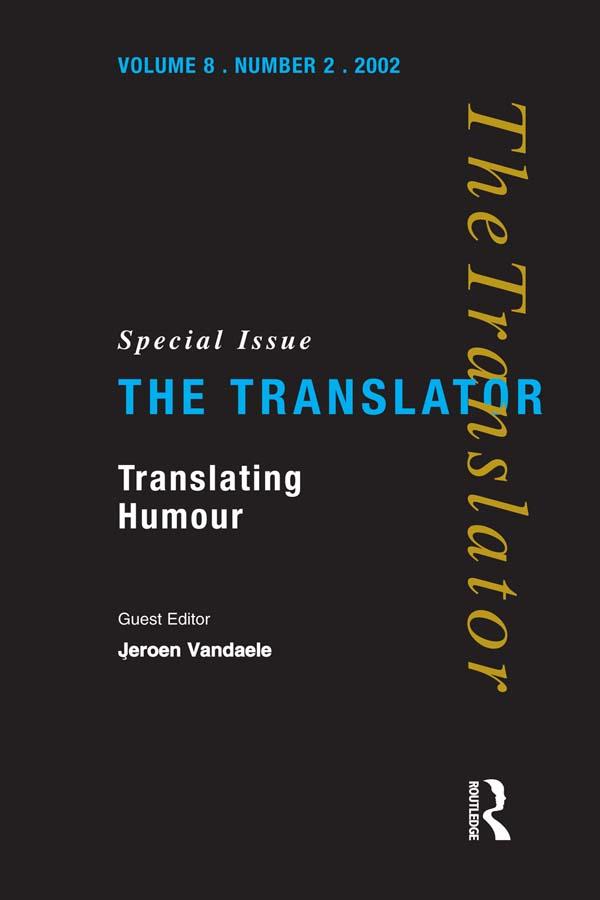
It is all too often assumed that humour is the very effect of a text. But humour is not a perlocutionary effect in its own right, nor is laughter. The humour of a text may be as general a characteristic as a serious text's seriousness. Like serious texts, humorous texts have many different purposes and effects. They can be subdivided into specific subgenres, with their own perlocutionary effects, their own types of laughter (or even other reactions).
Translation scholars need to be able to distinguish between various kinds of humour (or humorous effect) when comparing source and target texts, especially since the notion of "effect" pops up so frequently in the evaluation of humorous texts and their translations. In this special issue of The Translator, an attempt is made to delineate types of humorous effect, through careful linguistic and cultural analyses of specific examples and/or the introduction of new analytical tools. For a translator, who is both a receiver of the source text and sender of the target text, such analyses and tools may prove useful in grasping and pinning down the perlocutionary effect of a source text and devising strategies for producing comparable effects in the target text. For a translation scholar, who is a receiver of both source and target texts, the contributions in this issue will hopefully provide an analytical framework for the comparison of source and target perlocutionary effects.
Zahle einfach mit Karte, Klarna, Apple Pay oder Google Pay. Nicht zufrieden? Du hast immer ein 14-tägiges Widerrufsrecht. Lies mehr in unseren AGB. Hast du Fragen, schreib uns eine E-Mail an hello@memmo.org.
Memmo macht das Lernen einfacher – wo auch immer du bist. Bei uns findest du deine Kursbücher und smarte Lerntools an einem Ort: Zusammenfassungen, Quizzes, Podcasts und Lernkarten. Und Ted, dein Lernbuddy, beantwortet alles, was du wissen möchtest. Über 50.000 Studierende lernen bereits hier – gemacht, damit du schneller lernst und weniger Stress hast.