
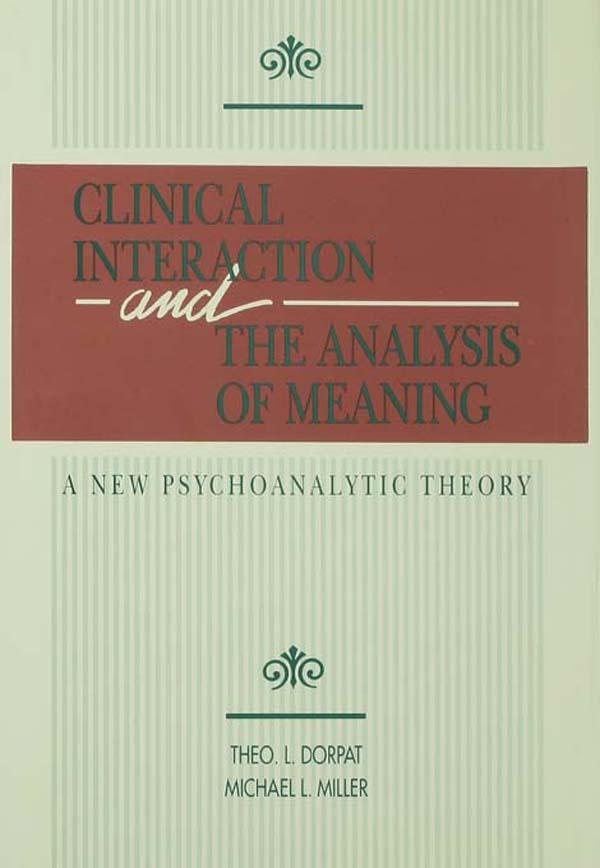
Clinical Interaction and the Analysis of Meaning evinces a therapeutic vitality all too rare in works of theory. Rather than fleeing from the insights of other disciplines, Dorpat and Miller discover in recent research confirmation of the possibilities of psychoanalytic treatment. In Section I, "Critique of Classical Theory," Dorpat proposes a radical revision of the notion of primary process consonant with contemporary cognitive science. Such a revised conception not only enlarges our understanding of the analytic process; it also provides analysis with a conceptual language that can articulate meaningful connections with a growing body of empirical research about the development and nature of human cognition.
In Section II, "Interactional Theory," Miller reverses the direction of inquiry. He begins with the literature on cognitive development and functioning, and proceeds to mine it for concepts relevant to the clinical process. He shows how a revised understanding of the operation of cognition and affect can impart new meaning to basic clinical concepts such as resistance, transference, and level of psychopathology. In Section III, "Applications and Exemplifications," Dorpat concludes this exemplary collaboration by exploring select topics from the standpoint of his and Miller's new psychoanalytic theory.
At the heart of the authors' endeavor it "meaning analysis," a concept that integrates an up-to-date model of human information processing with the traditional goals of psychoanalysis. The patient approaches the clinical encounter, they argue, with cognitive-affective schemas that are the accumulatice product of his life experience to date; the manifold meanings ascribed to the clinical interaction must be understood as the product of these schemas rather than as distortions deriving from unconscious, drive-related fantasies. The therapist's goal is to make the patient's meaning-making conscious and thus available for introspection.
Zahle einfach mit Karte, Klarna, Apple Pay oder Google Pay. Nicht zufrieden? Du hast immer ein 14-tägiges Widerrufsrecht. Lies mehr in unseren AGB. Hast du Fragen, schreib uns eine E-Mail an hello@memmo.org.
Memmo macht das Lernen einfacher – wo auch immer du bist. Bei uns findest du deine Kursbücher und smarte Lerntools an einem Ort: Zusammenfassungen, Quizzes, Podcasts und Lernkarten. Und Ted, dein Lernbuddy, beantwortet alles, was du wissen möchtest. Über 50.000 Studierende lernen bereits hier – gemacht, damit du schneller lernst und weniger Stress hast.