
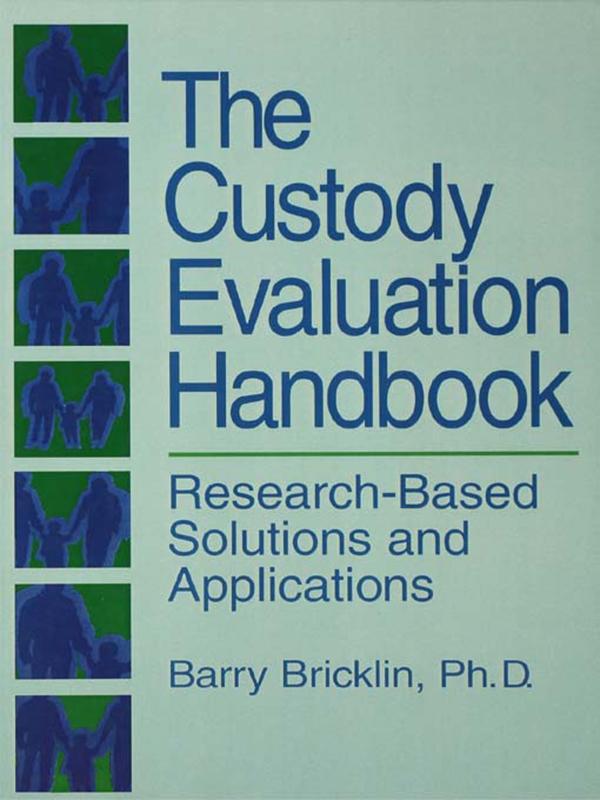
Joint custody. Same?sex custody. Young children with the mother. Which is the best arrangement? Unfortunately, for those who seek a trustworthy solution, research has proven that there is no single best arrangement for all children. This timely volume, however, does offer a practical and realisic methodology with which to confront the challenging and often confusing issues facing the custody evaluator. THe only book of its kind, The Custody Evaluation Handbook offers a strikingly helpful model for evaluating and assigning weight to the mountains of disparate information accumulated during a custody suit. Written by an unparalleled expert in the field of custody evaluation, the book eschews what the author calls the negative incident model in which each parent responds to the custody process by compiling a long list of grievances against the hated opponent. It advocates, instead a test?based approach that measures how successful each parent actually is at the job of parenting. The book describes numerous tests and tools for eliciting reliable information from both children and parents. With an eye to learning the actual impact a parent has on a child rather than what a given parent may or may not be doing, the book emphasizes obtaining measurements from the involved child. Parent tests are designed to reflect the effectiveness with which a parent responds to typical childcare situations, and the degree to which a parent truly knows ? and can satisfy the needs of ? a particular child. The volume also sets forth concepts derived from extensive research that are particularly helpful in understanding parent?child interactions, and provides a specific system of nonadversary communication strategies that can be used and modeled in all interchanges with evaluation participants, and in the wording of all written reports. Readers will also welcome the numerous suggestions from evaluators all over the country on specific custody dilemmas they have faced. The book is based on many years' meticulous research and is informed by a number of conceptual approaches that include: The proven premise that whatever certain parents intend to communicate is often not what their children are, in fact, perceiving and reacting to The Utilization Model of Milton E. Erikson The Thomas, Chess, and Birch goodness?of?fit model of parent?child interaction Bandler and Grinders' assertion that the meaning of a communication is the response it elicits, regardless of the intentions of the sender Clearly, spelling out the targets of a truly comprehensive and reliable evaluation, The Custody Evaluation Handbook will be an invaluable handbook for custody evaluators and marriage and family therapists, as well as other involved mental health professionals.
Zahle einfach mit Karte, Klarna, Apple Pay oder Google Pay. Nicht zufrieden? Du hast immer ein 14-tägiges Widerrufsrecht. Lies mehr in unseren AGB. Hast du Fragen, schreib uns eine E-Mail an hello@memmo.org.
Memmo macht das Lernen einfacher – wo auch immer du bist. Bei uns findest du deine Kursbücher und smarte Lerntools an einem Ort: Zusammenfassungen, Quizzes, Podcasts und Lernkarten. Und Ted, dein Lernbuddy, beantwortet alles, was du wissen möchtest. Über 50.000 Studierende lernen bereits hier – gemacht, damit du schneller lernst und weniger Stress hast.
Das könnte dir auch gefallen
Buch kaufen0