
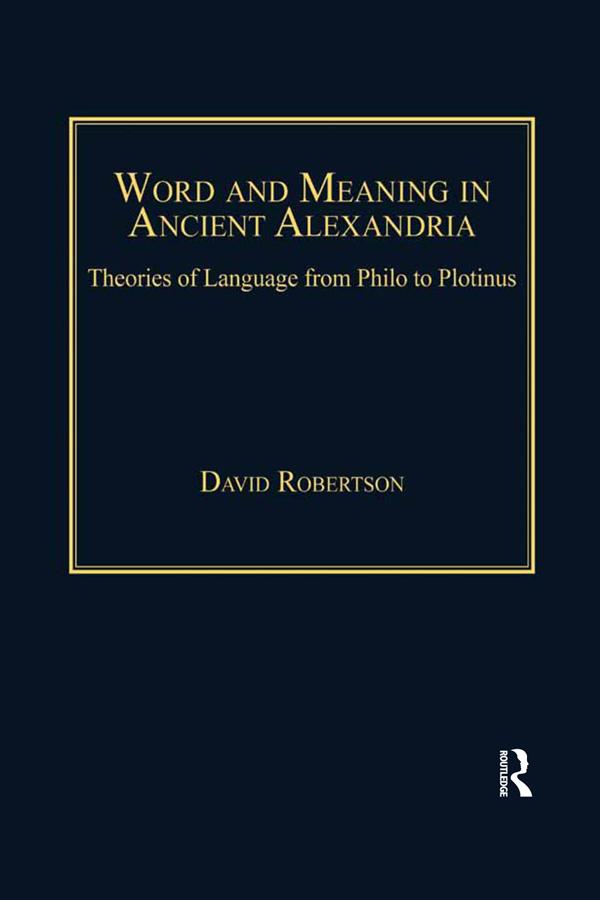
During the late Hellenistic and early Imperial periods (B.C. 50 - A.D. 300), important developments may be traced in the philosophy of language and its relationship to mind. This book examines theories of language in the work of theologians and philosophers linked to Ancient Alexandria. The growth of Judaism and Christianity in cultural centers of the Roman Empire, above all Alexandria, provides valuable testimony to the philosophical vitality of this period. The study of Later Greek philosophy should be more closely integrated with the Church Fathers, particularly in the theologically sensitive issue of the nature of language. Robertson traces some related attempts to reconcile immaterial, intelligible reality and the intelligibility of language, explain the structure of language, and clarify the nature of meaning. These shared problems are handled with greater philosophical sophistication by Plotinus, although the comparison with Philo, Clement, and Origen illustrates significant similarities as well as differences between Neoplatonism and early Jewish and Christian philosophy.
Zahle einfach mit Karte, Klarna, Apple Pay oder Google Pay. Nicht zufrieden? Du hast immer ein 14-tägiges Widerrufsrecht. Lies mehr in unseren AGB. Hast du Fragen, schreib uns eine E-Mail an hello@memmo.org.
Memmo macht das Lernen einfacher – wo auch immer du bist. Bei uns findest du deine Kursbücher und smarte Lerntools an einem Ort: Zusammenfassungen, Quizzes, Podcasts und Lernkarten. Und Ted, dein Lernbuddy, beantwortet alles, was du wissen möchtest. Über 50.000 Studierende lernen bereits hier – gemacht, damit du schneller lernst und weniger Stress hast.
Das könnte dir auch gefallen
Buch kaufen0