
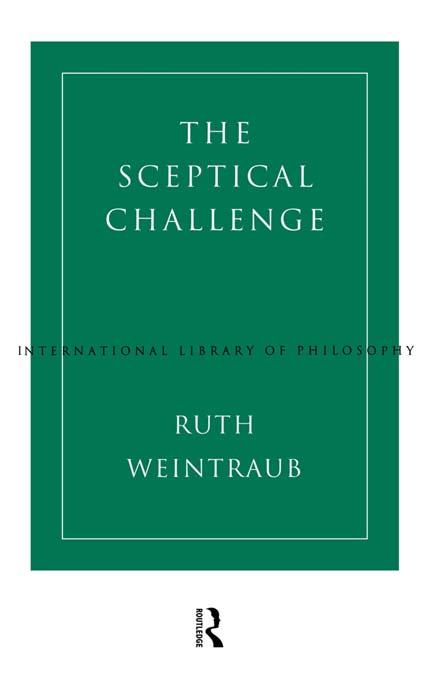
Do we really know the things we think we know? Are any of our beliefs reasonable? Scepticism gives a pessimistic reply to these important epistemological questions - we don't know anything; none of our beliefs are reasonable. But can such a seemingly paradoxical claim be more than an intellectual curiousity? And if it is, can it be refuted? Ruth Weintraub answers yes to both these questions.
The sceptical challenge is a formidable one, and should be confronted, not dismissed. The theoretical and practical difficulties it presents - in that the sceptical life cannot be lived, and the doctrine seems self-defeating - are in fact superficial, according to Ruth Weintraub. Her study looks at the sceptical arguments of Descartes, Hume and the ancient Greek sceptic, Sextus Empiricus. The author argues that by drawing on philosophy, rather than science, the sceptical challenge can be answered.
The Sceptical Challenge is a bold and original response to scepticism; it represents a new way of looking at the field for philosophers of epistemology.
Zahle einfach mit Karte, Klarna, Apple Pay oder Google Pay. Nicht zufrieden? Du hast immer ein 14-tägiges Widerrufsrecht. Lies mehr in unseren AGB. Hast du Fragen, schreib uns eine E-Mail an hello@memmo.org.
Memmo macht das Lernen einfacher – wo auch immer du bist. Bei uns findest du deine Kursbücher und smarte Lerntools an einem Ort: Zusammenfassungen, Quizzes, Podcasts und Lernkarten. Und Ted, dein Lernbuddy, beantwortet alles, was du wissen möchtest. Über 50.000 Studierende lernen bereits hier – gemacht, damit du schneller lernst und weniger Stress hast.