
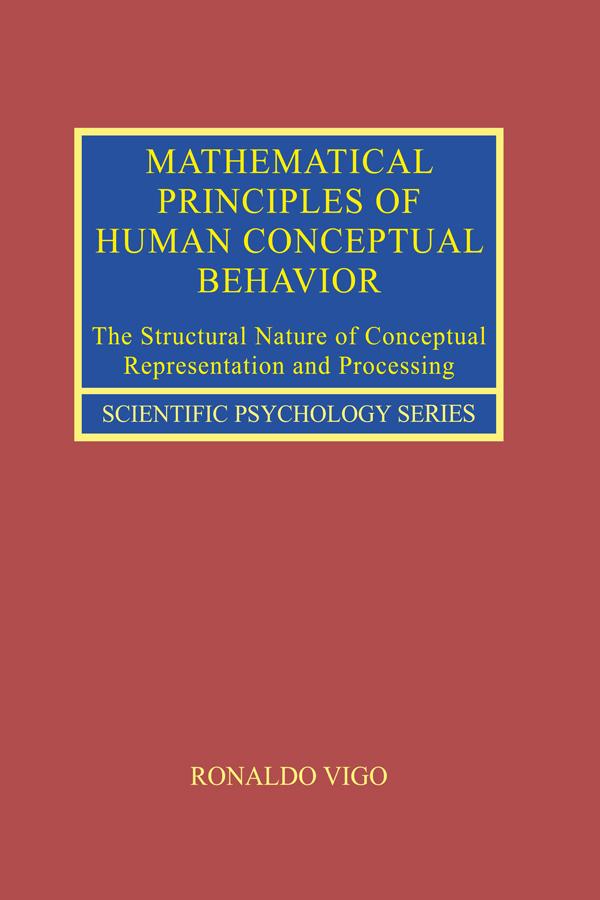
The ability to learn concepts lies at the very core of human cognition, enabling us to efficiently classify, organize, identify, and store complex information. In view of the basic role that concepts play in our everyday physical and mental lives, the fields of cognitive science and psychology face three long standing challenges: discovering the laws that govern concept learning and categorization behavior in organisms, showing how they inform other areas of cognitive research, and describing them with the mathematical systematicity and precision found in the physical sciences. In light of these theoretical and methodological shortcomings, this volume will introduce a set of general mathematical principles for predicting and explaining conceptual behavior.
The author’s theory is based on seven fundamental constructs of universal science: invariance, complexity, information, similarity, dissimilarity, pattern, and representation. These constructs are joined by a novel mathematical framework that does not depend on probability theory, and derives key results from conceptual behavior research with other key areas of cognitive research such as pattern perception, similarity assessment, and contextual choice. The result is a unique and systematic unifying foundation for cognitive science in the tradition of classical physics.
Zahle einfach mit Karte, Klarna, Apple Pay oder Google Pay. Nicht zufrieden? Du hast immer ein 14-tägiges Widerrufsrecht. Lies mehr in unseren AGB. Hast du Fragen, schreib uns eine E-Mail an hello@memmo.org.
Memmo macht das Lernen einfacher – wo auch immer du bist. Bei uns findest du deine Kursbücher und smarte Lerntools an einem Ort: Zusammenfassungen, Quizzes, Podcasts und Lernkarten. Und Ted, dein Lernbuddy, beantwortet alles, was du wissen möchtest. Über 50.000 Studierende lernen bereits hier – gemacht, damit du schneller lernst und weniger Stress hast.