
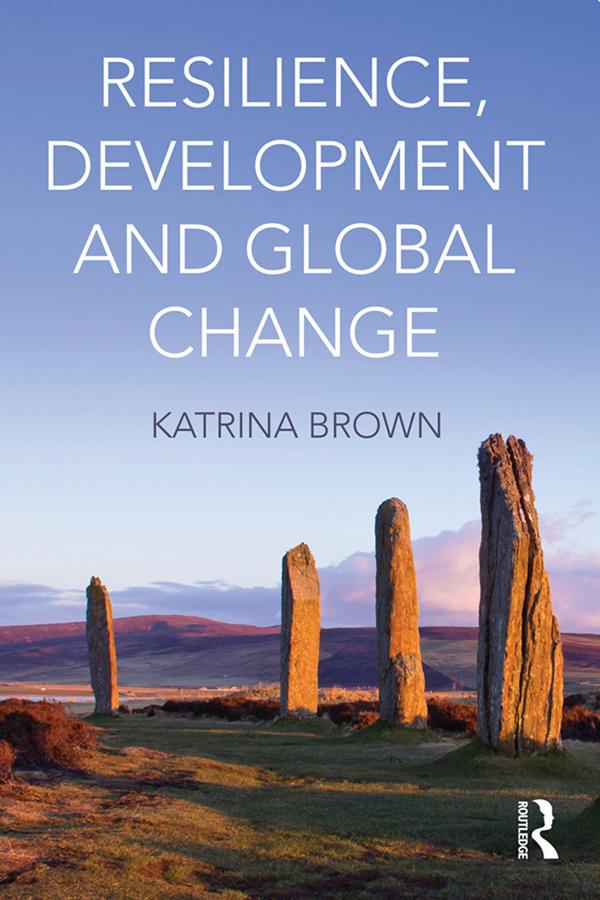
Resilience is currently infusing policy debates and public discourses, widely promoted as a normative goal in fields as diverse as the economy, national security, personal development and well-being. Resilience thinking provides a framework for understanding dynamics of complex, inter-connected social, ecological and economic systems. The book critically analyzes the multiple meanings and applications of resilience ideas in contemporary society and to suggests where, how and why resilience might cause us to re-think global change and development, and how this new approach might be operationalized.
The book shows how current policy discourses on resilience promote business-as-usual rather than radical responses to change. But it argues that resilience can help understand and respond to the challenges of the contemporary age. These challenges are characterized by high uncertainty; globalized and interconnected systems; increasing disparities and limited choices. Resilience thinking can overturn orthodox approaches to international development dominated by modernization, aid dependency and a focus on economic growth and to global environmental change – characterized by technocratic approaches, market environmentalism and commoditization of ecosystem services.
Resilience, Development and Global Change presents a sophisticated, theoretically informed synthesis of resilience thinking across disciplines. It applies resilience ideas specifically to international development and relates resilience to core theories in development and shows how a radical, resilience-based approach to development might transform responses to climate change, to the dilemmas of managing forests and ecosystems, and to rural and urban poverty in the developing world. The book provides fresh perspectives for scholars of international development, environmental studies and geography and add new dimensions for those studying broader fields of ecology and society.
Zahle einfach mit Karte, Klarna, Apple Pay oder Google Pay. Nicht zufrieden? Du hast immer ein 14-tägiges Widerrufsrecht. Lies mehr in unseren AGB. Hast du Fragen, schreib uns eine E-Mail an hello@memmo.org.
Memmo macht das Lernen einfacher – wo auch immer du bist. Bei uns findest du deine Kursbücher und smarte Lerntools an einem Ort: Zusammenfassungen, Quizzes, Podcasts und Lernkarten. Und Ted, dein Lernbuddy, beantwortet alles, was du wissen möchtest. Über 50.000 Studierende lernen bereits hier – gemacht, damit du schneller lernst und weniger Stress hast.