
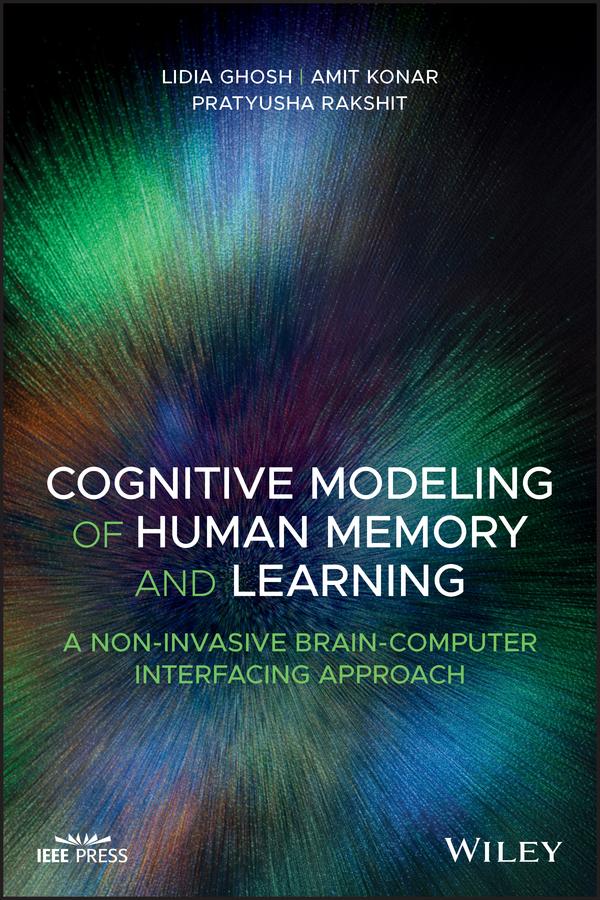
Proposes computational models of human memory and learning using a brain-computer interfacing (BCI) approach
Human memory modeling is important from two perspectives. First, the precise fitting of the model to an individual's short-term or working memory may help in predicting memory performance of the subject in future. Second, memory models provide a biological insight to the encoding and recall mechanisms undertaken by the neurons present in active brain lobes, participating in the memorization process. This book models human memory from a cognitive standpoint by utilizing brain activations acquired from the cortex by electroencephalographic (EEG) and functional near-infrared-spectroscopic (f-NIRs) means.
Cognitive Modeling of Human Memory and Learning A Non-invasive Brain-Computer Interfacing Approach begins with an overview of the early models of memory. The authors then propose a simplistic model of Working Memory (WM) built with fuzzy Hebbian learning. A second perspective of memory models is concerned with Short-Term Memory (STM)-modeling in the context of 2-dimensional object-shape reconstruction from visually examined memorized instances. A third model assesses the subjective motor learning skill in driving from erroneous motor actions. Other models introduce a novel strategy of designing a two-layered deep Long Short-Term Memory (LSTM) classifier network and also deal with cognitive load assessment in motor learning tasks associated with driving. The book ends with concluding remarks based on principles and experimental results acquired in previous chapters.
- Examines the scope of computational models of memory and learning with special emphasis on classification of memory tasks by deep learning-based models
- Proposes two algorithms of type-2 fuzzy reasoning: Interval Type-2 fuzzy reasoning (IT2FR) and General Type-2 Fuzzy Sets (GT2FS)
- Considers three classes of cognitive loads in the motor learning tasks for driving learners
Cognitive Modeling of Human Memory and Learning A Non-invasive Brain-Computer Interfacing Approach will appeal to researchers in cognitive neuro-science and human/brain-computer interfaces. It is also beneficial to graduate students of computer science/electrical/electronic engineering.
Zahle einfach mit Karte, Klarna, Apple Pay oder Google Pay. Nicht zufrieden? Du hast immer ein 14-tägiges Widerrufsrecht. Lies mehr in unseren AGB. Hast du Fragen, schreib uns eine E-Mail an hello@memmo.org.
Memmo macht das Lernen einfacher – wo auch immer du bist. Bei uns findest du deine Kursbücher und smarte Lerntools an einem Ort: Zusammenfassungen, Quizzes, Podcasts und Lernkarten. Und Ted, dein Lernbuddy, beantwortet alles, was du wissen möchtest. Über 50.000 Studierende lernen bereits hier – gemacht, damit du schneller lernst und weniger Stress hast.