
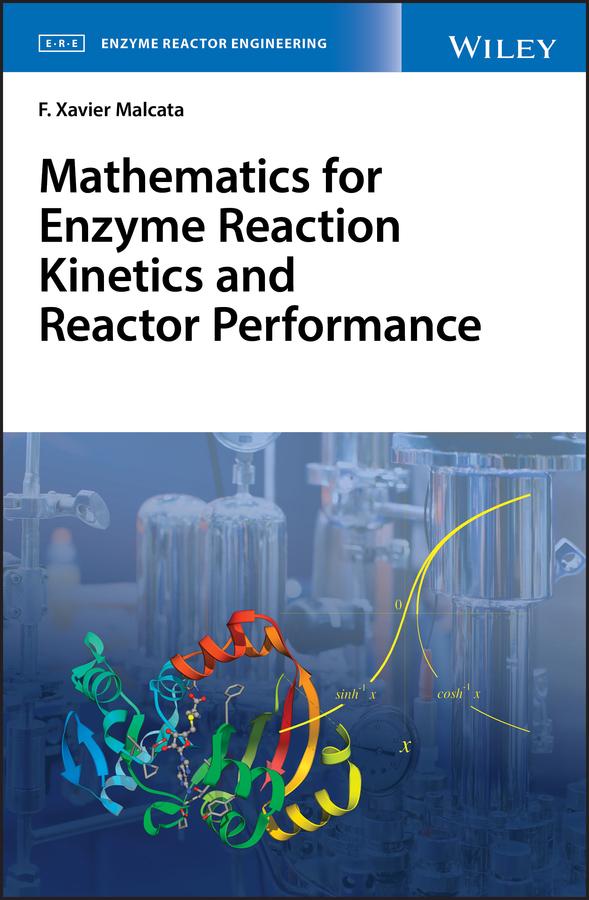
Mathematics for Enzyme Reaction Kinetics and Reactor Performance is the first set in a unique 11 volume-collection on Enzyme Reactor Engineering. This two volume-set relates specifically to the wide mathematical background required for systematic and rational simulation of both reaction kinetics and reactor performance; and to fully understand and capitalize on the modelling concepts developed. It accordingly reviews basic and useful concepts of Algebra (first volume), and Calculus and Statistics (second volume). A brief overview of such native algebraic entities as scalars, vectors, matrices and determinants constitutes the starting point of the first volume; the major features of germane functions are then addressed. Vector operations ensue, followed by calculation of determinants. Finally, exact methods for solution of selected algebraic equations – including sets of linear equations, are considered, as well as numerical methods for utilization at large.
The second volume begins with an introduction to basic concepts in calculus, i.e. limits, derivatives, integrals and differential equations; limits, along with continuity, are further expanded afterwards, covering uni- and multivariate cases, as well as classical theorems. After recovering the concept of differential and applying it to generate (regular and partial) derivatives, the most important rules of differentiation of functions, in explicit, implicit and parametric form, are retrieved – together with the nuclear theorems supporting simpler manipulation thereof. The book then tackles strategies to optimize uni- and multivariate functions, before addressing integrals in both indefinite and definite forms. Next, the book touches on the methods of solution of differential equations for practical applications, followed by analytical geometry and vector calculus. Brief coverage of statistics–including continuous probability functions, statistical descriptors and statistical hypothesis testing, brings the second volume to a close.
Zahle einfach mit Karte, Klarna, Apple Pay oder Google Pay. Nicht zufrieden? Du hast immer ein 14-tägiges Widerrufsrecht. Lies mehr in unseren AGB. Hast du Fragen, schreib uns eine E-Mail an hello@memmo.org.
Memmo macht das Lernen einfacher – wo auch immer du bist. Bei uns findest du deine Kursbücher und smarte Lerntools an einem Ort: Zusammenfassungen, Quizzes, Podcasts und Lernkarten. Und Ted, dein Lernbuddy, beantwortet alles, was du wissen möchtest. Über 50.000 Studierende lernen bereits hier – gemacht, damit du schneller lernst und weniger Stress hast.