
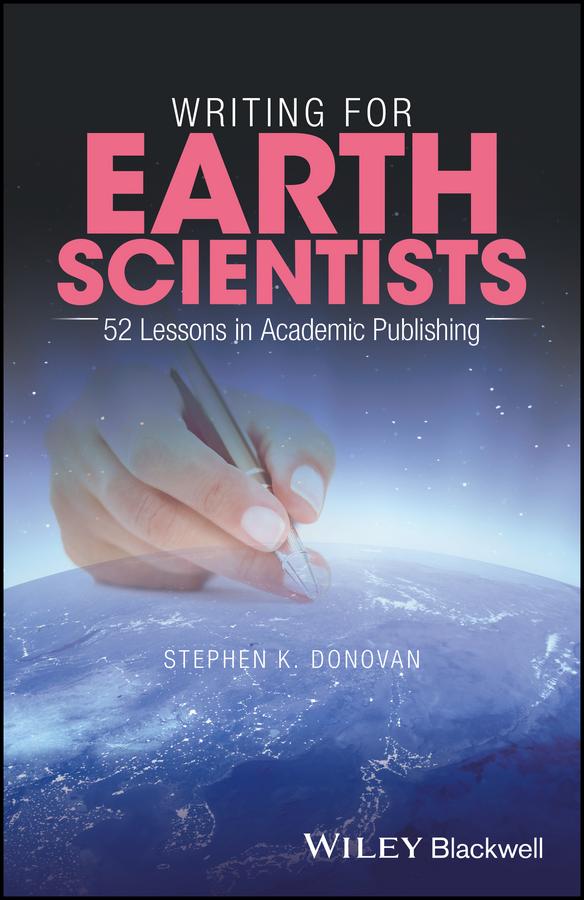
The time has come. You are an Earth scientist. You’ve spent weeks, months, years working on this project – now is the time to pull it together for publication. You might be writing an undergraduate or graduate thesis, a research paper for a leading journal, a note for the newsletter of the local amateur scientific society, a book review or an abstract for a specialist geological conference. How do you make the transition from promising unpublished researcher to established academic author? Of course, the phrase ‘academic publishing’ covers a multitude of sins; monographs, research papers, book reviews, conference abstracts or whatever each requires a different approach. You have to decide what it is you are going to write and where to publish it. There are co-authors, supervisors of your degree, peer reviewers and editors to deal with on the way. But the only way to write like an academic is to write like an academic. . . where do you start? You could do much worse than start here.
There are many books on how to write and be published aimed at research students and other aspiring academics. Many of these are readable, comprehensive and provide good advice. This book is composed of numerous short chapters on this subject, all directly relevant to one or more aspects of academic publishing and aimed particularly at the Earth scientists in the broadest sense. Geologists will be encouraged to use the book as much as a reference as a reader, ‘dipping in’ to the chapters that contain relevant tips, hints and comments to enable them to improve the paper that they are currently writing. The book is intended to be informative, readable and, above all, of practical application for all readers. In summary, the volume will be a readable compilation investigating many facets of academic publishing relevant to the Earth sciences. It will be of particular interest to postgraduate students, postdocs and new academics
Zahle einfach mit Karte, Klarna, Apple Pay oder Google Pay. Nicht zufrieden? Du hast immer ein 14-tägiges Widerrufsrecht. Lies mehr in unseren AGB. Hast du Fragen, schreib uns eine E-Mail an hello@memmo.org.
Memmo macht das Lernen einfacher – wo auch immer du bist. Bei uns findest du deine Kursbücher und smarte Lerntools an einem Ort: Zusammenfassungen, Quizzes, Podcasts und Lernkarten. Und Ted, dein Lernbuddy, beantwortet alles, was du wissen möchtest. Über 50.000 Studierende lernen bereits hier – gemacht, damit du schneller lernst und weniger Stress hast.