
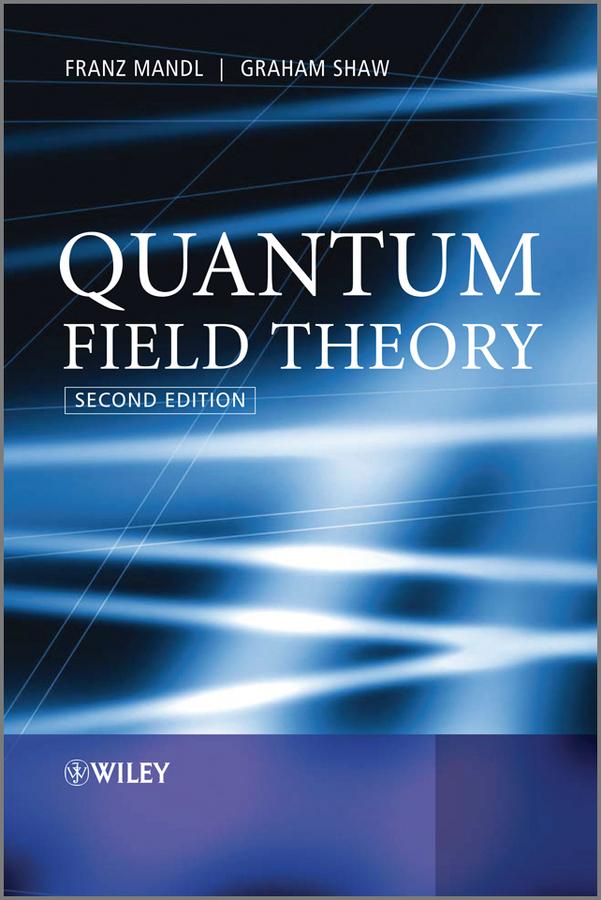
Following on from the successful first (1984) and revised (1993) editions, this extended and revised text is designed as a short and simple introduction to quantum field theory for final year physics students and for postgraduate students beginning research in theoretical and experimental particle physics.
The three main objectives of the book are to:
Explain the basic physics and formalism of quantum field theory
To make the reader proficient in theory calculations using Feynman diagrams
To introduce the reader to gauge theories, which play a central role in elementary particle physics.
Thus, the first ten chapters deal with QED in the canonical formalism, and are little changed from the first edition. A brief introduction to gauge theories (Chapter 11) is then followed by two sections, which may be read independently of each other. They cover QCD and related topics (Chapters 12-15) and the unified electroweak theory (Chapters 16 - 19) respectively. Problems are provided at the end of each chapter.
New to this edition:
Five new chapters, giving an introduction to quantum chromodynamics and the methods used to understand it: in particular, path integrals and the renormalization group.
The treatment of electroweak interactions has been revised and updated to take account of more recent experiments.
The three main objectives of the book are to:
Explain the basic physics and formalism of quantum field theory
To make the reader proficient in theory calculations using Feynman diagrams
To introduce the reader to gauge theories, which play a central role in elementary particle physics.
Thus, the first ten chapters deal with QED in the canonical formalism, and are little changed from the first edition. A brief introduction to gauge theories (Chapter 11) is then followed by two sections, which may be read independently of each other. They cover QCD and related topics (Chapters 12-15) and the unified electroweak theory (Chapters 16 - 19) respectively. Problems are provided at the end of each chapter.
New to this edition:
Five new chapters, giving an introduction to quantum chromodynamics and the methods used to understand it: in particular, path integrals and the renormalization group.
The treatment of electroweak interactions has been revised and updated to take account of more recent experiments.
Zahle einfach mit Karte, Klarna, Apple Pay oder Google Pay. Nicht zufrieden? Du hast immer ein 14-tägiges Widerrufsrecht. Lies mehr in unseren AGB. Hast du Fragen, schreib uns eine E-Mail an hello@memmo.org.
Memmo macht das Lernen einfacher – wo auch immer du bist. Bei uns findest du deine Kursbücher und smarte Lerntools an einem Ort: Zusammenfassungen, Quizzes, Podcasts und Lernkarten. Und Ted, dein Lernbuddy, beantwortet alles, was du wissen möchtest. Über 50.000 Studierende lernen bereits hier – gemacht, damit du schneller lernst und weniger Stress hast.