
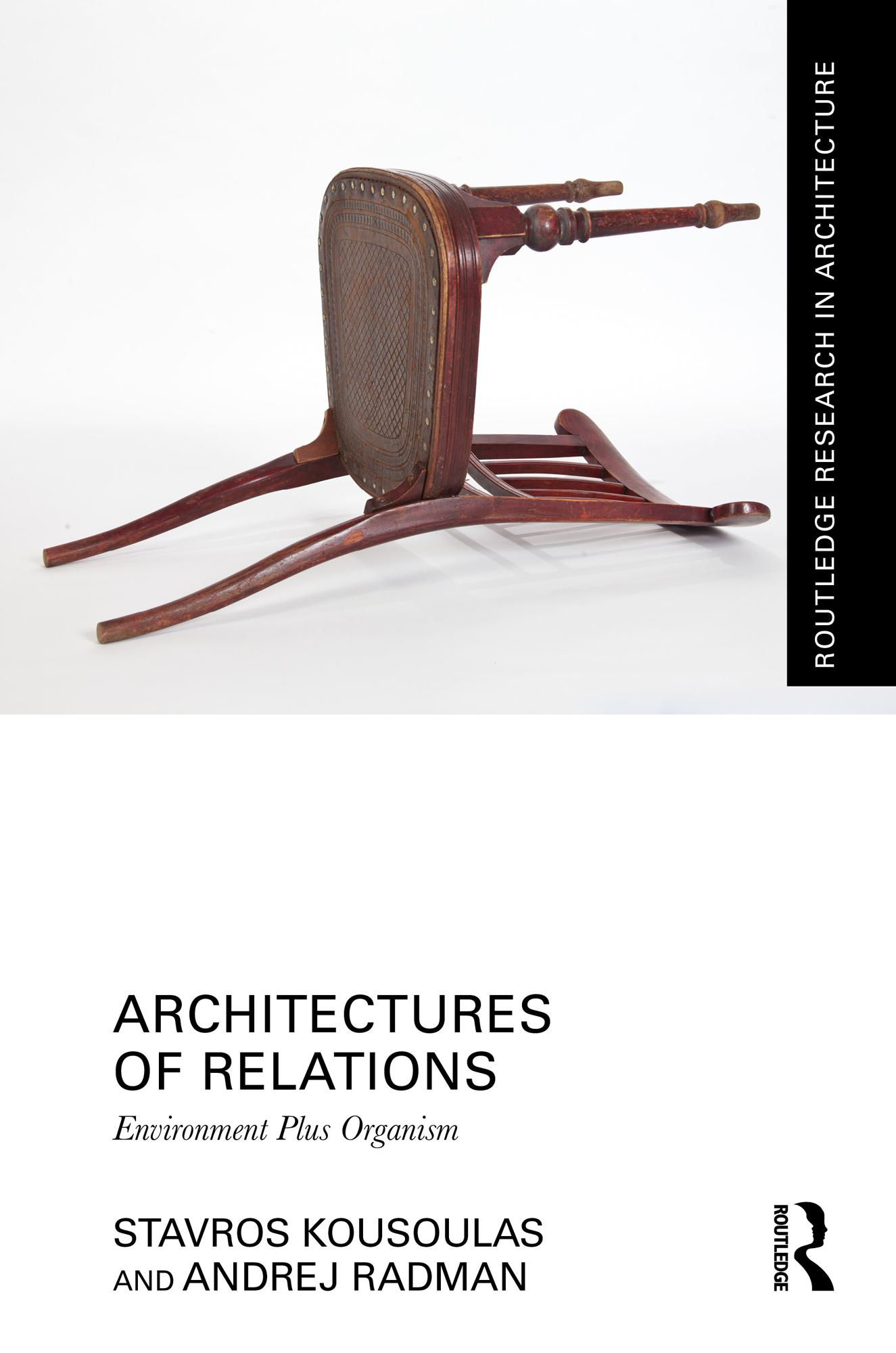
This book examines how environments and organisms dynamically produce one another. As such, it takes its title very seriously (and very literally): to speak of environment plus organism is the only viable way where neither term gets to be reduced to the other. It is rather their coming together, what thinkers like Gilbert Simondon call transindividuation, and its unfolding that stand as the most exigent ambition of this book. In simple terms, this book claims that the minimum unit of analysis in any architectural account is always the environment, the organism, and their (technological) plusing, examined as one.
Architectures of Relations has three interrelated ambitions, which are fundamentally pedagogical: (1) Irreducibility: it ‘makes no sense whatsoever to try to understand the anatomy of half a chicken’ as Gregory Bateson puts it, and this book makes a constant plea for an architectural account of the Batesonian claim. (2) A Real Copernican Revolution: our ingrained anthropocentrism always sees the organism as antecedent to the environment. To counter it, this book cultivates an architectural ethos that sees organisms and environments as co-constitutive equals. (3) Exteriority of Relations: highlighting the power of plusing, this book underscores the ever-changing how of a form of life. A mode of existence never pre-exists an event of plusing environments and organisms.
Readers of this book will be exposed to an original philosophy of architecture that brings together transdisciplinary concerns through concrete architectural examples, while opening its audience to a broad population of interests, from social sciences to media studies and affect theory. Written in a playful manner, it wishes to make accessible notions, concepts and ideas that can transform contemporary architectural thinking and open it to a broad speculative logic. This book will be of interest to researchers and students of architecture, architectural theory, architectural history, and philosophy.
Zahle einfach mit Karte, Klarna, Apple Pay oder Google Pay. Nicht zufrieden? Du hast immer ein 14-tägiges Widerrufsrecht. Lies mehr in unseren AGB. Hast du Fragen, schreib uns eine E-Mail an hello@memmo.org.
Memmo macht das Lernen einfacher – wo auch immer du bist. Bei uns findest du deine Kursbücher und smarte Lerntools an einem Ort: Zusammenfassungen, Quizzes, Podcasts und Lernkarten. Und Ted, dein Lernbuddy, beantwortet alles, was du wissen möchtest. Über 50.000 Studierende lernen bereits hier – gemacht, damit du schneller lernst und weniger Stress hast.