
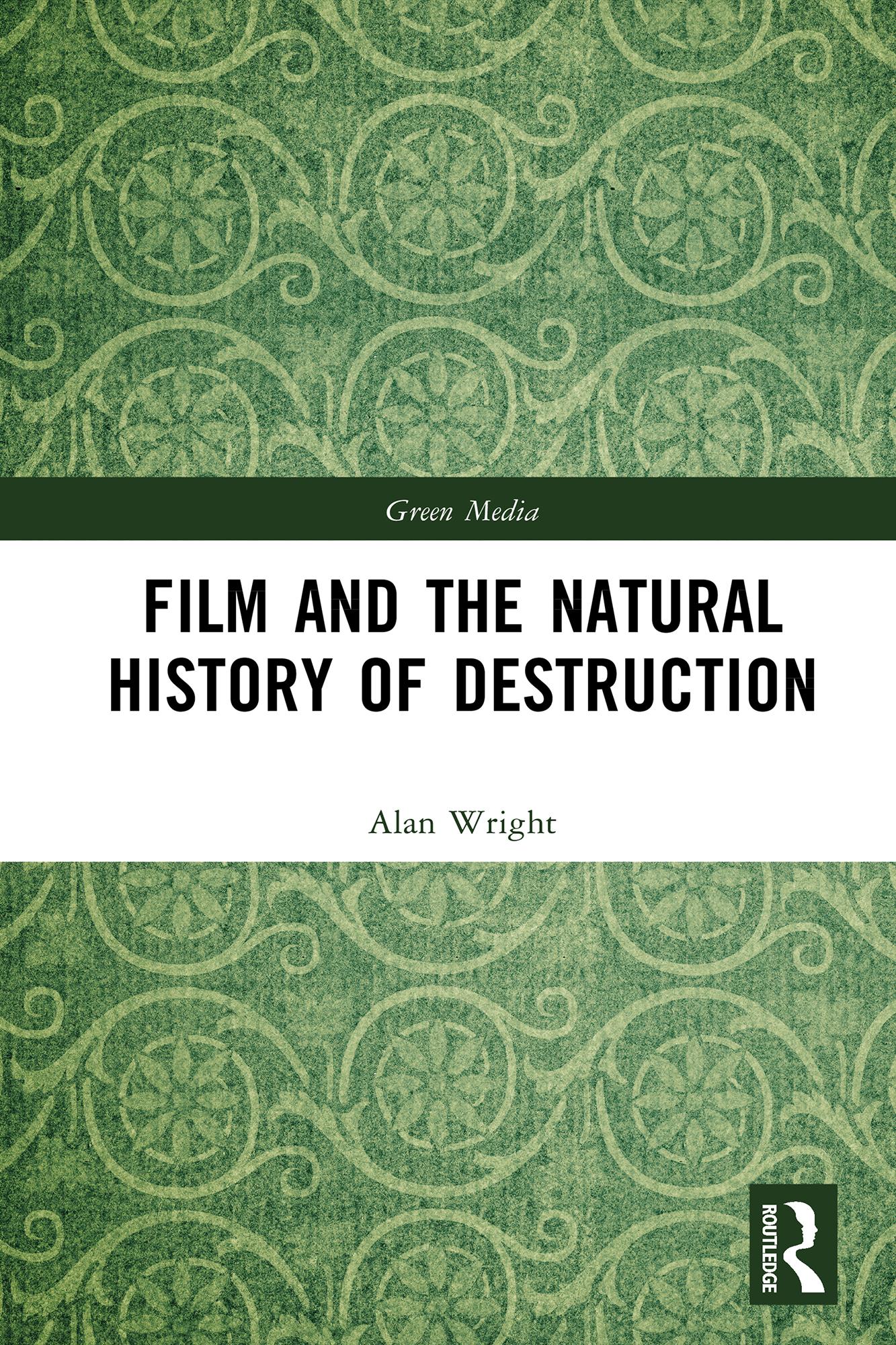
Film and the Natural History of Destruction explores the interface between film, memory and ecological thought. It addresses several areas of crucial importance for contemporary film and media studies: biopolitics and ecological catastrophe, cultural memory and film in the Anthropocene, media archaeology and the environmental humanities and, of course, the abiding relevance of Walter Benjamin’s work for critical theory and film studies.
Benjamin’s essays on media and modernity have long been regarded as important texts for film studies. The concept of natural history, however, remains a neglected tool in Benjamin’s critical arsenal yet may provide a valuable theoretical resource for analysing the visual culture of the Anthropocene. As a medium of preservation, transmission, transformation and decay, film is inherently bound up in processes of natural and historical destruction. Film images, like fossils or ruins, reveal the imprint of history as it is embedded in forms of nonhuman temporality and nonhuman life.
Alan Wright brings such moments of discontinuity and dislocation into stark relief by examining images and scenes from the films of Roberto Rossellini, Belà Tarr and David Lynch, alongside recent work by Bill Morrison, John Akomfrah and Patricio Guzmán.
The Open Access version of this book, available at http://www.taylorfrancis.com, has been made available under a Creative Commons Attribution-Non Commercial-No Derivatives (CC-BY-NC-ND) 4.0 license.
Zahle einfach mit Karte, Klarna, Apple Pay oder Google Pay. Nicht zufrieden? Du hast immer ein 14-tägiges Widerrufsrecht. Lies mehr in unseren AGB. Hast du Fragen, schreib uns eine E-Mail an hello@memmo.org.
Memmo macht das Lernen einfacher – wo auch immer du bist. Bei uns findest du deine Kursbücher und smarte Lerntools an einem Ort: Zusammenfassungen, Quizzes, Podcasts und Lernkarten. Und Ted, dein Lernbuddy, beantwortet alles, was du wissen möchtest. Über 50.000 Studierende lernen bereits hier – gemacht, damit du schneller lernst und weniger Stress hast.