
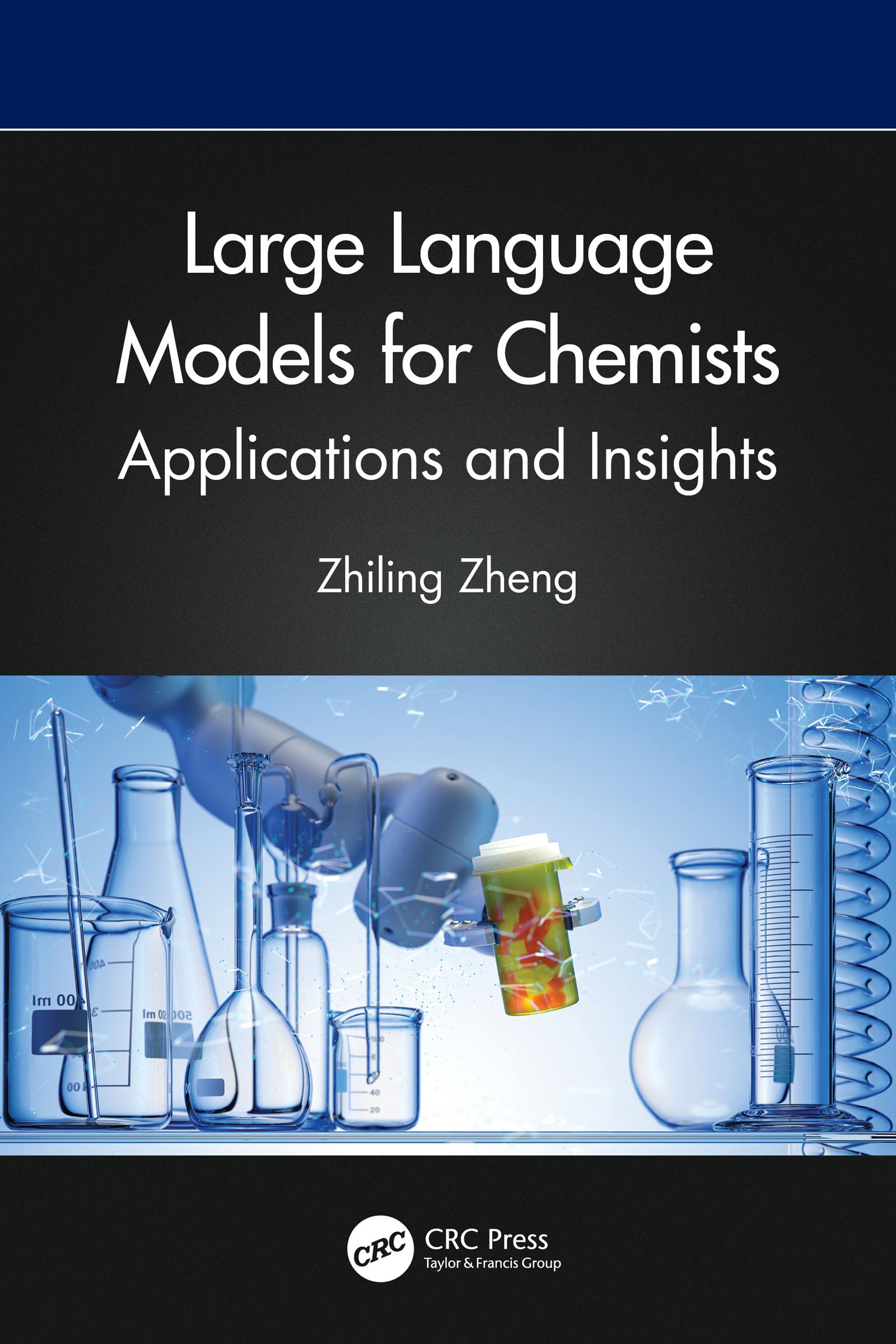
In recent years, LLMs (such as ChatGPT, Claude, DeepSeek, LLaMA, and other transformer-based models) have emerged as powerful tools in chemistry, enabling new approaches to scientific discovery. While many chemists, from undergraduate students to researchers, find these AI models interesting, they may lack a certain knowledge base to better integrate these tools into their daily research.
Large Language Models for Chemists breaks down that barrier by demystifying how LLMs work in an accessible way and showing, step by step, how they can be applied to solve real chemistry problems. Written in a friendly, tutorial style, the book assumes only a basic background in chemistry and minimal programming experience. It begins by gently introducing artificial intelligence and machine learning concepts in lay terms, building up to the inner workings of LLMs without heavy math. Readers will learn how these models “think” and generate text, gaining an intuitive understanding of concepts like neural networks, transformers, and training data using analogies and simple diagrams. Crucially, each concept is reinforced with chemistry-focused examples. It spans from understanding chemical nomenclature and reactions as a “language” to exploring how an LLM can suggest synthetic routes or explain spectral data.
Beyond theory, this book emphasizes practical application. Each chapter includes hands-on tutorials and case studies that invite readers to experiment with real tools. Using open-source libraries (such as RDKit for cheminformatics and standard Python machine learning frameworks), readers will walk through projects like predicting molecular properties with the aid of an LLM, generating novel compound ideas, analyzing research papers, and even using an LLM as a conversational chemistry assistant. For example, one case study guides the reader in using an LLM to mine a chemistry literature database and then write Python code to analyze reaction trends, mirroring cutting-edge research where LLMs assist in code generation and data mining for chemical discovery.
Zahle einfach mit Karte, Klarna, Apple Pay oder Google Pay. Nicht zufrieden? Du hast immer ein 14-tägiges Widerrufsrecht. Lies mehr in unseren AGB. Hast du Fragen, schreib uns eine E-Mail an hello@memmo.org.
Memmo macht das Lernen einfacher – wo auch immer du bist. Bei uns findest du deine Kursbücher und smarte Lerntools an einem Ort: Zusammenfassungen, Quizzes, Podcasts und Lernkarten. Und Ted, dein Lernbuddy, beantwortet alles, was du wissen möchtest. Über 50.000 Studierende lernen bereits hier – gemacht, damit du schneller lernst und weniger Stress hast.