
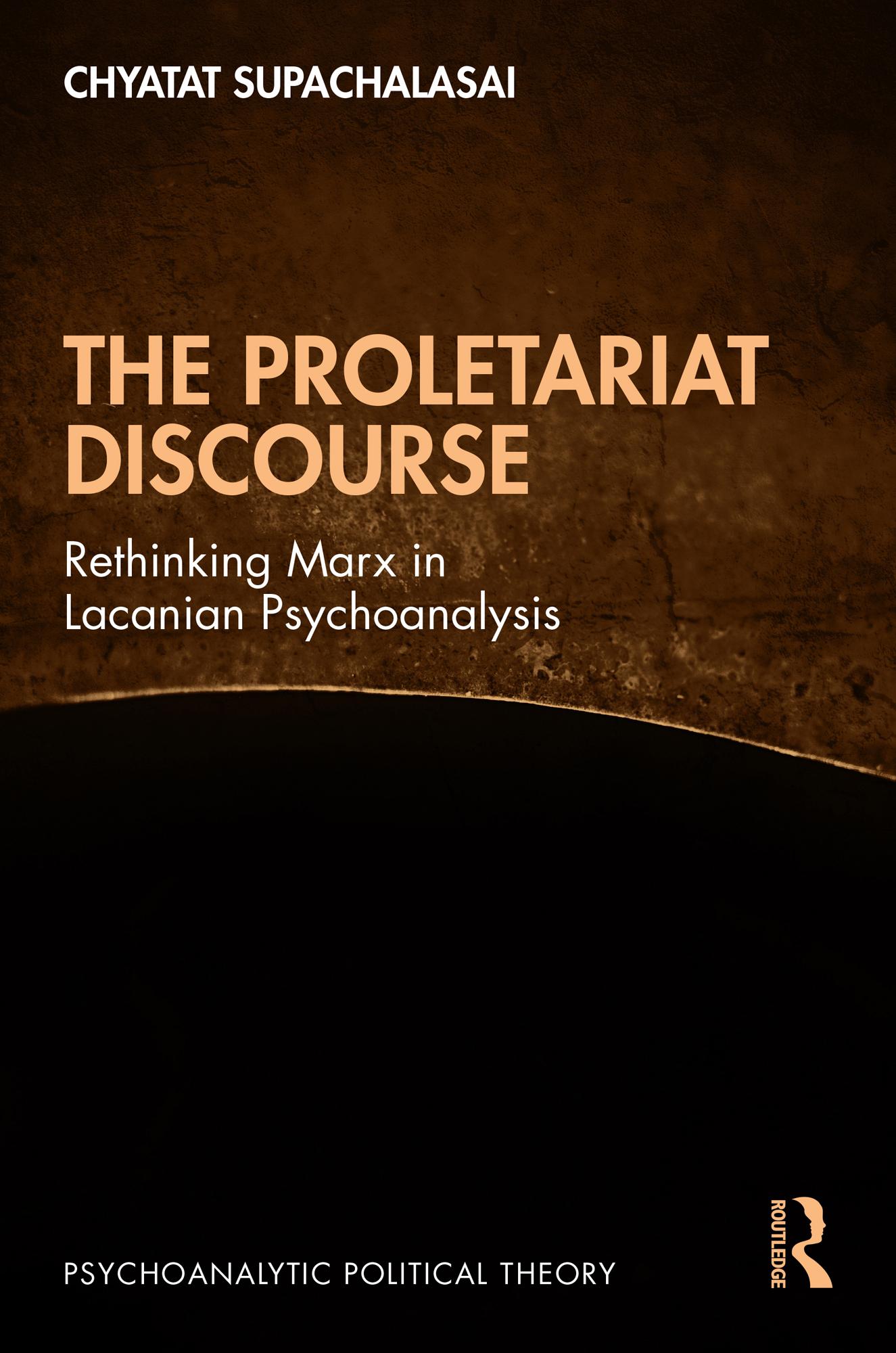
In this book, Chyatat Supachalasai offers a reinterpretation of Marx’s concept of the proletariat through a Lacanian lens, drawing on the works of Karl Marx and Jacques Lacan.
Building on the intellectual connection between Marx and Lacan, Supachalasai proposes “proletariat discourse”, which arises from a re-reading of Marx’s proletariat through Lacanian psychoanalysis, drawing on key concepts such as the hysteric, alienation, enjoyment, anxiety, and trauma. Supachalasai argues that Lacan’s notion of capitalist discourse, developed in the 1970s, reveals an inherent “non-relationship” aspect within this discourse, indicating the position of proletariat discourse. This proletariat discourse encapsulates three essential components. First, it establishes an agreement and disagreement between Marxist political theory and Lacanian psychoanalysis. Second, it posits that Marx’s understanding of the proletariat can be redefined and comprehended through a Lacanian psychoanalytic framework. Lastly, while portraying Marx’s proletariat as a subject of resistance to capitalism, this discussion connects with Lacan’s goal of seeking an “exit from capitalism”. However, from a Lacanian perspective, this connection also highlights the limitations inherent in Marx’s concept of the proletariat.
The Proletariat Discourse will be of great interest to scholars and readers interested in Lacanian-Marxist partnership, psychoanalysis, political thought, Lacanian studies, and critical theory.
Zahle einfach mit Karte, Klarna, Apple Pay oder Google Pay. Nicht zufrieden? Du hast immer ein 14-tägiges Widerrufsrecht. Lies mehr in unseren AGB. Hast du Fragen, schreib uns eine E-Mail an hello@memmo.org.
Memmo macht das Lernen einfacher – wo auch immer du bist. Bei uns findest du deine Kursbücher und smarte Lerntools an einem Ort: Zusammenfassungen, Quizzes, Podcasts und Lernkarten. Und Ted, dein Lernbuddy, beantwortet alles, was du wissen möchtest. Über 50.000 Studierende lernen bereits hier – gemacht, damit du schneller lernst und weniger Stress hast.