
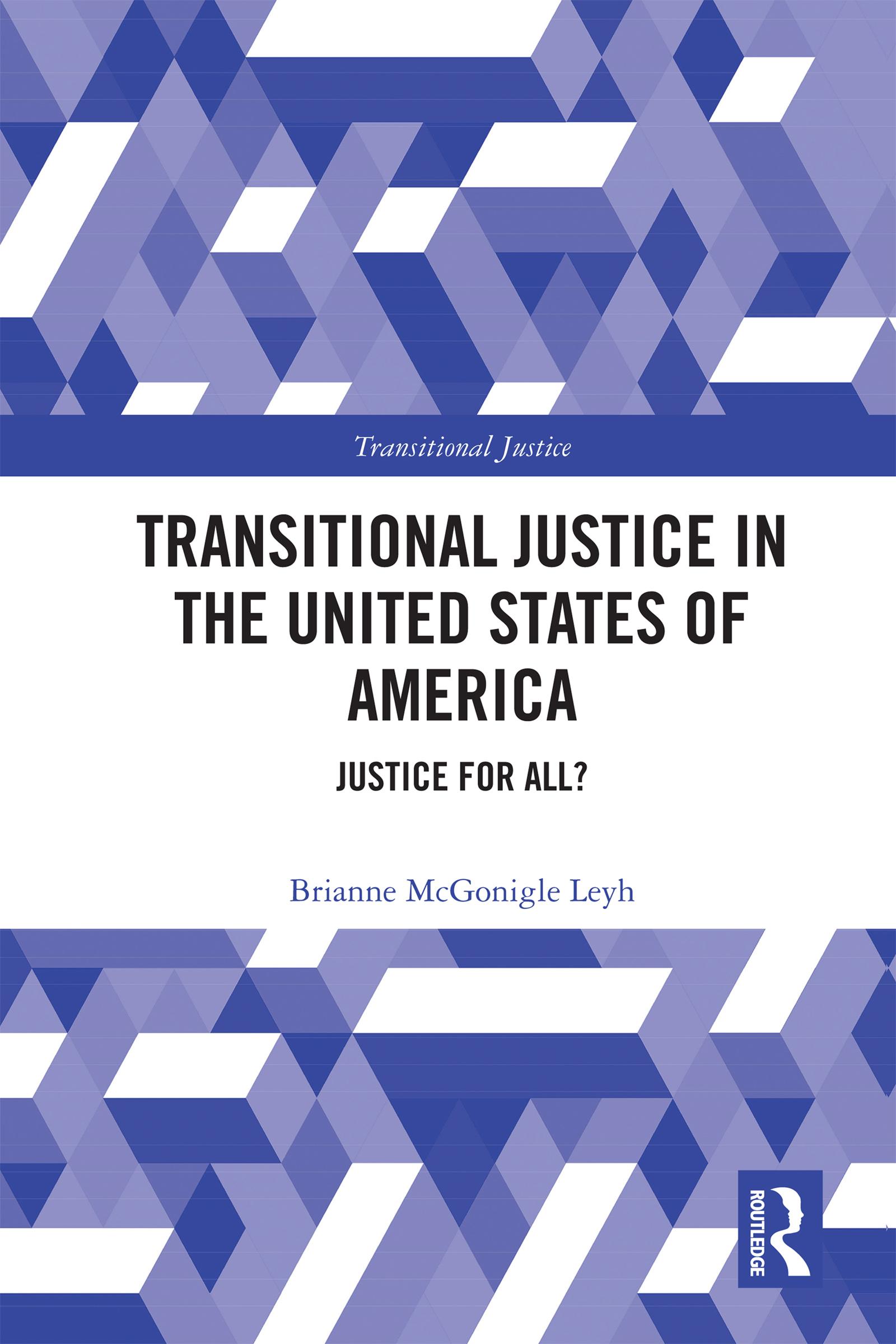
This book employs a transitional justice lens in order to explore justice initiatives in the United States of America.
Transitional justice developed out of societal demands to better address serious abuse, injustice, and atrocities – initially in South American post-authoritarian contexts transitioning to democratic states and later elsewhere, but especially within post-conflict contexts. The lens of transitional justice has only rarely been extended to the United States and never in a comprehensive way. This book aims to provide a contemporary and critical analysis of relevant developments and debates within the United States related to transitional justice. Using the framework of the five main ‘pillars’ of transitional justice – truth, reparation, accountability, guarantee of non-repetition, and memory – the book identifies and explores relevant justice initiatives, both historical and contemporary, across federal, state, and local levels in the United States. The empirical examples taken up show how a broad array of civil society actors are driving transitional justice processes across the country. By recognizing both extraordinary and ordinary justice processes as transitional justice, the book offers a broader understanding of how groups navigate transitions to more democratic, peaceful, and socially just societies. The examples further shed light on the expansion of the field to nontraditional contexts, the relationship between global norms and local practices, and the role of law and political compromise. The book concludes by emphasizing the value and power of the plurality of initiatives taking shape across the United States but calls for a more coherent transitional justice policy at the national level.
This book is relevant for scholars and students with interests in transitional justice, conflict resolution, human rights, Indigenous studies, culture, and race.
Zahle einfach mit Karte, Klarna, Apple Pay oder Google Pay. Nicht zufrieden? Du hast immer ein 14-tägiges Widerrufsrecht. Lies mehr in unseren AGB. Hast du Fragen, schreib uns eine E-Mail an hello@memmo.org.
Memmo macht das Lernen einfacher – wo auch immer du bist. Bei uns findest du deine Kursbücher und smarte Lerntools an einem Ort: Zusammenfassungen, Quizzes, Podcasts und Lernkarten. Und Ted, dein Lernbuddy, beantwortet alles, was du wissen möchtest. Über 50.000 Studierende lernen bereits hier – gemacht, damit du schneller lernst und weniger Stress hast.