
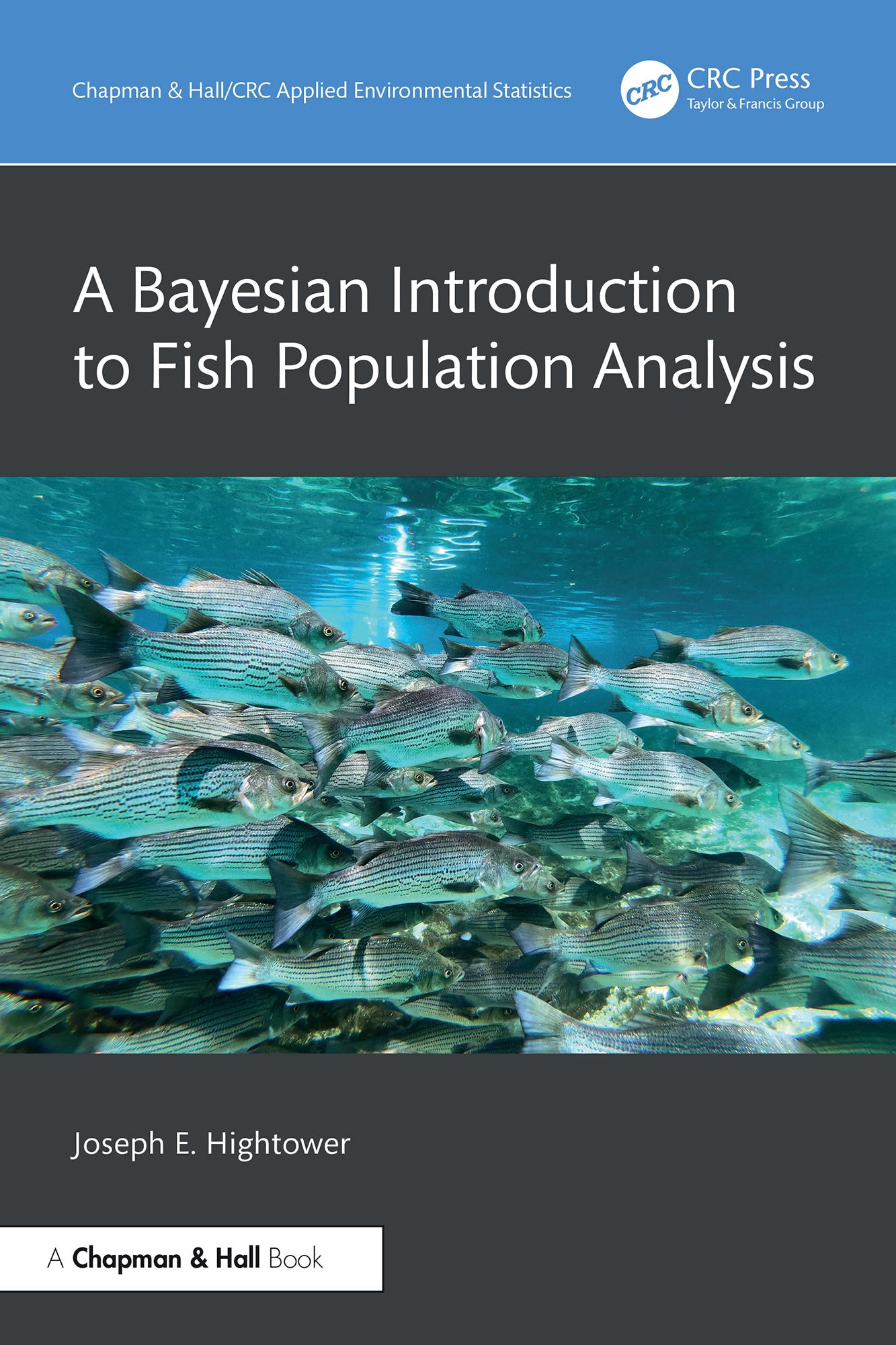
Fisheries science is an applied field. A biologist working on a depleted population might need to forecast the population trajectory or examine which factors are limiting recovery. For an exploited population, a biologist might investigate whether the fishery or the stock would be improved through harvest regulation, such as a quota or size limit. Addressing those sorts of questions generally involves estimating parameters such as population size or survival rate. An essential step is characterizing the degree of uncertainty in results, which can be substantial for fisheries models. Bayesian methods and current software provide a flexible and powerful framework for addressing these challenges. Models developed using Bayesian software can be tailored to the unique aspects of each field study.
A Bayesian Introduction to Fish Population Analysis is aimed at advanced undergraduate and graduate students as well as working professionals interested in a hands-on introduction to Bayesian approaches for fitting fisheries models. Chapters address key aspects of population dynamics: abundance, mortality, growth, and recruitment. The book includes complete R code for simulating each study design and JAGS Bayesian code for model fitting; code files are also available online. No prior knowledge of R or JAGS is assumed and new commands are introduced gradually through the sequence of examples. There is emphasis throughout the book on how to vary simulation settings to develop intuition about fisheries models (e.g., how many fish should be tagged in order to obtain usefully precise results). Additional topics include development of integrated population models, model checking, model selection, and uninformative and informative prior distributions.
Key features include:
- The book begins with a focus on ecologically relevant probability distributions (e.g. binomial, Poisson, normal, lognormal) as a foundation for the applied fisheries chapters.
- Subsequent chapters demonstrate Bayesian approaches for estimating abundance, mortality, growth, and recruitment.
- Full open-source code is provided for simulation and plotting using R and Bayesian model fitting using JAGS.
- The book demonstrates how simulation can be used to gain a deeper understanding of analytical methods and for planning field studies.
Joseph E. Hightower is a professor emeritus in the Department of Applied Ecology at NC
State University. His research interests focus on fish population dynamics, especially field and
analytical methods for estimating population parameters. His primary teaching role was a
graduate course in quantitative fisheries management, including Bayesian methods that serve
as the foundation for this book.
Zahle einfach mit Karte, Klarna, Apple Pay oder Google Pay. Nicht zufrieden? Du hast immer ein 14-tägiges Widerrufsrecht. Lies mehr in unseren AGB. Hast du Fragen, schreib uns eine E-Mail an hello@memmo.org.
Memmo macht das Lernen einfacher – wo auch immer du bist. Bei uns findest du deine Kursbücher und smarte Lerntools an einem Ort: Zusammenfassungen, Quizzes, Podcasts und Lernkarten. Und Ted, dein Lernbuddy, beantwortet alles, was du wissen möchtest. Über 50.000 Studierende lernen bereits hier – gemacht, damit du schneller lernst und weniger Stress hast.