
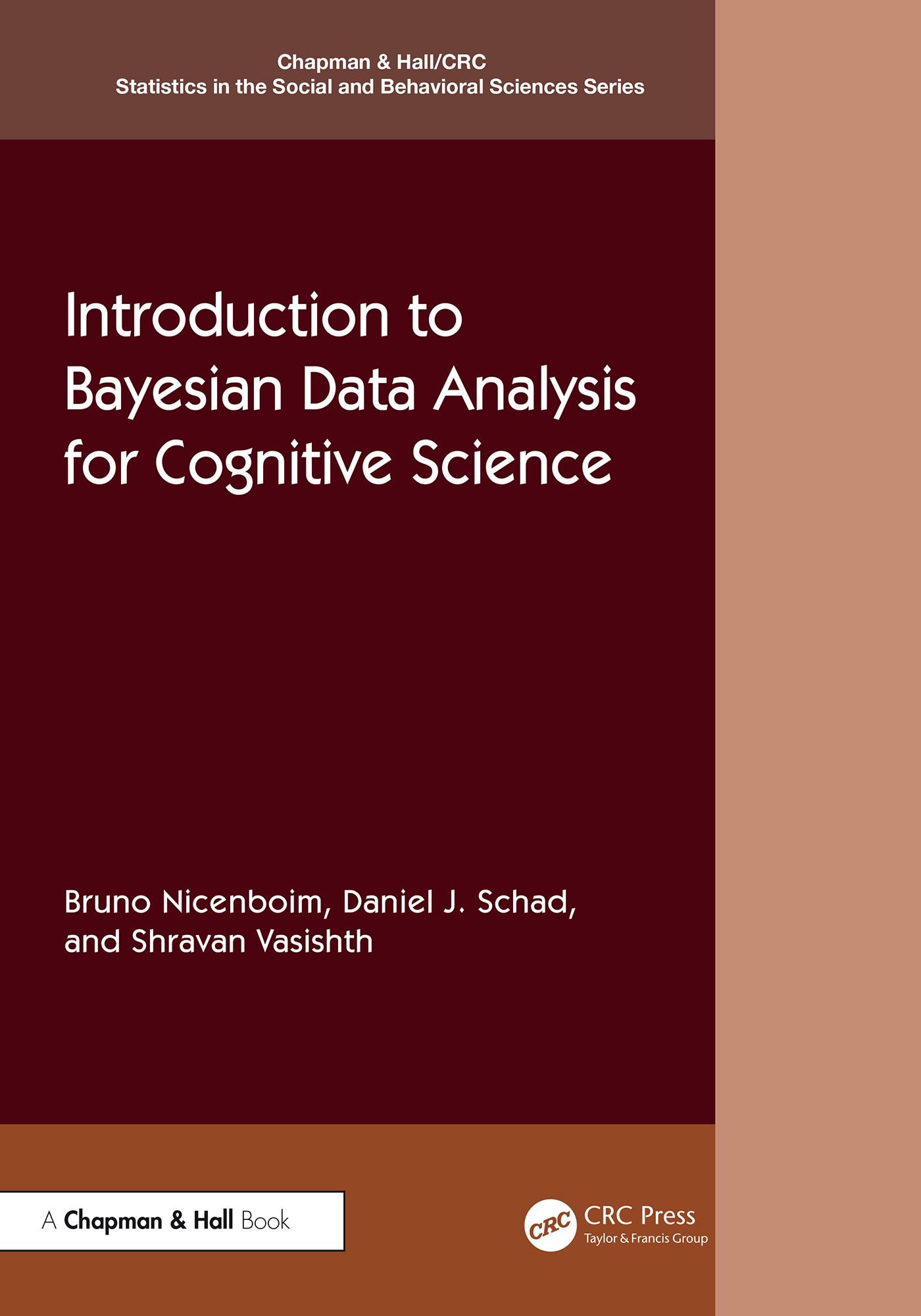
This book introduces Bayesian data analysis and Bayesian cognitive modeling to students and researchers in cognitive science (e.g., linguistics, psycholinguistics, psychology, computer science), with a particular focus on modeling data from planned experiments. The book relies on the probabilistic programming language Stan and the R package brms, which is a front-end to Stan. The book only assumes that the reader is familiar with the statistical programming language R, and has basic high school exposure to pre-calculus mathematics; some of the important mathematical constructs needed for the book are introduced in the first chapter.
Through this book, the reader will be able to develop a practical ability to apply Bayesian modeling within their own field. The book begins with an informal introduction to foundational topics such as probability theory, and univariate and bi-/multivariate discrete and continuous random variables. Then, the application of Bayes' rule for statistical inference is introduced with several simple analytical examples that require no computing software; the main insight here is that the posterior distribution of a parameter is a compromise between the prior and the likelihood functions. The book then gradually builds up the regression framework using the brms package in R, ultimately leading to hierarchical regression modeling (aka the linear mixed model). Along the way, there is detailed discussion about the topic of prior selection, and developing a well-defined workflow. Later chapters introduce the Stan programming language, and cover advanced topics using practical examples: contrast coding, model comparison using Bayes factors and cross-validation, hierarchical models and reparameterization, defining custom distributions, measurement error models and meta-analysis, and finally, some examples of cognitive models: multinomial processing trees, finite mixture models, and accumulator models. Additional chapters, appendices, and exercises are provided as online materials and can be accessed here: https://github.com/bnicenboim/bayescogsci. Further additional material can be accessed here: https://open.hpi.de/courses/bayesian-statistics2023 and here:https://vasishth.github.io/LecturesIntroBayes/.
Zahle einfach mit Karte, Klarna, Apple Pay oder Google Pay. Nicht zufrieden? Du hast immer ein 14-tägiges Widerrufsrecht. Lies mehr in unseren AGB. Hast du Fragen, schreib uns eine E-Mail an hello@memmo.org.
Memmo macht das Lernen einfacher – wo auch immer du bist. Bei uns findest du deine Kursbücher und smarte Lerntools an einem Ort: Zusammenfassungen, Quizzes, Podcasts und Lernkarten. Und Ted, dein Lernbuddy, beantwortet alles, was du wissen möchtest. Über 50.000 Studierende lernen bereits hier – gemacht, damit du schneller lernst und weniger Stress hast.