
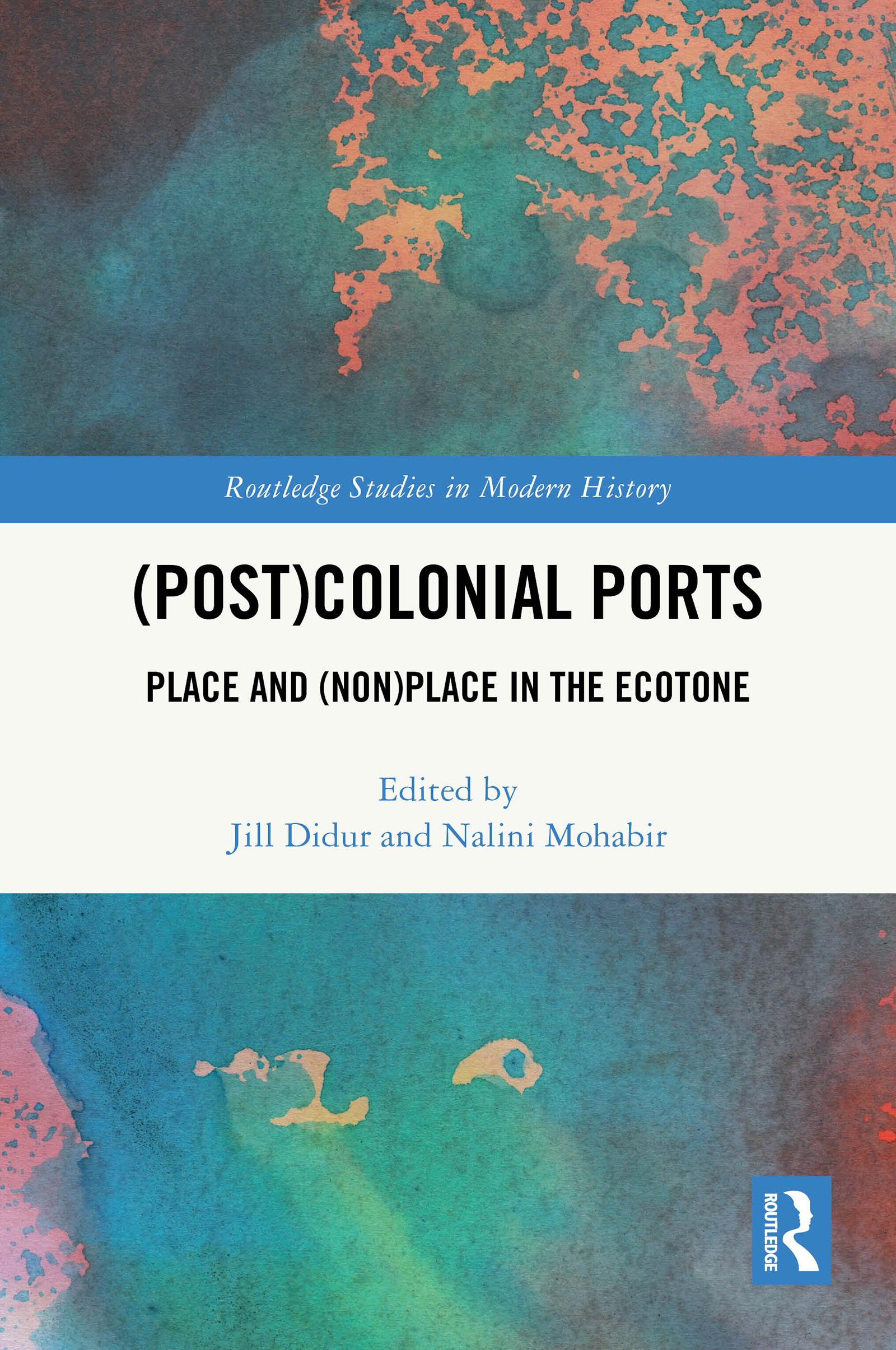
This book examines the role of (post)colonial ports in creating and shaping the ecotonal, cultural, historical, material, environmental, socio-political, and economic contexts in formerly colonized regions, spanning the Caribbean, Africa, North America, Europe, and the Pacific.
The essays assess the role that literature, visual culture, architecture, archives, and ethnography can play in enriching our understanding of the complex histories of ports and port cities. They present the relation between ports and colonial infrastructure such as immigration checkpoints, detention centers, mines, plantations, shipping containers, canals, sewers, and rivers, and their impact on human and more-than-human environments. The volume approaches (post)colonial ports through the “ecotone,” a concept borrowed from geography and ecology to describe a transition zone where two biological communities meet and mix—such as a forest and a grassland—to bring attention to port (non)spaces as a hinge between their environments, communities, and colonial infrastructure. It foregrounds postcolonial and decolonial approaches to the ecotone to draw attention to the cultural, ecological, and geographical dynamics that inform the social fabric of contemporary ports and port cities in the wake of the empire.
This volume is aimed at scholars and postgraduates across disciplines such as literature, geography, fine arts, cultural studies, and history.
Zahle einfach mit Karte, Klarna, Apple Pay oder Google Pay. Nicht zufrieden? Du hast immer ein 14-tägiges Widerrufsrecht. Lies mehr in unseren AGB. Hast du Fragen, schreib uns eine E-Mail an hello@memmo.org.
Memmo macht das Lernen einfacher – wo auch immer du bist. Bei uns findest du deine Kursbücher und smarte Lerntools an einem Ort: Zusammenfassungen, Quizzes, Podcasts und Lernkarten. Und Ted, dein Lernbuddy, beantwortet alles, was du wissen möchtest. Über 50.000 Studierende lernen bereits hier – gemacht, damit du schneller lernst und weniger Stress hast.