
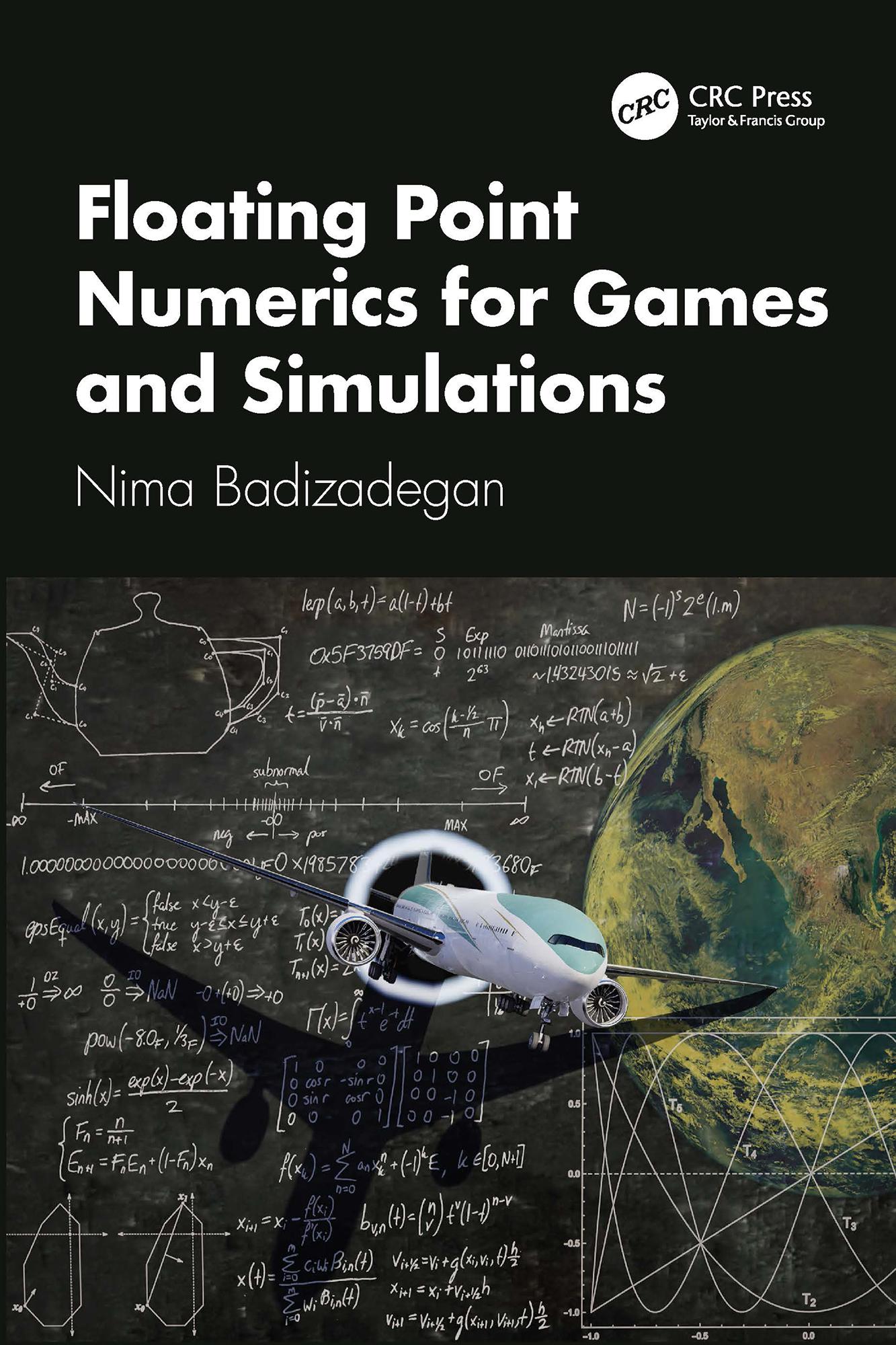
Floating point is ubiquitous in computers, where it is the default way to represent non-integer numbers. However, few people understand it. We all see weird behavior sometimes, and many programmers treat it as a mystical and imprecise system of math that just works until it sometimes doesn’t. We hear that we shouldn’t trust floating point with money, we know that 0.1 + 0.2 does not equal 0.3, and “NaN” shows up in our logs when things break. We rarely hear why any of this is the case, and less about what to do about it.
This book pulls back the veil on floating point and shows how this number system we program with every day works. It discusses how to leverage the number system for common calculations, particularly in graphics and simulations, and avoid pitfalls. Further, we will review methods that can give you either better performance or better accuracy on tasks like numerical integration and function approximation, so you can learn to make the right tradeoffs in your programs.
This book builds upon a basic knowledge of calculus and linear algebra, working with illustrative examples that demonstrate concepts rather than relying on theoretical proofs. Along the way, we will learn why Minecraft has struggled with boat physics and what the heck John Carmack was thinking with Quake III’s infamous fast reciprocal square root algorithm. By the end of the book, you will be able to understand how to work with floating point in a practical sense, from tracking down and preventing error in small calculations to choosing numerical building blocks for complex 3D simulations.
- Gives insight into how and why floating-point math works
- Describes how floating-point error arises and how to avoid it
- Surveys numerical methods important to graphics and numerical simulations
- Includes modern techniques to apply to your numerical problems
- Shows how to hack the floating-point numbers to compute faster and more accurately
Zahle einfach mit Karte, Klarna, Apple Pay oder Google Pay. Nicht zufrieden? Du hast immer ein 14-tägiges Widerrufsrecht. Lies mehr in unseren AGB. Hast du Fragen, schreib uns eine E-Mail an hello@memmo.org.
Memmo macht das Lernen einfacher – wo auch immer du bist. Bei uns findest du deine Kursbücher und smarte Lerntools an einem Ort: Zusammenfassungen, Quizzes, Podcasts und Lernkarten. Und Ted, dein Lernbuddy, beantwortet alles, was du wissen möchtest. Über 50.000 Studierende lernen bereits hier – gemacht, damit du schneller lernst und weniger Stress hast.