
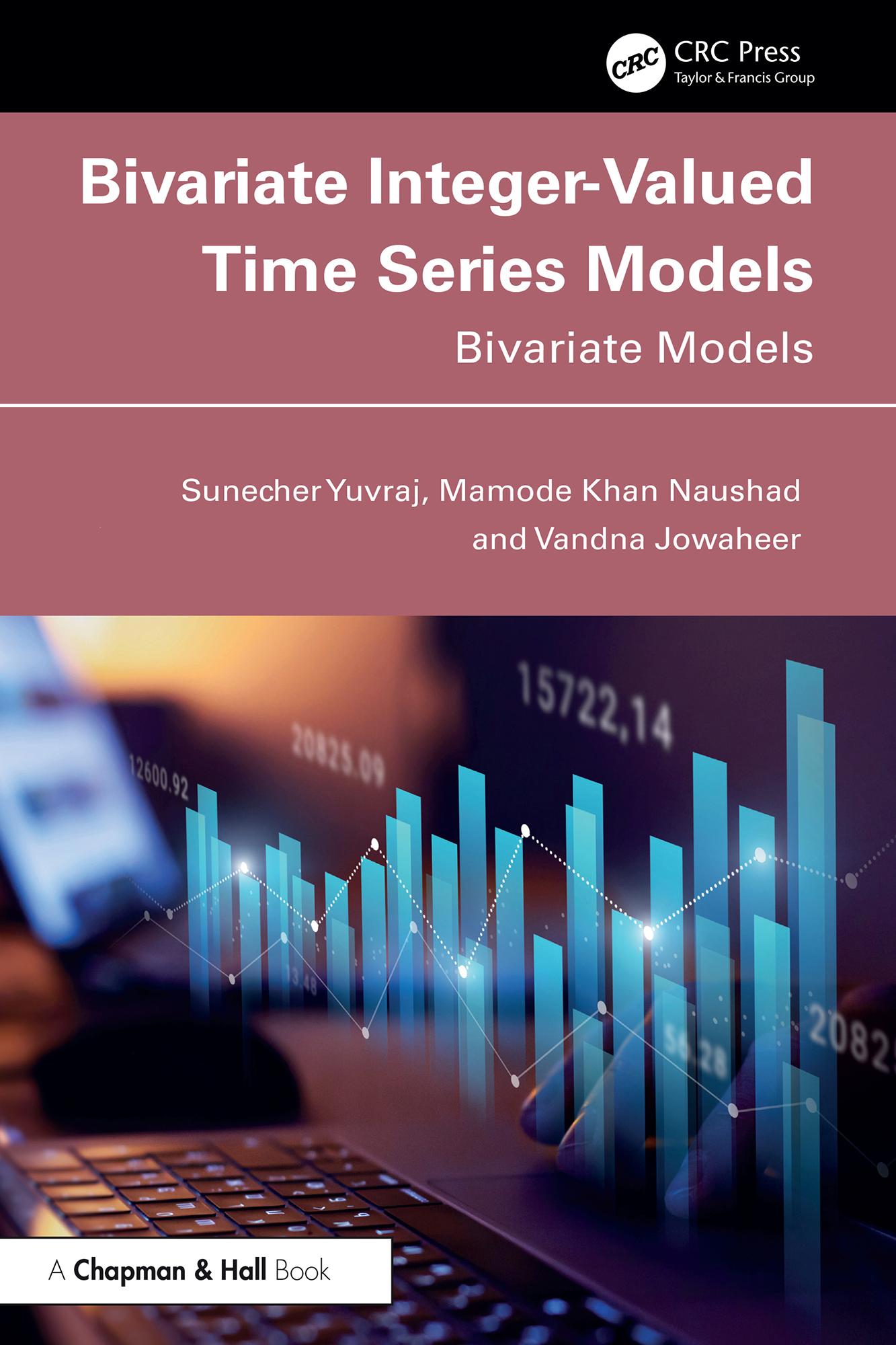
This book proposes some novel models based on the autoregressive and moving average structures under various distributional assumptions of the innovation series for analysing non-stationary bivariate time series of counts.
Time series of count responses are recorded for different correlated variables which may be marginally dispersed relative to their means, may exhibit different levels of dispersion and may be commonly influenced by one or more dynamic explanatory variables. Analysis of such type of bivariate time series data is quite challenging and the challenge mounts up further if these time series are non-stationary. This book proposes some bivariate models that allow for different levels of dispersion as well as non-stationarity. Specifically, BINAR(1) and BINMA(1) models under Poisson, NB and COM-Poisson innovations are constructed and tested. Another important contribution of this book is in developing a novel estimation procedure for estimating the parameters of the proposed BINAR(1) and BINMA(1) models. Hence, a new estimation approach based on the GQL is proposed. Monte-Carlo simulations are implemented to assess the performance of the GQL. In some simple cases of stationarity, we also compare the GQL with the other estimation techniques such as CMLE and FGLS.
This book is a useful resource for undergraduate students, postgraduate students, researchers and academics in the field of time series models.
Zahle einfach mit Karte, Klarna, Apple Pay oder Google Pay. Nicht zufrieden? Du hast immer ein 14-tägiges Widerrufsrecht. Lies mehr in unseren AGB. Hast du Fragen, schreib uns eine E-Mail an hello@memmo.org.
Memmo macht das Lernen einfacher – wo auch immer du bist. Bei uns findest du deine Kursbücher und smarte Lerntools an einem Ort: Zusammenfassungen, Quizzes, Podcasts und Lernkarten. Und Ted, dein Lernbuddy, beantwortet alles, was du wissen möchtest. Über 50.000 Studierende lernen bereits hier – gemacht, damit du schneller lernst und weniger Stress hast.