
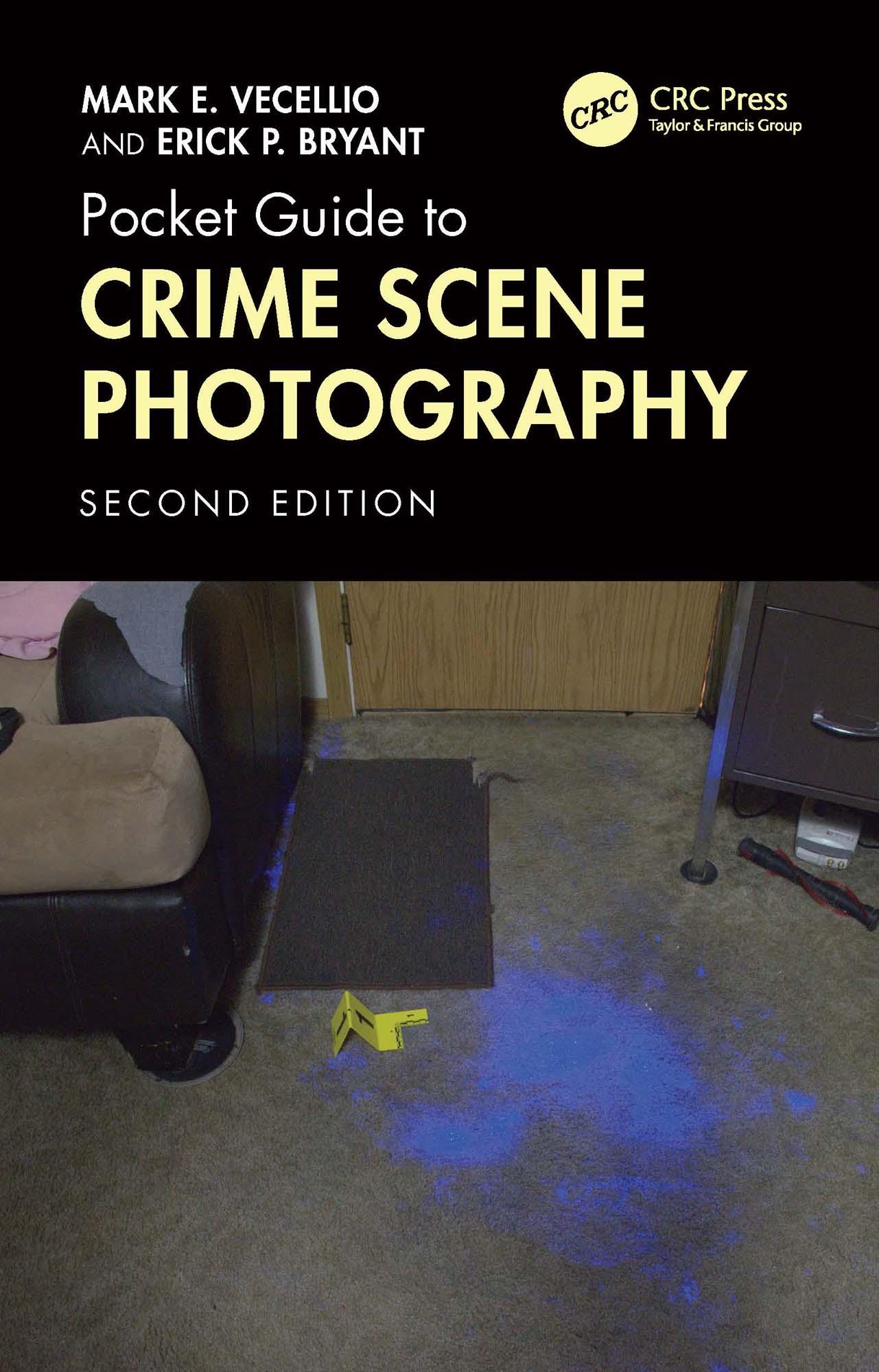
There are more than 800,000 sworn law enforcement officers employed within the United States, many of whom are regularly tasked with photographing crime scenes or evidence associated with criminal investigations. Despite this fact, law enforcement personnel—including detectives and crime scene investigators—frequently receive little to no formal training in the art and science of photography, let alone for capturing photographic evidence for forensic casework and future legal proceedings.
Unlike other resources on the topic that often contain overly complicated or rife with unnecessary or confusing technical jargon—this edition of Pocket Guide to Crime Scene Photography follows in the tradition of the first. The book is wholly updated, based on best practices and advances in camera technology to provide a practical, streamlined approach guide to the photographic documentation of crime scenes and physical evidence. The coverage includes extensive illustrations with two completely new chapters. The first focuses on specialized instructions for photographing shooting incident scenes, bloodstains, and evidence, made visible through infrared light; the is second dedicated to offering advice for photographing crime scenes and evidence with mobile device cameras.
Chapters distill the technical jargon and complex processes of photographing crime scenes and evidence into straightforward step-by-step descriptions. Pocket Guide to Crime Scene Photography, Second Edition has been designed in a smaller, handy trim size as a convenient, portable tool to help busy professionals. Its techniques include practical guidelines that can be immediately implemented by law enforcement personnel to maximize their time and improve their skills.
Features:
- Provides an up-to-date, portable reference ideal for use in the field; includes full-color photographs throughout to illustrate key concepts
- Details how to document various types of evidence, and crime scenes, using both standard and specialized techniques
- Outlines visualization and photography of evidence—illuminated with alternative light sources—including visible wavelengths, UV, and infrared
- Presents guidance for personnel who might only be able to use cell phone cameras for photographing evidence and scenes
- Written by two experienced professionals who know the investigative and courtroom requirements for quality admissible photos.
Zahle einfach mit Karte, Klarna, Apple Pay oder Google Pay. Nicht zufrieden? Du hast immer ein 14-tägiges Widerrufsrecht. Lies mehr in unseren AGB. Hast du Fragen, schreib uns eine E-Mail an hello@memmo.org.
Memmo macht das Lernen einfacher – wo auch immer du bist. Bei uns findest du deine Kursbücher und smarte Lerntools an einem Ort: Zusammenfassungen, Quizzes, Podcasts und Lernkarten. Und Ted, dein Lernbuddy, beantwortet alles, was du wissen möchtest. Über 50.000 Studierende lernen bereits hier – gemacht, damit du schneller lernst und weniger Stress hast.