
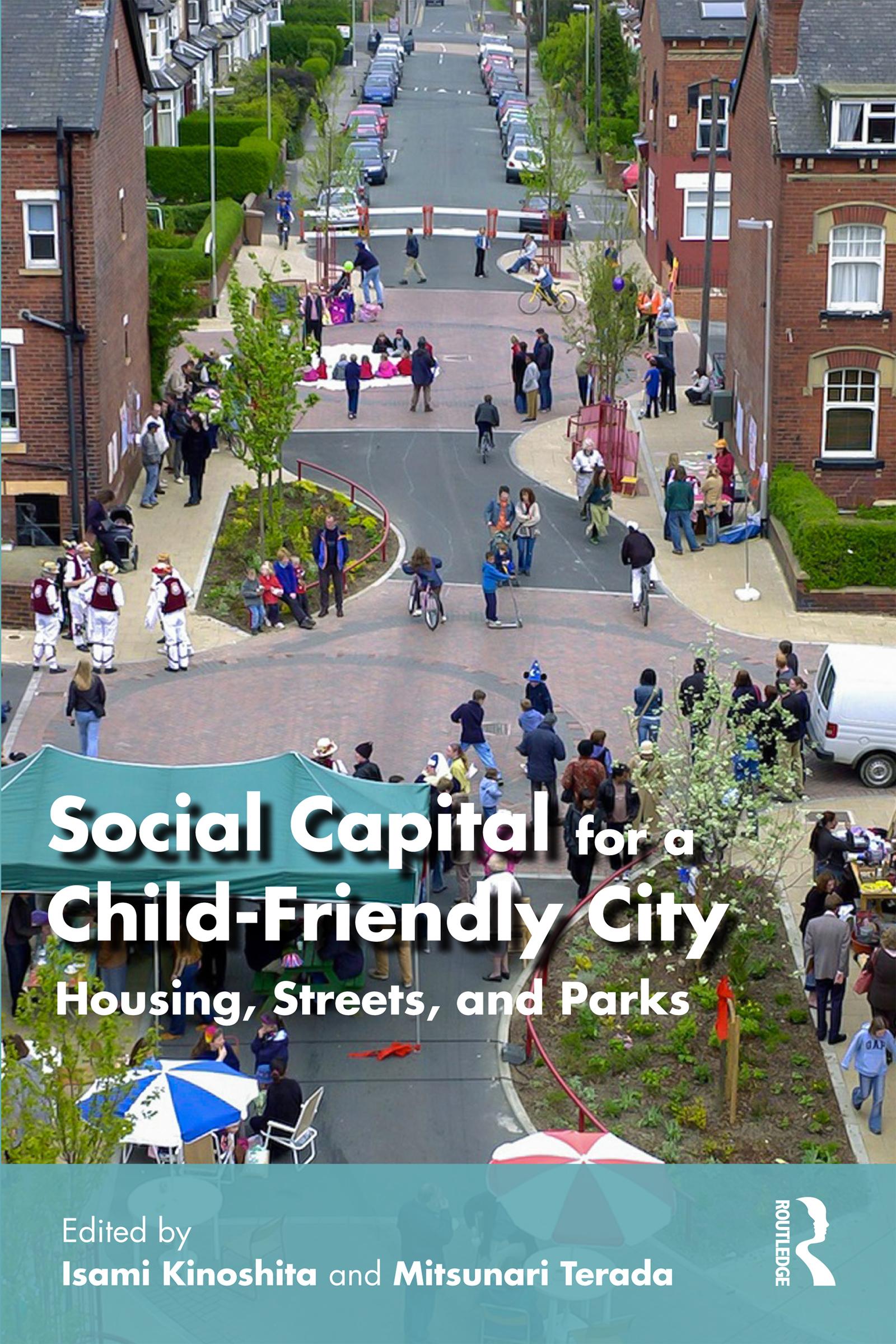
Social Capital for a Child-Friendly City argues for the importance of relationship networks (social capital) in children’s growth and socialization, and explores how child-friendly social capital can be cultivated through urban planning and community development. As outdoor play decreases and children spend more time online, Kinoshita and Terada return to John Dewey’s proposal that social capital is essential for nurturing the next generation and establish a democratic and sustainable society. The book features examples from Sweden, Finland, Germany, Switzerland, the UK, and Japan, exploring methods for cultivating social capital and spaces for children to play and develop in cooperative housing, outdoor play spaces, streets, parks, and neighbourhoods. We express our gratitude to Dr. Marketta Kytta, Professor of Aalto University, who gave valuable suggestions about the key term ‘bullerby’ and ‘social capital’.
This book will be of use to students and practitioners of urban planning and landscape architecture, as well as any community leaders or developers seeking to foster a nurturing environment where children can flourish.
Zahle einfach mit Karte, Klarna, Apple Pay oder Google Pay. Nicht zufrieden? Du hast immer ein 14-tägiges Widerrufsrecht. Lies mehr in unseren AGB. Hast du Fragen, schreib uns eine E-Mail an hello@memmo.org.
Memmo macht das Lernen einfacher – wo auch immer du bist. Bei uns findest du deine Kursbücher und smarte Lerntools an einem Ort: Zusammenfassungen, Quizzes, Podcasts und Lernkarten. Und Ted, dein Lernbuddy, beantwortet alles, was du wissen möchtest. Über 50.000 Studierende lernen bereits hier – gemacht, damit du schneller lernst und weniger Stress hast.