
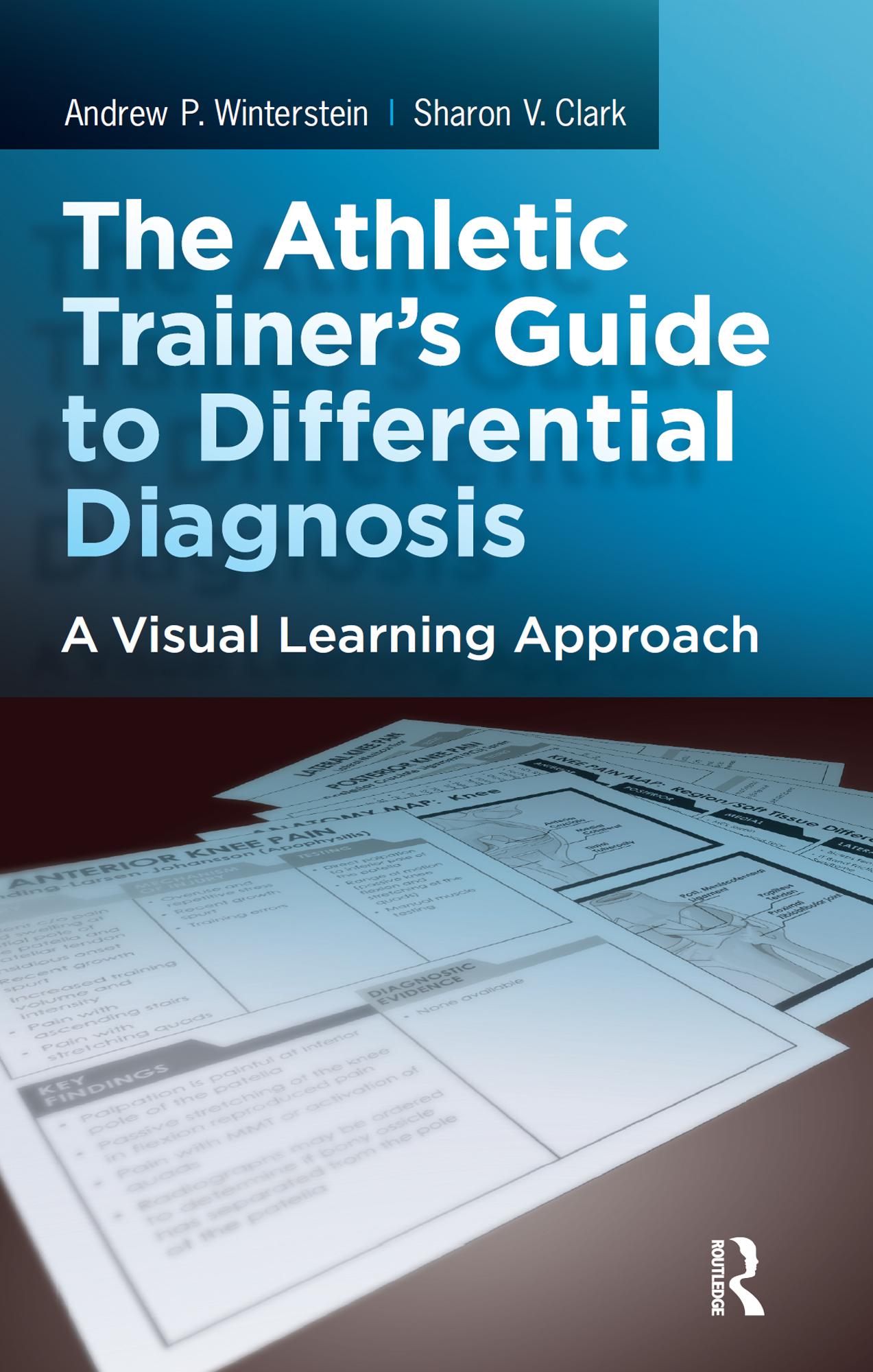
As educators, we strive to teach students to think critically and to commit to a diagnosis, the ability to make that commitment is one of the most difficult steps for clinicians in training. With many possible injuries and conditions, and an equally large number of diagnostic elements, a clear and logical method is needed.
The Athletic Trainer’s Guide to Differential Diagnosis: A Visual Learning Approach provides an approach that helps the reader sort through the possibilities and think about the clinical evaluation within a clinical thinking framework using a visual mapping approach.
The Athletic Trainer’s Guide to Differential Diagnosis is not designed to be a “how-to” evaluation text. Rather, it is designed to create a framework that allows the reader to think differently about differential diagnoses, access existing knowledge in anatomy and clinical evaluation, and assess information for the purpose of making higher-order clinical decisions.
Dr. Andrew P. Winterstein and Sharon V. Clark have organized The Athletic Trainer’s Guide to Differential Diagnosis by body part, as well as by location in the body. The reader will be able to examine the possible diagnoses by location and approach the evaluation in a more focused and organized fashion. This method of evaluation also allows the reader the opportunity to apply evidence-based principles to the clinical evaluation process.
The Athletic Trainer’s Guide to Differential Diagnosis takes a visual learning approach with an emphasis on diagrams, tables, and boxes to illustrate the visual evaluation framework. In addition, each chapter offers a clinical case to provide a springboard for approaching the differential diagnosis process.
The Athletic Trainer’s Guide to Differential Diagnosis: A Visual Learning Approach will enhance the athletic training student and clinician’s critical thinking skills, as well as be an excellent resource for self-assessment and preparation for certification.
Zahle einfach mit Karte, Klarna, Apple Pay oder Google Pay. Nicht zufrieden? Du hast immer ein 14-tägiges Widerrufsrecht. Lies mehr in unseren AGB. Hast du Fragen, schreib uns eine E-Mail an hello@memmo.org.
Memmo macht das Lernen einfacher – wo auch immer du bist. Bei uns findest du deine Kursbücher und smarte Lerntools an einem Ort: Zusammenfassungen, Quizzes, Podcasts und Lernkarten. Und Ted, dein Lernbuddy, beantwortet alles, was du wissen möchtest. Über 50.000 Studierende lernen bereits hier – gemacht, damit du schneller lernst und weniger Stress hast.