
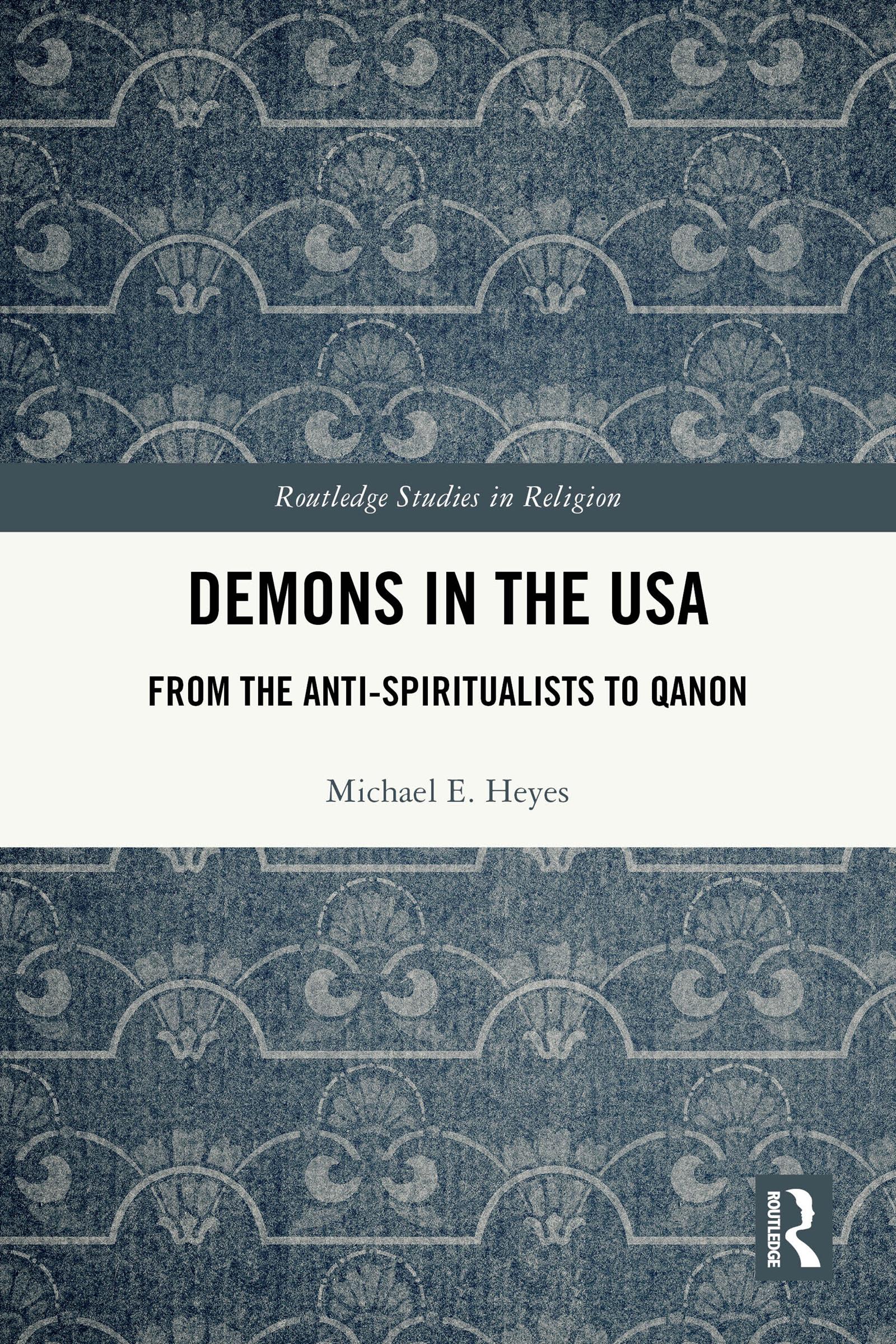
Demons in the USA argues that the discourse on the demonic that developed in the nineteenth century continues to exert a powerful hold over the American spiritual imagination.
The book begins by tracing the conservative Christian encounter with Spiritualism in the nineteenth century and the mode of thinking about the demonic which developed. As Spiritualism’s core principles reappeared in the New Age, Christian interlocutors once more drew on this "anti-Spiritualist" paradigm to condemn the movement. This condemnation is absorbed by and amplified through the film The Exorcist. The author considers how the success of the film disseminates the anti-Spiritualist paradigm in surprising ways, entangling it with entertainment, science, and politics such that it influences psychology, the Satanic Panic of the 1980s, and the contemporary QAnon movement. This entanglement points to the broader argument of the work: While we may wish to think of a film as "entertainment" (and thus, having no bearing on "reality") or demonic material as "religious" (and thus exempt from categories like "politics" or "science"), the truth is that categories are not so easily separated. The author contends that the need to enforce the boundaries of such categories (and the failure to do so) is a hallmark of the intellectual construct of modernity, and that those who believe in demons in the contemporary United States are surprisingly modern in their views. The book grounds the importance of media to the twentieth-and twenty-first- century religious experience, arguing that the United States of today would not be possible without The Exorcist and its products.
Demons in the USA will be of particular interest to scholars dealing with religion in America, those with a focus on religion and film, or those involved with contemporary demonology.
Zahle einfach mit Karte, Klarna, Apple Pay oder Google Pay. Nicht zufrieden? Du hast immer ein 14-tägiges Widerrufsrecht. Lies mehr in unseren AGB. Hast du Fragen, schreib uns eine E-Mail an hello@memmo.org.
Memmo macht das Lernen einfacher – wo auch immer du bist. Bei uns findest du deine Kursbücher und smarte Lerntools an einem Ort: Zusammenfassungen, Quizzes, Podcasts und Lernkarten. Und Ted, dein Lernbuddy, beantwortet alles, was du wissen möchtest. Über 50.000 Studierende lernen bereits hier – gemacht, damit du schneller lernst und weniger Stress hast.