
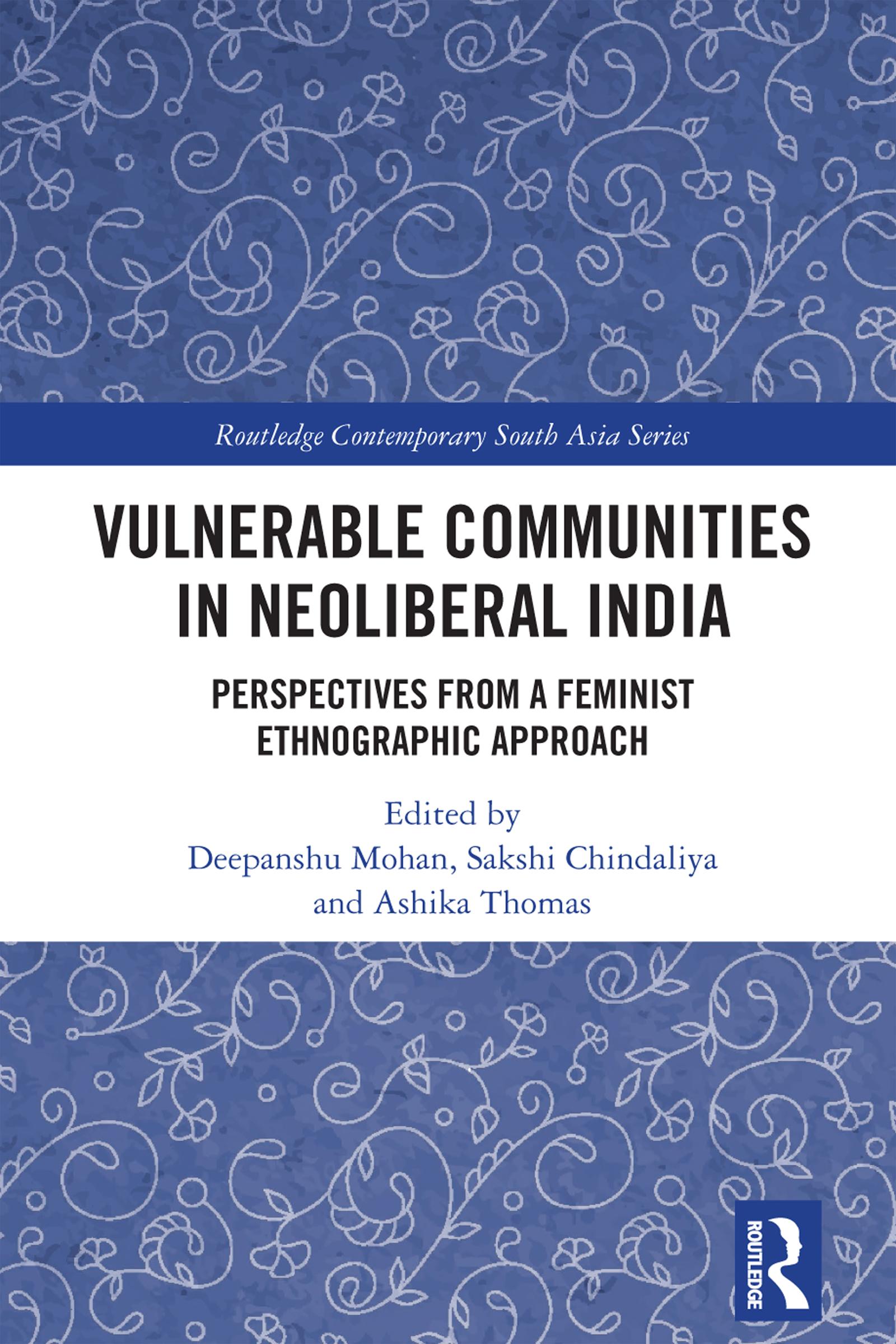
Mohan, Chindaliya, and Thomas offer an ethnographic critique of modern, neoliberal India from the perspective of studying the daily lives-livelihoods of marginalised, unsecured, informal vulnerable communities residing in the urban, peri-urban spaces across the nation.
With case studies ranging from groups of pastoralists, fisher-folk, and handicraft workers of Kashmir to the weavers of Kutch, and the factory workers and artisans of the Delhi capital, this edited volume of feminist ethnographies cover previously undocumented geographical and socio-cultural contexts of vulnerable groups, put together by the Centre for New Economics Studies, O.P. Jindal Global University. The diverse range of ethnographic case studies further explore the invisibilisation of the growing informal sector in India’s labor market, studied through the applied concepts of Gayatri Spivak’s othering, Doreen Massey’s power geometries and Pierre Bourdieu’s (fractured) habitus. In addition to providing visual narratives of daily lifestyle, livelihoods of identified communities, our ethnographic analysis is rooted in discussing feminist paradigms from each study’s respondents.
A useful read for scholars and policymakers interested in understanding intersectional applications of development studies in context of the unsecured workforce in India, with application across disciplines of social-economic anthropology of South Asia, using the methodological lens of experimental ethnography.
Zahle einfach mit Karte, Klarna, Apple Pay oder Google Pay. Nicht zufrieden? Du hast immer ein 14-tägiges Widerrufsrecht. Lies mehr in unseren AGB. Hast du Fragen, schreib uns eine E-Mail an hello@memmo.org.
Memmo macht das Lernen einfacher – wo auch immer du bist. Bei uns findest du deine Kursbücher und smarte Lerntools an einem Ort: Zusammenfassungen, Quizzes, Podcasts und Lernkarten. Und Ted, dein Lernbuddy, beantwortet alles, was du wissen möchtest. Über 50.000 Studierende lernen bereits hier – gemacht, damit du schneller lernst und weniger Stress hast.