
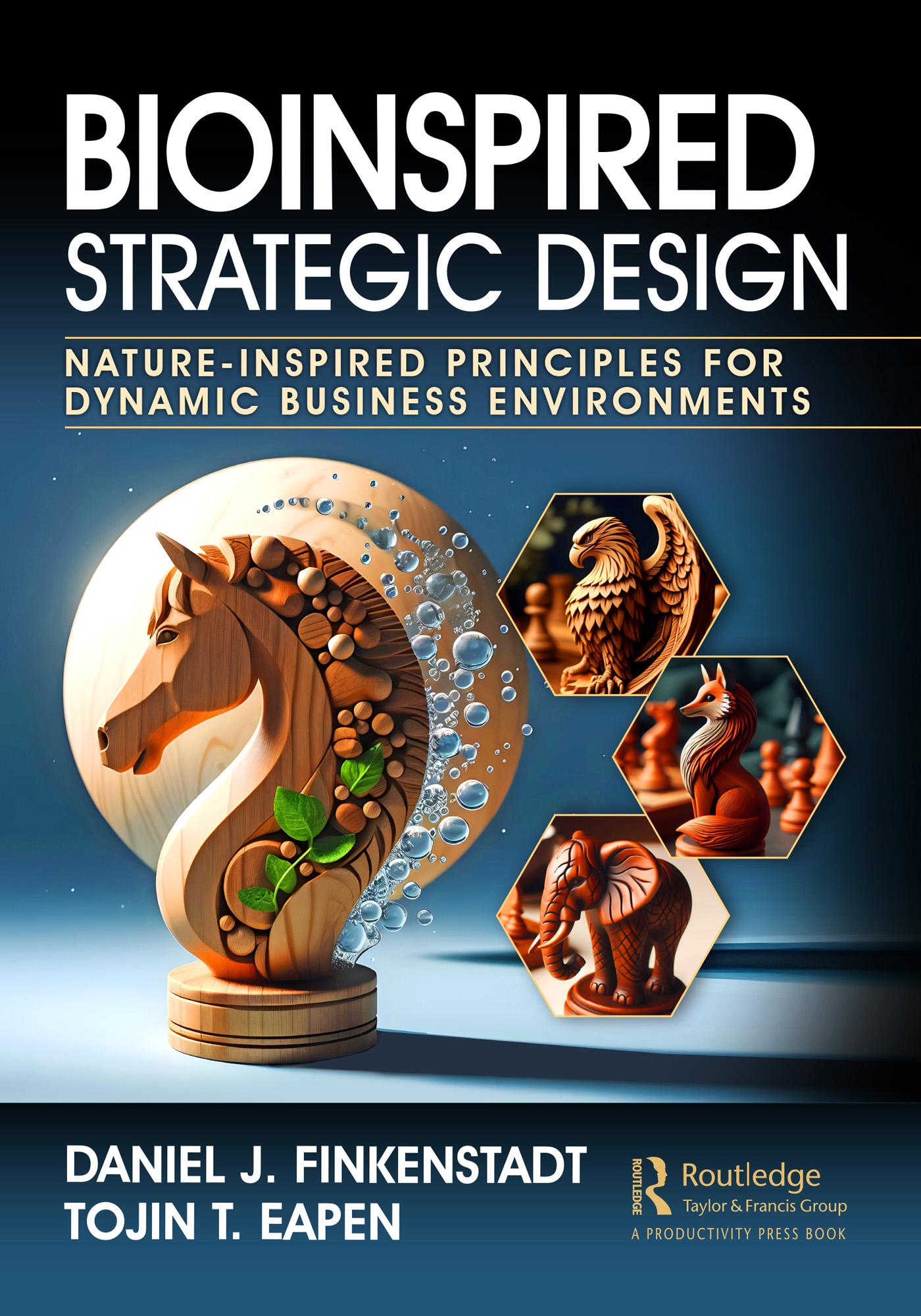
Organizations are commonly thrust into hostile operating environments where they are required to make strategic decisions that involve significant and costly tradeoffs. Such hostile environments may be endemic such as an economic recession or idiosyncratic such as a predatory action by an adversary. Many features of such hostile environments parallel those of living organisms that also demonstrate fine-tuned strategies to improve their survivability under adverse conditions. How can organizations use these “bioinspired strategies” to survive, and even potentially innovate?
This book shows that the same three capabilities essential for the survival of living organisms in harsh environments – efficiency, resilience, and prominence – are also critical for organizations in their process of navigating through their own hostile environments. Throughout the book, the authors provide organizational executives with a systematic framework for thinking about strategic decision-making in a hostile environment leaning on analysis of real-world cases to draw out ontologies and methods for guiding their teams through disruptions, change management, innovation, and process improvements.
In the first part, organizations are provided with a systematic approach to analyzing three survivability influences – forces, resources, and observers and their interrelationships. While all three influences are active across all organisms (and organizations), the exact nature of their interrelationship and the significance of each influence are unique to every organism (or organization). The framework helps organizations nail down the specific features of their operating environment that can help or hinder survivability by analyzing the three influences. Organizations can respond to external influences by developing three-pronged capabilities – efficiency, resilience, and prominence (ERP) – that respond to the three survivability influences. Organizations often struggle with identifying the appropriate strategies to apply under different conditions. Fortunately, nature provides several mechanisms that can be analogically applied to guide business strategies.
The book contains many illustrations and examples of strategic principles observed among living organisms that can help an organization develop ERP capability. Finally, the book introduces seven strategic design heuristics – Combination, Elimination, Separation, Segmentation, Replication, Dynamics, and Maximization – observed in a living system that can be flexibly utilized to generate ideas to achieve strategic ends.
Zahle einfach mit Karte, Klarna, Apple Pay oder Google Pay. Nicht zufrieden? Du hast immer ein 14-tägiges Widerrufsrecht. Lies mehr in unseren AGB. Hast du Fragen, schreib uns eine E-Mail an hello@memmo.org.
Memmo macht das Lernen einfacher – wo auch immer du bist. Bei uns findest du deine Kursbücher und smarte Lerntools an einem Ort: Zusammenfassungen, Quizzes, Podcasts und Lernkarten. Und Ted, dein Lernbuddy, beantwortet alles, was du wissen möchtest. Über 50.000 Studierende lernen bereits hier – gemacht, damit du schneller lernst und weniger Stress hast.