
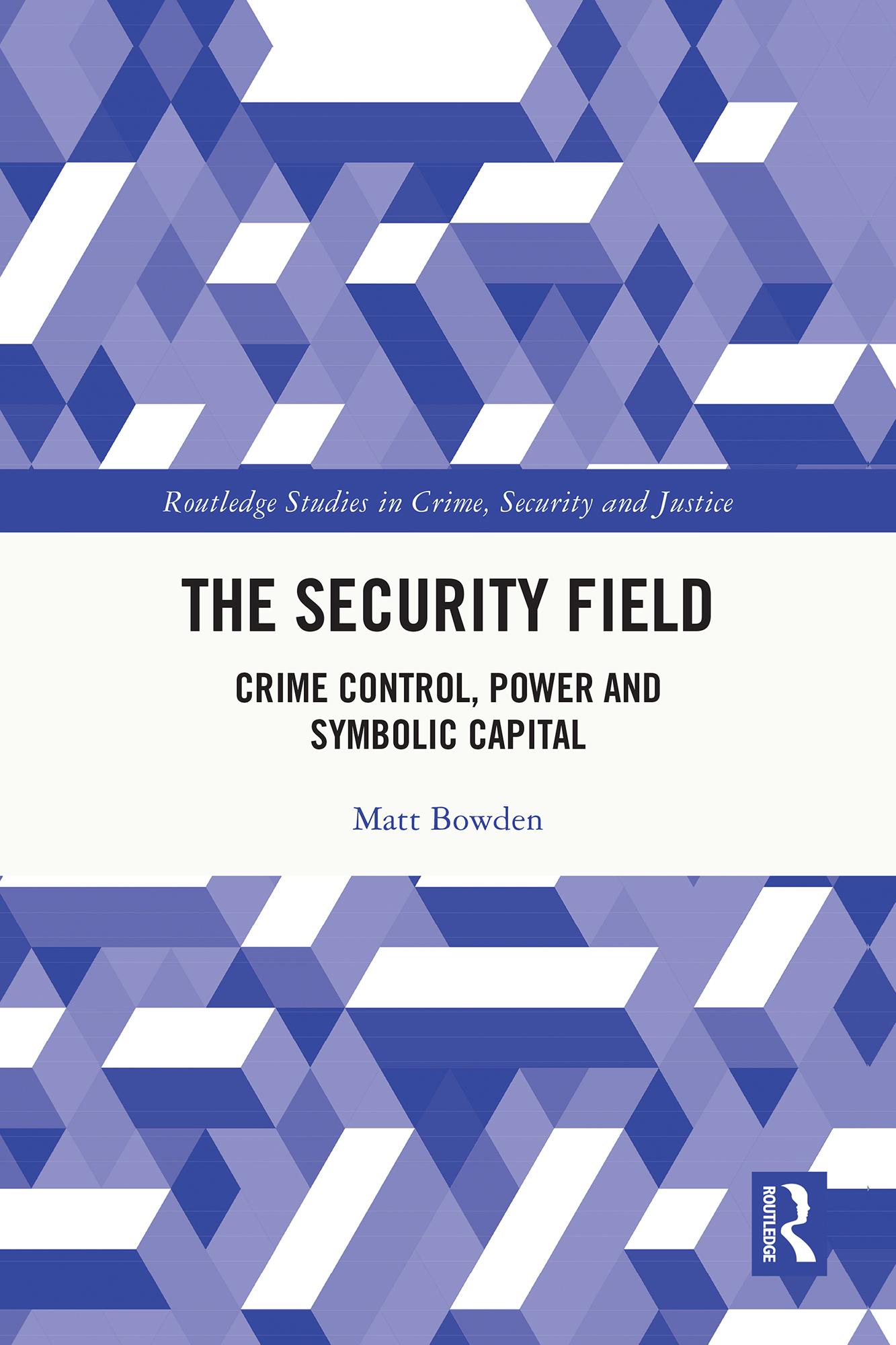
How crime and security are governed has become a critical issue in criminology over the first quarter of the twenty-first century. Today, we see a broader landscape of regulatory players who are involved in the control and management of crime, whether in crime prevention, safety in the community or in providing private security services. The Security Field: Crime Control, Power and Symbolic Capital gets to grips with these changes and argues that this forms an emerging field in which different players appear to compete and co-operate but are ultimately vying to shape and order the field. This book draws on new thinking in the social sciences on questions of crime, fear and security and contributes to the expanding interest on the sociology and criminology of security by offering a Bourdieusian approach to plural policing and the everyday political economy of security.
Drawing from Bourdieu’s concept of field, this book builds a theory of the security field based upon a series of in-depth interviews with security actors such as senior police officers, NGOs, private security professionals, government officials and community safety workers in Ireland. It demonstrates how security producers compete for cultural capital in its many forms – as data, information and relationships – and ultimately as a way of cementing their positions in this emerging field. It shows the dominant power of the formal police and central government in shaping and ordering this relational space. In doing so, The Security Field: Crime Control, Power and Symbolic Capital builds an empirical case from three distinct areas of security production: urban security, community safety and the connections between regulated private security and public crime prevention. It explores the challenges of securitisation in respect of public safety, security and rights and the way in which social problems such as drug use, homelessness and urban marginality are recast as ‘security’ concerns.
An accessible and compelling read, this book will appeal to students and scholars of criminology, sociology, urban studies and security studies.
Zahle einfach mit Karte, Klarna, Apple Pay oder Google Pay. Nicht zufrieden? Du hast immer ein 14-tägiges Widerrufsrecht. Lies mehr in unseren AGB. Hast du Fragen, schreib uns eine E-Mail an hello@memmo.org.
Memmo macht das Lernen einfacher – wo auch immer du bist. Bei uns findest du deine Kursbücher und smarte Lerntools an einem Ort: Zusammenfassungen, Quizzes, Podcasts und Lernkarten. Und Ted, dein Lernbuddy, beantwortet alles, was du wissen möchtest. Über 50.000 Studierende lernen bereits hier – gemacht, damit du schneller lernst und weniger Stress hast.