
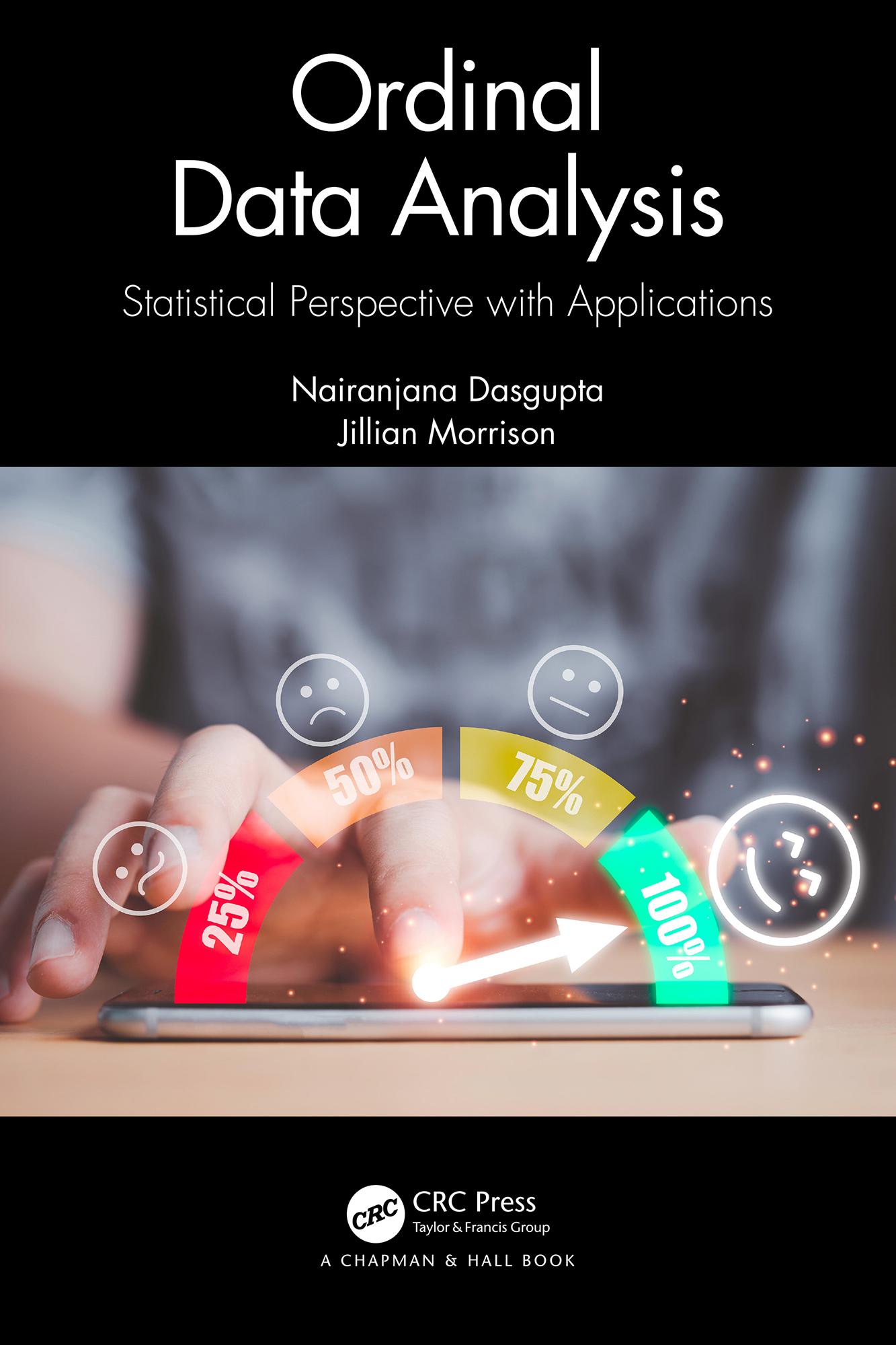
This book is a step-by-step data story for analyzing ordinal data from start to finish. The book is for researchers, statisticians and scientists who are working with datasets where the response is ordinal. This type of data is common in many disciplines, not just in surveys (as is often thought). For example, in the biological sciences, there is an interest in understanding and predicting the (growth) stage (of a plant or animal) based on a multitude of factors. Likewise, ordinal data is common in environmental sciences (for example, stage of a storm), chemical sciences (for example, type of reaction), physical sciences (for example, stage of damage when force is applied), medical sciences (for example, degree of pain) and social sciences (for example, demographic factors like social status categorized in brackets). There has been no complete text about how to model an ordinal response as a function of multiple numerical and categorical predictors. There has always been a reluctance and reticence towards ordinal data as it lies in a no-man’s land between numerical and categorical data.
Examples from health sciences are used to illustrate in detail the process of how to analyze ordinal data, from exploratory analysis to modeling, to inference and diagnostics. This book also shows how Likert-type analysis is often used incorrectly and discusses the reason behind it. Similarly, it discusses the methods related to Structural Equations and talks about appropriate uses of this class of methods.
The text is meant to serve as a reference book and to be a “how-to” resource along with the “why” and “when” for modeling ordinal data.
Key Features:
- Includes applications of the statistical theory
- Includes illustrated examples with the associated R and SAS code
- Discusses the key differences between the different methods that are used for ordinal data analysis
- Bridges the gap between methods for ordinal data analysis used in different disciplines
Zahle einfach mit Karte, Klarna, Apple Pay oder Google Pay. Nicht zufrieden? Du hast immer ein 14-tägiges Widerrufsrecht. Lies mehr in unseren AGB. Hast du Fragen, schreib uns eine E-Mail an hello@memmo.org.
Memmo macht das Lernen einfacher – wo auch immer du bist. Bei uns findest du deine Kursbücher und smarte Lerntools an einem Ort: Zusammenfassungen, Quizzes, Podcasts und Lernkarten. Und Ted, dein Lernbuddy, beantwortet alles, was du wissen möchtest. Über 50.000 Studierende lernen bereits hier – gemacht, damit du schneller lernst und weniger Stress hast.