
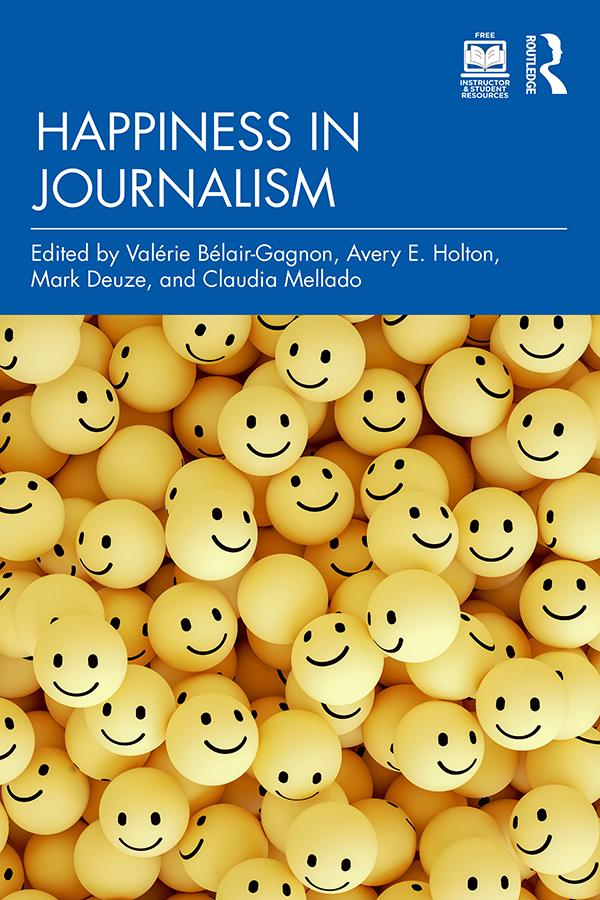
This book examines how journalism can overcome harmful institutional issues such as work-related trauma and precarity, focusing specifically on questions of what happiness in journalism means, and how one can be successful and happy on the job.
Acknowledging profound variations across people, genres of journalism, countries, types of news organizations, and methodologies, this book brings together an array of international perspectives from academia and practice. It suggests that there is much that can be done to improve journalists’ subjective well-being, despite there being no one-size-fits-all solution. It advocates for a shift in mindset as much in theoretical as in methodological approaches, moving away from a focus on platforms and adaptation to pay real attention to the human beings at the center of the industry. That shift in mindset and approach involves exploring what happiness is, how happiness manifests in journalism and media industries, and what future we can imagine that would be better for the profession. Happiness is conceptualized from both psychological and philosophical perspectives. Issues such as trauma, harassment, inequality, digital security, and mental health are considered alongside those such as precarity, recruitment, emotional literacy, intelligence, resilience, and self-efficacy. Authors point to norms, values and ethics in their regions and suggest best practices based on their experience.
Constituting a first-of-its-kind study and guide, Happiness in Journalism is recommended reading for journalists, educators, and advanced students interested in topics relating to journalists’ mental health and emotion, media management, and workplace well-being.
This book is accompanied by an online platform which supports videos, exercises, reports and links to useful further reading.
Zahle einfach mit Karte, Klarna, Apple Pay oder Google Pay. Nicht zufrieden? Du hast immer ein 14-tägiges Widerrufsrecht. Lies mehr in unseren AGB. Hast du Fragen, schreib uns eine E-Mail an hello@memmo.org.
Memmo macht das Lernen einfacher – wo auch immer du bist. Bei uns findest du deine Kursbücher und smarte Lerntools an einem Ort: Zusammenfassungen, Quizzes, Podcasts und Lernkarten. Und Ted, dein Lernbuddy, beantwortet alles, was du wissen möchtest. Über 50.000 Studierende lernen bereits hier – gemacht, damit du schneller lernst und weniger Stress hast.