
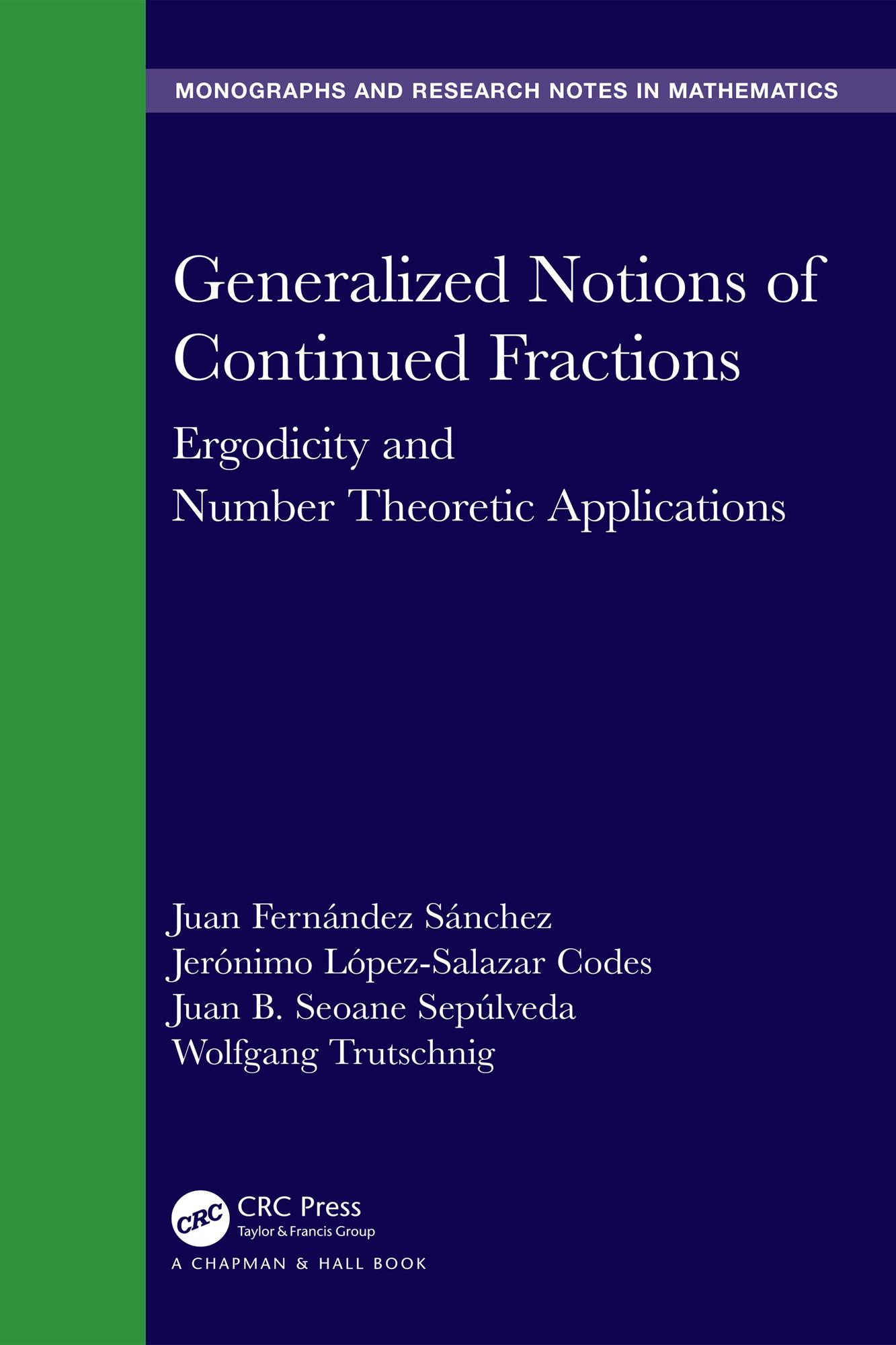
Ancient times witnessed the origins of the theory of continued fractions. Throughout time, mathematical geniuses such as Euclid, Aryabhata, Fibonacci, Bombelli, Wallis, Huygens, or Euler have made significant contributions to the development of this famous theory, and it continues to evolve today, especially as a means of linking different areas of mathematics.
This book, whose primary audience is graduate students and senior researchers, is motivated by the fascinating interrelations between ergodic theory and number theory (as established since the 1950s). It examines several generalizations and extensions of classical continued fractions, including generalized Lehner, simple, and Hirzebruch-Jung continued fractions. After deriving invariant ergodic measures for each of the underlying transformations on [0,1] it is shown that any of the famous formulas, going back to Khintchine and Levy, carry over to more general settings. Complementing these results, the entropy of the transformations is calculated and the natural extensions of the dynamical systems to [0,1]2 are analyzed.
Features
- Suitable for graduate students and senior researchers
- Written by international senior experts in number theory
- Contains the basic background, including some elementary results, that the reader may need to know before hand, making it a self-contained volume
Zahle einfach mit Karte, Klarna, Apple Pay oder Google Pay. Nicht zufrieden? Du hast immer ein 14-tägiges Widerrufsrecht. Lies mehr in unseren AGB. Hast du Fragen, schreib uns eine E-Mail an hello@memmo.org.
Memmo macht das Lernen einfacher – wo auch immer du bist. Bei uns findest du deine Kursbücher und smarte Lerntools an einem Ort: Zusammenfassungen, Quizzes, Podcasts und Lernkarten. Und Ted, dein Lernbuddy, beantwortet alles, was du wissen möchtest. Über 50.000 Studierende lernen bereits hier – gemacht, damit du schneller lernst und weniger Stress hast.