
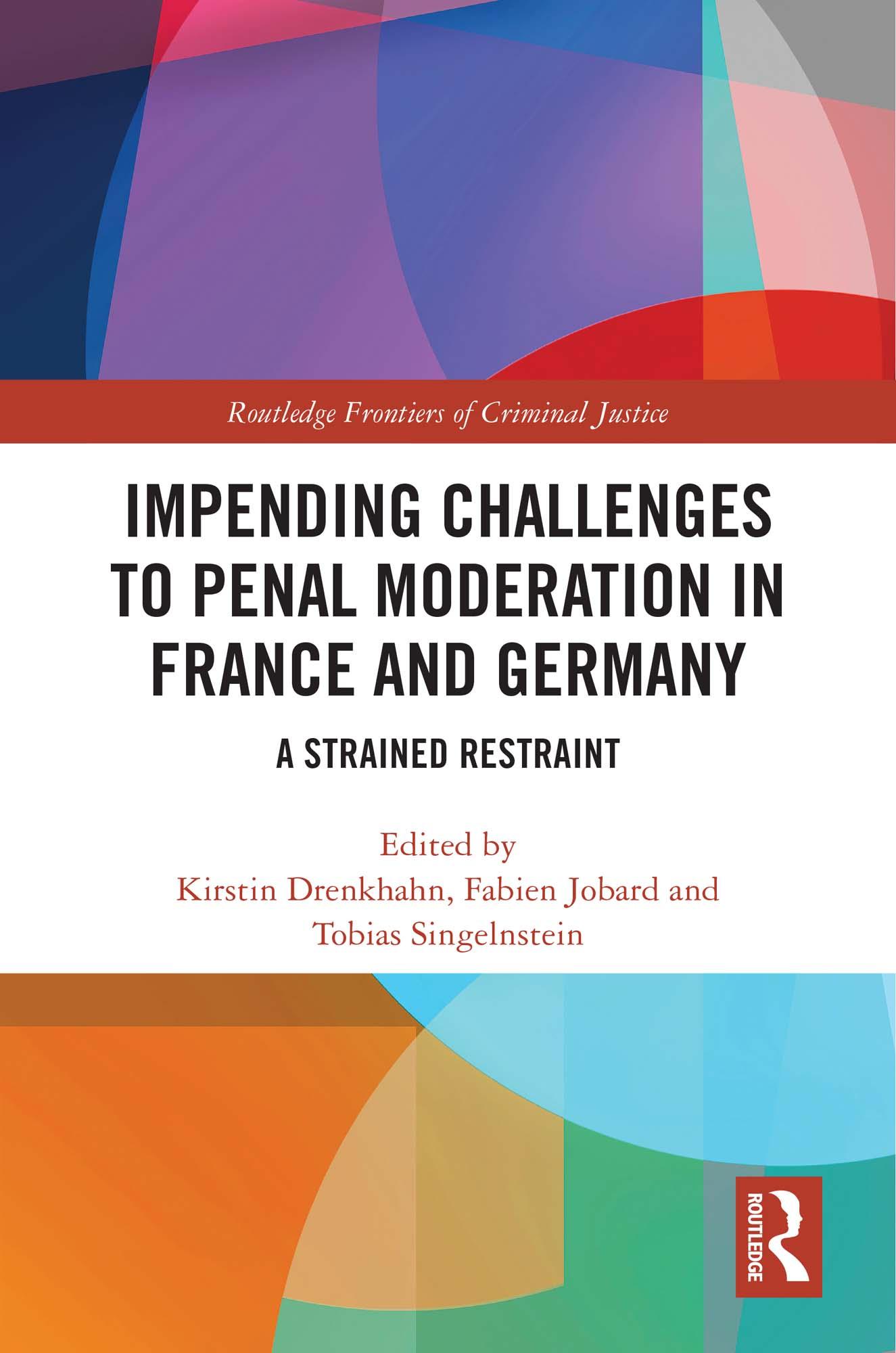
This book investigates the penal culture in France and Germany – how it is shaped in politics, media, and public opinion. Although compared with the US or the UK, France and Germany seem to place a strong emphasis on the ideal of rehabilitation that would block excessive punishment and other outcomes of punitive developments in society, there is a steady increase in punitiveness over time for which the term “strained restraint” is proposed. The book shows that the idea of penal moderation is deeply rooted in public opinion, politics, and the media and that it is renegotiated every day in a dynamic interplay between these spheres.
Punishment and society research has traditionally focused on the US and the UK. In comparative research, both are considered extreme in punitive developments with high rates of imprisonment and large groups of the population under penal control. The other extreme in comparative research would be Scandinavia with the famous Nordic Exceptionalism marked by low prison population rates. Germany and France are often considered to be “the same” when compared with each other, and “the other” with reference to both of these extremes. However, this book shows that France and Germany are far from being the same when it comes to state organization (centralistic vs. federal), criminal justice and the criminal law, political traditions, and the media. Also, research from both countries has looked at whether developments such as the “punitive turn” have occurred in Germany and France. Research focused on the domestic situation concludes that punitiveness is on the rise, and that both countries are indeed experiencing their own punitive turn.
How do we reconcile these contradictory findings? Why do these two seem to follow the path of penal moderation in the overall outcome of punishment in society when we look at comparative research? And how is it that from a domestic perspective, punitive attitudes and desires are leading to more punitiveness? By focusing on the meso level, with a comparative perspective on the two countries and a dynamic analytical approach, this book reconciles the fluidity of individual attitudes and opinions with the relative stability of societal discourse. The authors posit that penal moderation comes at a price: overall and in an internationally comparative perspective, there is penal moderation, but a closer look at the domestic situation and development reveals that it is nonetheless challenged by a slowly rising tide of punitiveness.
Going beyond the main tenets of punishment and society research with a dynamic analysis of two large societies in Europe, this book is ideal reading for scholars and students of penology, criminal justice, and European studies.
Zahle einfach mit Karte, Klarna, Apple Pay oder Google Pay. Nicht zufrieden? Du hast immer ein 14-tägiges Widerrufsrecht. Lies mehr in unseren AGB. Hast du Fragen, schreib uns eine E-Mail an hello@memmo.org.
Memmo macht das Lernen einfacher – wo auch immer du bist. Bei uns findest du deine Kursbücher und smarte Lerntools an einem Ort: Zusammenfassungen, Quizzes, Podcasts und Lernkarten. Und Ted, dein Lernbuddy, beantwortet alles, was du wissen möchtest. Über 50.000 Studierende lernen bereits hier – gemacht, damit du schneller lernst und weniger Stress hast.