
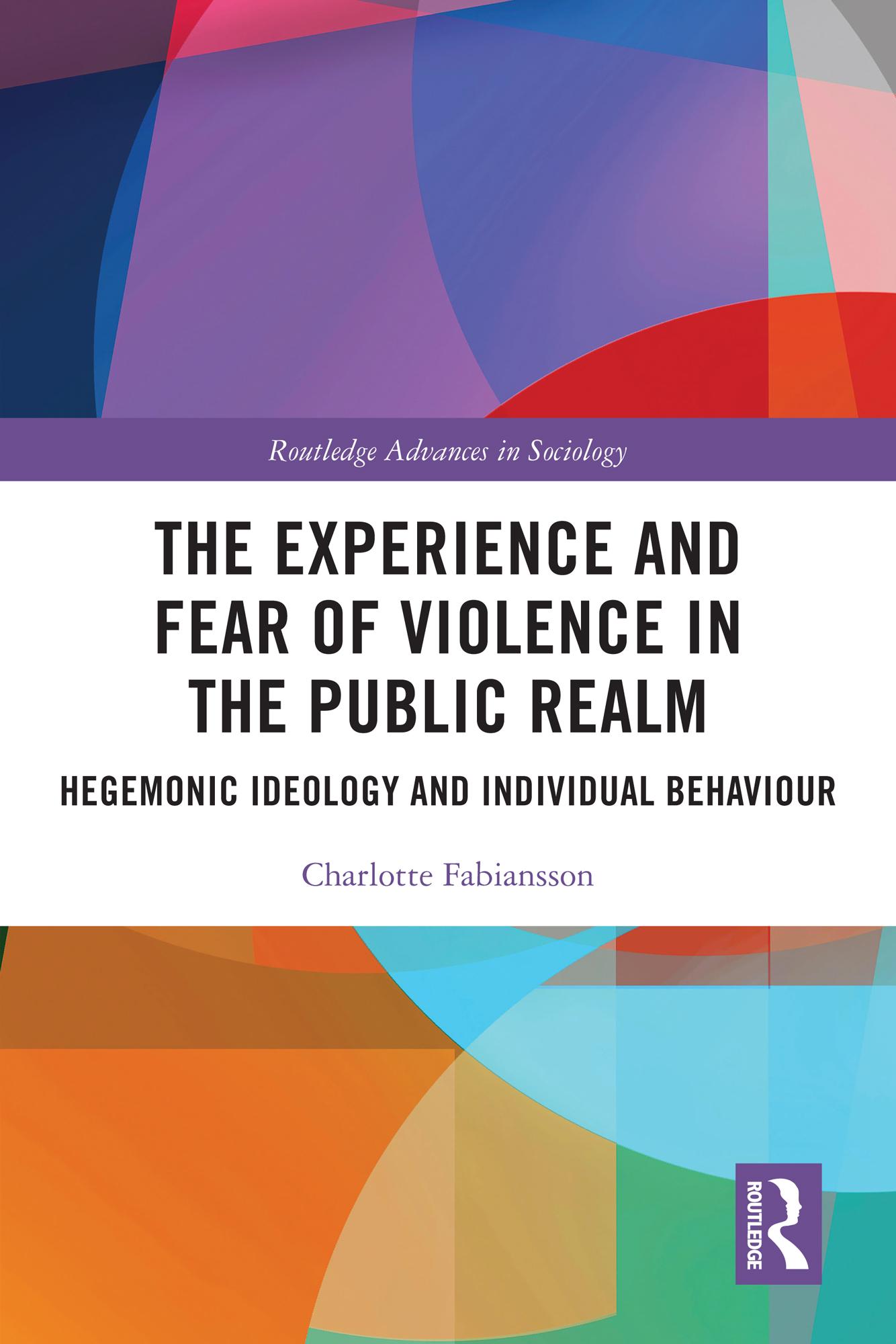
This book explores violent and discriminatory values and beliefs and their interconnectedness between societal echelons. Violence has a foundation and a context. It comes from somewhere and is directed at someone or something, and it has an ambience established through generations of social, cultural, political, financial and religious strategies. It fashions nation-states’ hegemonic ideology and frames individual behaviours and attitudes, thus creating a milieu that enables the normalisation of violence. The focus is on violence-infused behaviours and actions in the public realm, a multifunctional environment for social and cultural activities, as well as a workplace, entertainment and transport hub. It is a public setting, sometimes demanding onerous deftness of individuals to stay safe. Attitudes, values and beliefs around violence, harassment and discrimination in the public realm frequently occur openly without anyone noticing that a crime has been committed, including by close bystanders. An audience steeped in societal hegemonic social and cultural patriarchal ideology might be oblivious to harassing or discriminative behaviours and attitudes against females, minority genders and ethnic minority groups. The habitual nature and normalisation of these invisible crimes make them easy to dismiss. Violence materialises on all societal levels: the hegemonic structural (macro) level, consisting of the society’s dominating political, financial, social, cultural and religious leaders, educational and community institutions (meso) level and the individual-agency (micro) level, hence the nationstate’s populace. Societal order is underpinned by structural, systemic and symbolic violence, all integrated into contemporary society’s cultural and social fabric, thus inconspicuous social norms as ingrained through internalisation. The book is written from a sociological perspective and within the risk society discourse, where the risk of violence in the public domain is omnipresent. Discourses of Arendt, Bauman, Bourdieu, Marx, Foucault, Galtung and Beck and present-day analysis underpin the discussions. The agency and political leadership research emphatically show that violence and discrimination are normalised and ingrained in the contemporary milieu.
Zahle einfach mit Karte, Klarna, Apple Pay oder Google Pay. Nicht zufrieden? Du hast immer ein 14-tägiges Widerrufsrecht. Lies mehr in unseren AGB. Hast du Fragen, schreib uns eine E-Mail an hello@memmo.org.
Memmo macht das Lernen einfacher – wo auch immer du bist. Bei uns findest du deine Kursbücher und smarte Lerntools an einem Ort: Zusammenfassungen, Quizzes, Podcasts und Lernkarten. Und Ted, dein Lernbuddy, beantwortet alles, was du wissen möchtest. Über 50.000 Studierende lernen bereits hier – gemacht, damit du schneller lernst und weniger Stress hast.