
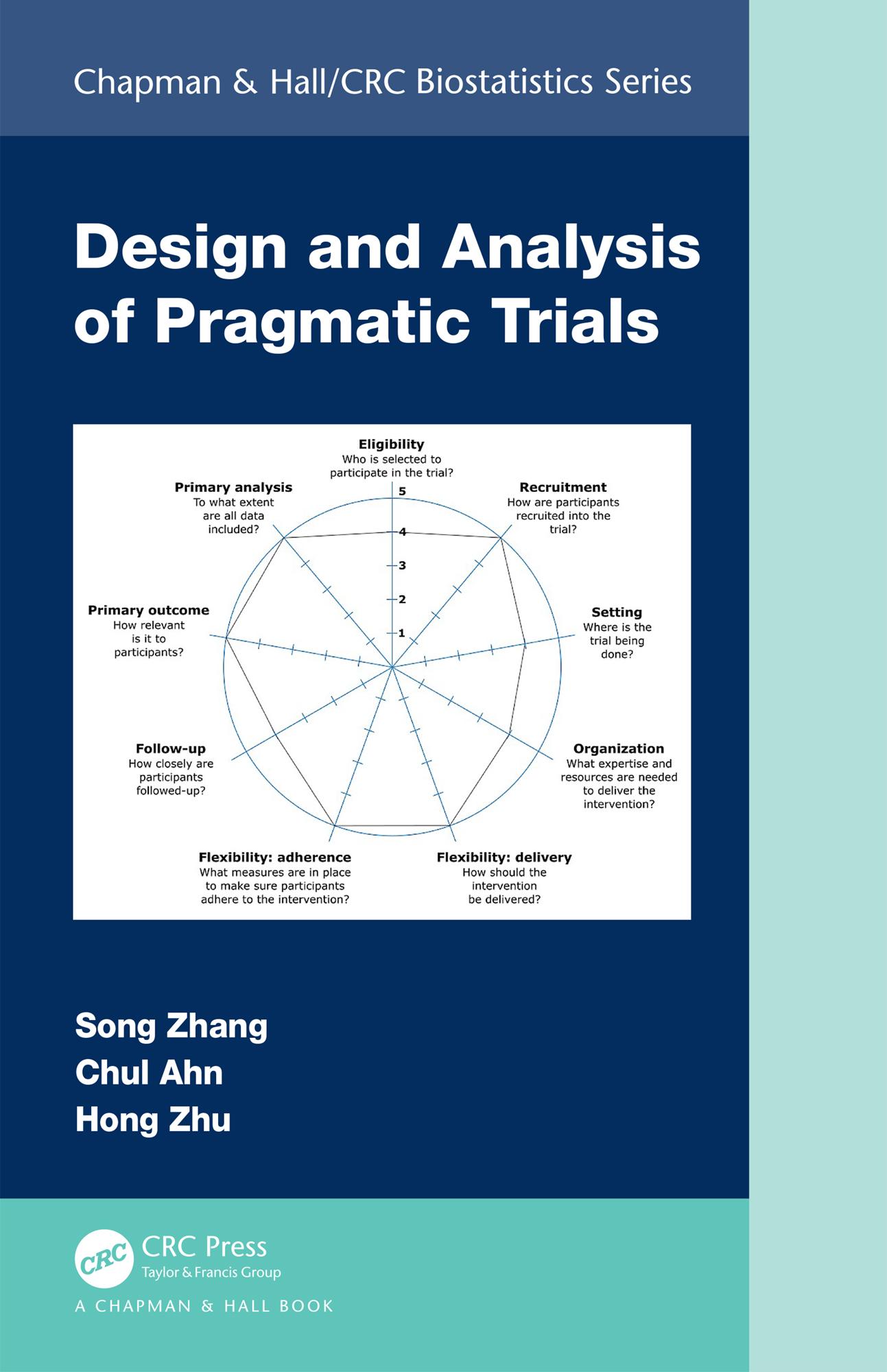
This book begins with an introduction of pragmatic cluster randomized trials (PCTs) and reviews various pragmatic issues that need to be addressed by statisticians at the design stage. It discusses the advantages and disadvantages of each type of PCT, and provides sample size formulas, sensitivity analyses, and examples for sample size calculation. The generalized estimating equation (GEE) method will be employed to derive sample size formulas for various types of outcomes from the exponential family, including continuous, binary, and count variables. Experimental designs that have been frequently employed in PCTs will be discussed, including cluster randomized designs, matched-pair cluster randomized design, stratified cluster randomized design, stepped-wedge cluster randomized design, longitudinal cluster randomized design, and crossover cluster randomized design. It demonstrates that the GEE approach is flexible to accommodate pragmatic issues such as hierarchical correlation structures, different missing data patterns, randomly varying cluster sizes, etc. It has been reported that the GEE approach leads to under-estimated variance with limited numbers of clusters. The remedy for this limitation is investigated for the design of PCTs. This book can assist practitioners in the design of PCTs by providing a description of the advantages and disadvantages of various PCTs and sample size formulas that address various pragmatic issues, facilitating the proper implementation of PCTs to improve health care. It can also serve as a textbook for biostatistics students at the graduate level to enhance their knowledge or skill in clinical trial design.
Key Features:
- Discuss the advantages and disadvantages of each type of PCTs, and provide sample size formulas, sensitivity analyses, and examples.
- Address an unmet need for guidance books on sample size calculations for PCTs;
- A wide variety of experimental designs adopted by PCTs are covered;
- The sample size solutions can be readily implemented due to the accommodation of common pragmatic issues encountered in real-world practice;
- Useful to both academic and industrial biostatisticians involved in clinical trial design;
- Can be used as a textbook for graduate students majoring in statistics and biostatistics.
Zahle einfach mit Karte, Klarna, Apple Pay oder Google Pay. Nicht zufrieden? Du hast immer ein 14-tägiges Widerrufsrecht. Lies mehr in unseren AGB. Hast du Fragen, schreib uns eine E-Mail an hello@memmo.org.
Memmo macht das Lernen einfacher – wo auch immer du bist. Bei uns findest du deine Kursbücher und smarte Lerntools an einem Ort: Zusammenfassungen, Quizzes, Podcasts und Lernkarten. Und Ted, dein Lernbuddy, beantwortet alles, was du wissen möchtest. Über 50.000 Studierende lernen bereits hier – gemacht, damit du schneller lernst und weniger Stress hast.