
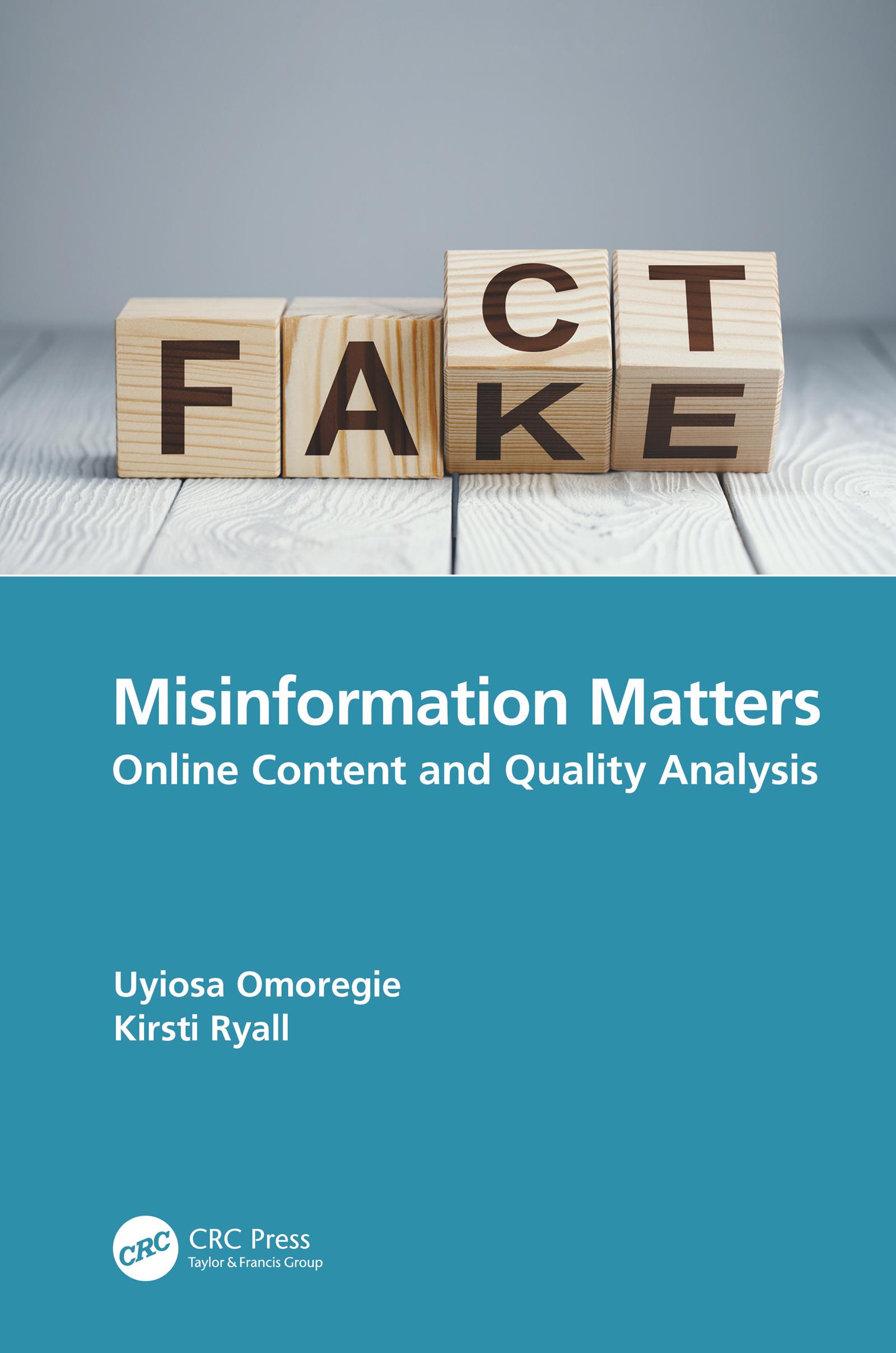
What is "misinformation"? Why does it matter? How does it spread on the internet, especially on social media platforms? What can we do to counteract the worst of its effects? Can we counteract its effects now that it is ubiquitous? These are the questions we answer in this book. We are living in an information age (specifically an "algorithmic age") which prioritizes information "quantity" over "quality". Social media has brought billions of people from across the world together online and the impact of diverse platforms, such as Facebook, WeChat, Reddit, LinkedIn, Signal, WhatsApp, Gab, Instagram, Telegram, and Snapchat, has been transformational.
The internet was created, with the best of intentions, as an online space where written content could be created, consumed and diffused without any real intermediary. This empowering aspect of the web is still, mostly, a force for good. People, on the whole, are better informed and online discussion is more inclusive because barriers to participation are reduced. As activity online has grown, however, an expanding catalogue of research reveals a darker side to social media, and the internet generally. Namely, misinformation’s ability to negatively influence our behaviour both online and offline.
The solution we provide to this growing dilemma is informed by Ludwig Wittgenstein’s Tractatus Logico-Philosophicus, which examines the relationship between language and reality from a philosophical perspective, and complements Claude Shannon’s Information Quantity Theory, which addresses the quantification, storage and communication of digital information from a mathematical perspective. The book ends by setting out a model designed by us: a "Wittgensteinian" approach to information quality. It defines content published online by clarifying the propositions and claims made within it. Our model’s online information quality check allows users to effectively analyse the quality of trending online content. This approach to misinformation analysis and prevention has been designed to be both easy to use and pragmatic. It upholds freedom of speech online while using the "harm principle" to categorise problematic content.
Zahle einfach mit Karte, Klarna, Apple Pay oder Google Pay. Nicht zufrieden? Du hast immer ein 14-tägiges Widerrufsrecht. Lies mehr in unseren AGB. Hast du Fragen, schreib uns eine E-Mail an hello@memmo.org.
Memmo macht das Lernen einfacher – wo auch immer du bist. Bei uns findest du deine Kursbücher und smarte Lerntools an einem Ort: Zusammenfassungen, Quizzes, Podcasts und Lernkarten. Und Ted, dein Lernbuddy, beantwortet alles, was du wissen möchtest. Über 50.000 Studierende lernen bereits hier – gemacht, damit du schneller lernst und weniger Stress hast.