
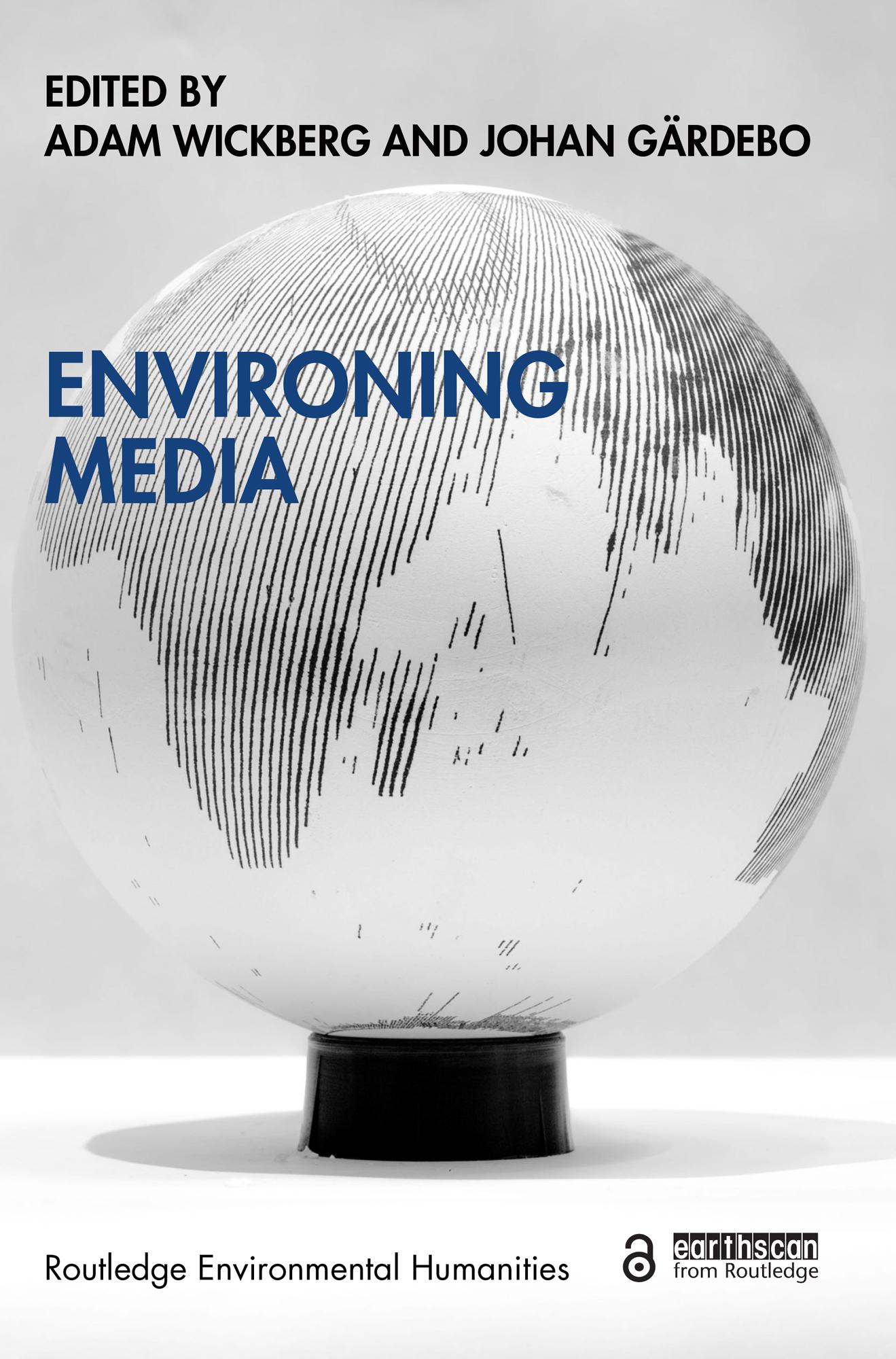
This edited volume interrogates the role of media technologies in the formation of environments, understood both as physical spaces and as epistemological constructs about them. Using the concept of ‘environing media’, the book advances a deeper understanding of how media processes – defined here as the storage, process, and transmission of data – influence human-Earth relations.
Virtually all aspects of the interconnected global ecological crisis can be related to the intensification and acceleration of scaling up the human imprint on the planet by technological means. Combining ideas from the humanities, arts, and humanistic social sciences, Environing Media offers a perspective on how we entered the current geological epoch – the Anthropocene. The ten chapters explore colonial, planetary, and elemental environing media, with cases including indigenous history, ocean monitoring, computational history, climate modeling, environmental history, the air as medium, the biosphere, and the Earth system.
Drawing upon a breadth of examples and expertise in history, anthropology, geography, cultural history, science and technology studies, and media studies, the book discovers a novel approach to human-Earth histories that demonstrates how technologies have mediated between humans and environments and in the process contributed to a societal feedback loop between knowing and doing environment, each impacting the other. Environing Media is a timely addition for scholars and upper-level students in environmental humanities and media studies.
The Open Access version of chapters 1, 2, 3, 4, 5, 7, 8, and 9 are available at http://www.taylorfrancis.com/books/e/9781003282891. Chapters 1, 2, 4, 5, and 7 have been made available under a Creative Commons Attribution-Non Commercial-No Derivatives 4.0 (CC BY-NC-ND 4.0) license. Chapters 3, 8, and 9 have been made available under a Creative Commons Attribution (CC-BY 4.0) license.
Zahle einfach mit Karte, Klarna, Apple Pay oder Google Pay. Nicht zufrieden? Du hast immer ein 14-tägiges Widerrufsrecht. Lies mehr in unseren AGB. Hast du Fragen, schreib uns eine E-Mail an hello@memmo.org.
Memmo macht das Lernen einfacher – wo auch immer du bist. Bei uns findest du deine Kursbücher und smarte Lerntools an einem Ort: Zusammenfassungen, Quizzes, Podcasts und Lernkarten. Und Ted, dein Lernbuddy, beantwortet alles, was du wissen möchtest. Über 50.000 Studierende lernen bereits hier – gemacht, damit du schneller lernst und weniger Stress hast.