
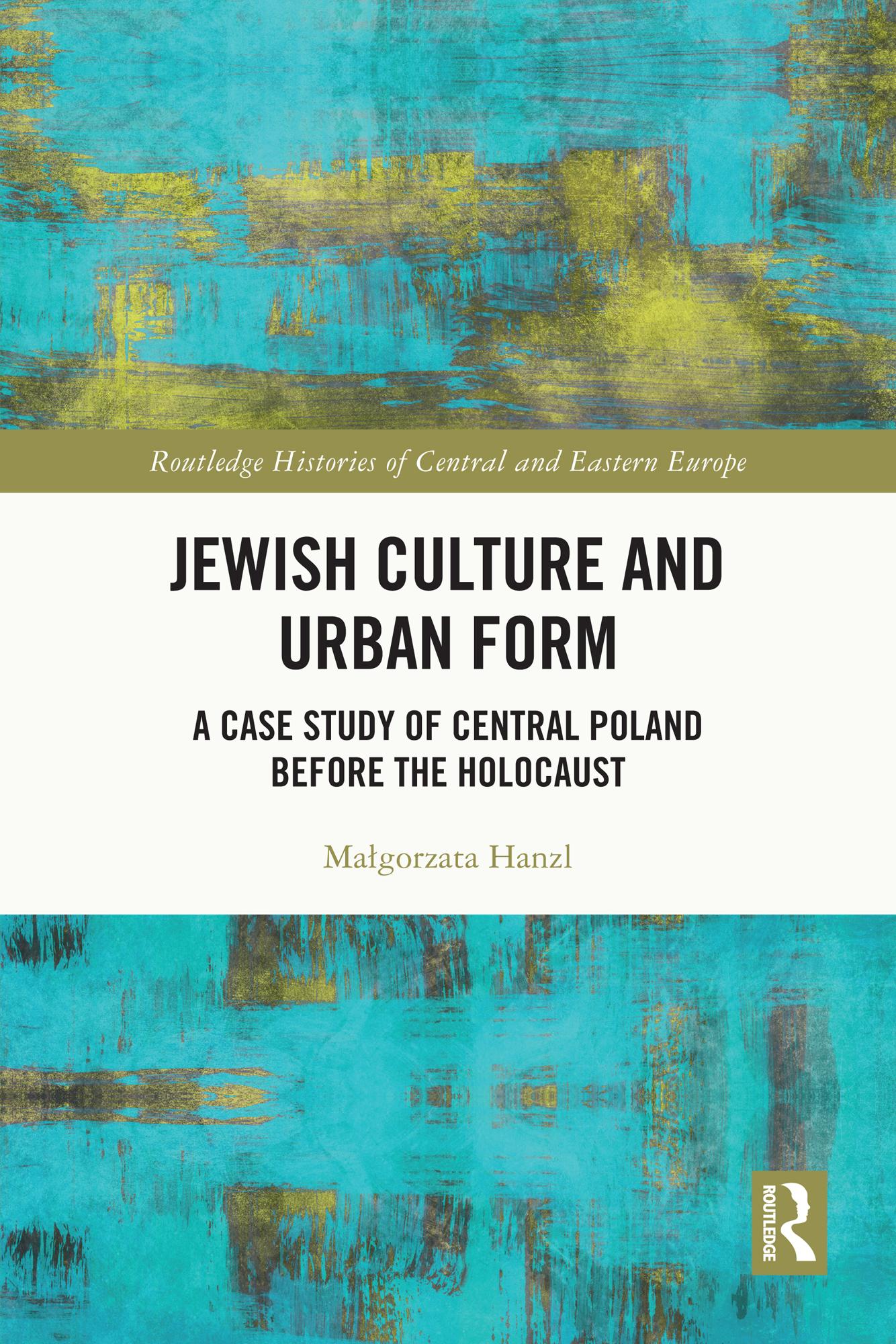
Across a range of disciplines, urban morphology has offered lenses through which we can read the city. Reading the urban form, when conflated with ethnographic studies, enables us to return to past situations and recreate the long-gone everyday life. Urbanscapes – the artefacts of urban life – have left us the story portrayed in the pages of this book.
The notions of time and space contribute to depicting the Jewish-Polish culture in central Poland before the Holocaust. The research proves that Jewish society in pre-Holocaust Poland was an example of self-organising complexity. Through bottom-up activities, it had a significant impact on the unique character of the spaces left behind. Several features confirm this influence. Not only do the edifices, both public and private, convey meanings related to the Jewish culture, but public and semi-private space also tell the story of long-gone social situations. The specific atmosphere that still lingers there recalls the long-gone Jewish culture, with the unique settlement patterns indicating a separate spatial order. The Author reveals to the international cast of practitioners and theorists of urban and Jewish studies a vivid and comprehensive account.
This book will appeal to researchers and students alike studying Jewish communities in Poland and Jewish-Polish society and urbanisation, as well as all those interested in Jewish-Polish Culture.
Zahle einfach mit Karte, Klarna, Apple Pay oder Google Pay. Nicht zufrieden? Du hast immer ein 14-tägiges Widerrufsrecht. Lies mehr in unseren AGB. Hast du Fragen, schreib uns eine E-Mail an hello@memmo.org.
Memmo macht das Lernen einfacher – wo auch immer du bist. Bei uns findest du deine Kursbücher und smarte Lerntools an einem Ort: Zusammenfassungen, Quizzes, Podcasts und Lernkarten. Und Ted, dein Lernbuddy, beantwortet alles, was du wissen möchtest. Über 50.000 Studierende lernen bereits hier – gemacht, damit du schneller lernst und weniger Stress hast.