
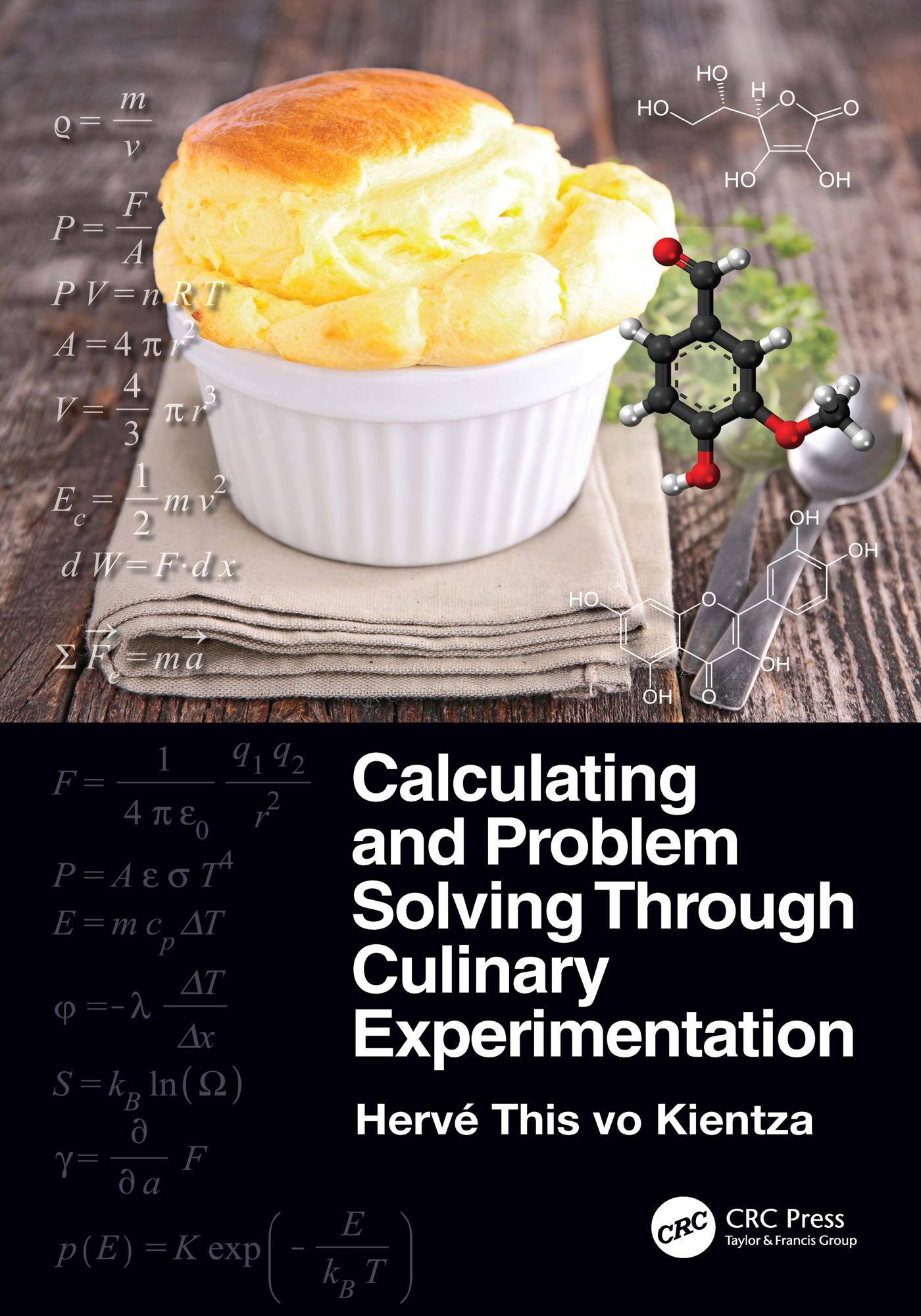
While many books proliferate elucidating the science behind the transformations during cooking, none teach the concepts of physics chemistry through problem solving based on culinary experiments as this one by renowned chemist and one of the founders of molecular gastronomy.
Calculating and Problem Solving Through Culinary Experimentation offers an appealing approach to teaching experimental design and scientific calculations.
Given the fact that culinary phenomena need physics and chemistry to be interpreted, there are strong and legitimate reasons for introducing molecular gastronomy in scientific curriculum.
As any scientific discipline, molecular gastronomy is based on experiments (to observe the phenomena to be studied) and calculation (to fit the many data obtained by quantitative characterization of the studied phenomena), but also for making the theoretical work without which no real science is done, including refuting consequences of the introduced theories. Often, no difficult calculations are needed, and many physicists, in particular, make their first steps in understanding phenomena with very crude calculations. Indeed, they simply apply what they learned, before moving to more difficult math.
In this book, the students are invited first to make simple experiments in order to get a clear idea of the (culinary) phenomena that they will be invited to investigate, and then are asked simple questions about the phenomena, for which they have to transform their knowledge into skills, using a clear strategy that is explained throughout. Indeed, the is "problem solving based on experiments", and all this about food and cooking.
Key Features:
- Introduces readers to tips for experimental work
- Shows how simple scientific knowledge can be applied in understanding questions
- Provides a sound method ("strategy") for calculation in physics and chemistry
- Presents important definitions and laws for physical chemistry
- Gives confidence in one’s calculation skill and problem solving skills
- Explore physical and chemical phenomena that occur during cooking
A unique mix of culinary arts and correct calculations, this book is useful to students as well as professors in chemistry, physics, biology, food science and technology.
Zahle einfach mit Karte, Klarna, Apple Pay oder Google Pay. Nicht zufrieden? Du hast immer ein 14-tägiges Widerrufsrecht. Lies mehr in unseren AGB. Hast du Fragen, schreib uns eine E-Mail an hello@memmo.org.
Memmo macht das Lernen einfacher – wo auch immer du bist. Bei uns findest du deine Kursbücher und smarte Lerntools an einem Ort: Zusammenfassungen, Quizzes, Podcasts und Lernkarten. Und Ted, dein Lernbuddy, beantwortet alles, was du wissen möchtest. Über 50.000 Studierende lernen bereits hier – gemacht, damit du schneller lernst und weniger Stress hast.