
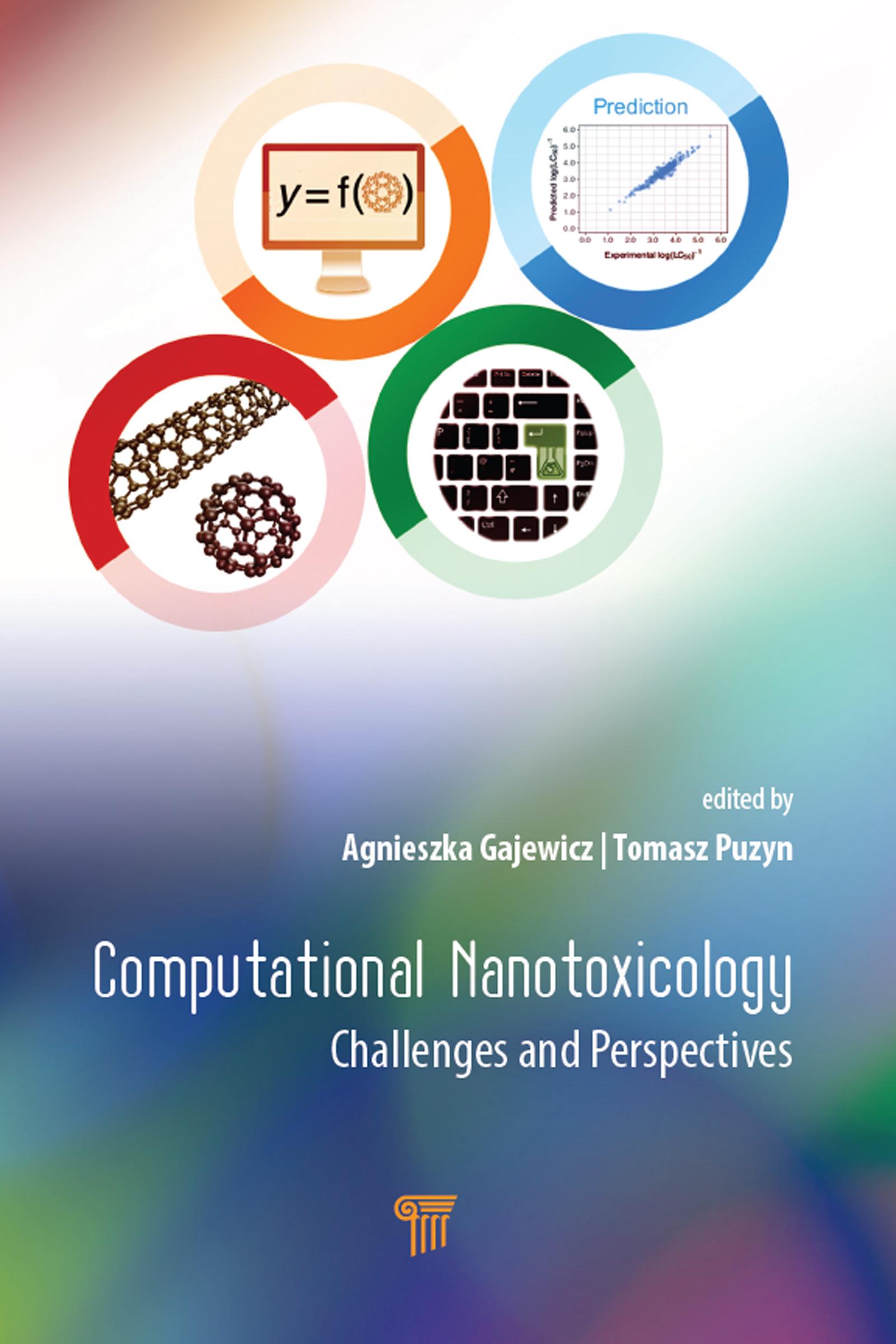
The development of computational methods that support human health and environmental risk assessment of engineered nanomaterials (ENMs) has attracted great interest because the application of these methods enables us to fill existing experimental data gaps. However, considering the high degree of complexity and multifunctionality of ENMs, computational methods originally developed for regular chemicals cannot always be applied explicitly in nanotoxicology. This book discusses the current state of the art and future needs in the development of computational modeling techniques for nanotoxicology. It focuses on (i) computational chemistry (quantum mechanics, semi-empirical methods, density functional theory, molecular mechanics, molecular dynamics), (ii) nanochemoinformatic methods (quantitative structure–activity relationship modeling, grouping, read-across), and (iii) nanobioinformatic methods (genomics, transcriptomics, proteomics, metabolomics). It reviews methods of calculating molecular descriptors sufficient to characterize the structure of nanoparticles, specifies recent trends in the validation of computational methods, and discusses ways to cope with the uncertainty of predictions. In addition, it highlights the status quo and further challenges in the application of computational methods in regulation (e.g., REACH, OECD) and in industry for product development and optimization and the future directions for increasing acceptance of computational modeling for nanotoxicology.
Zahle einfach mit Karte, Klarna, Apple Pay oder Google Pay. Nicht zufrieden? Du hast immer ein 14-tägiges Widerrufsrecht. Lies mehr in unseren AGB. Hast du Fragen, schreib uns eine E-Mail an hello@memmo.org.
Memmo macht das Lernen einfacher – wo auch immer du bist. Bei uns findest du deine Kursbücher und smarte Lerntools an einem Ort: Zusammenfassungen, Quizzes, Podcasts und Lernkarten. Und Ted, dein Lernbuddy, beantwortet alles, was du wissen möchtest. Über 50.000 Studierende lernen bereits hier – gemacht, damit du schneller lernst und weniger Stress hast.