
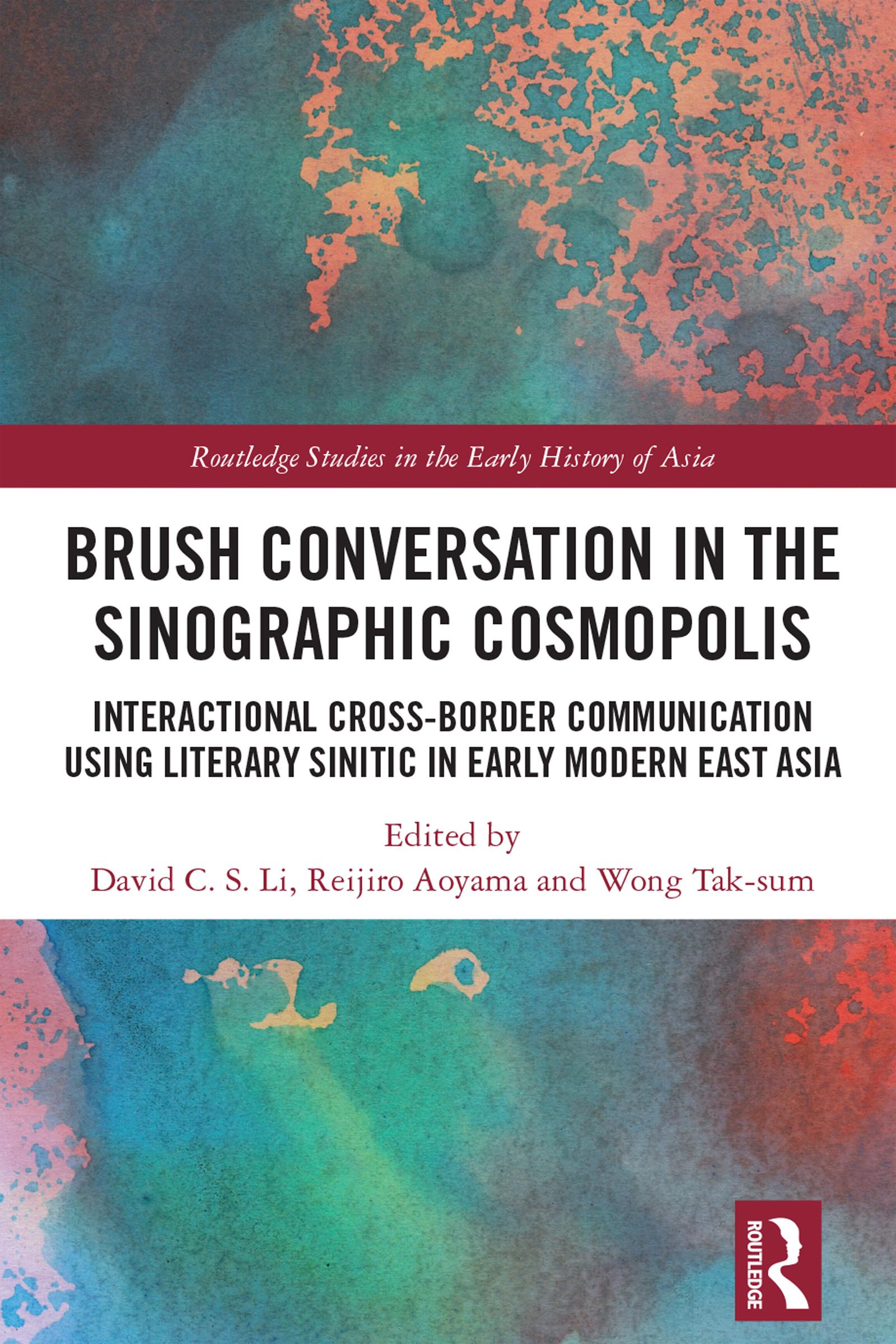
For hundreds of years until the 1900s, in today’s China, Japan, North and South Korea, and Vietnam, literati of Classical Chinese or Literary Sinitic (wényán 文言) could communicate in writing interactively, despite not speaking each other’s languages.
This book outlines the historical background of, and the material conditions that led to, widespread literacy development in premodern and early modern East Asia, where reading and writing for formal purposes was conducted in Literary Sinitic. To exemplify how ‘silent conversation’ or ‘brush-assisted conversation’ is possible through writing-mediated brushed interaction, synchronously face-to-face, this book presents contextualized examples from recurrent contexts involving (i) boat drifters; (ii) traveling literati; and (iii) diplo- matic envoys. Where profound knowledge of classical canons and literary works in Sinitic was a shared attribute of the brush-talkers concerned, their brush-talk would characteristically be intertwined with poetic improvisation.
Being the first monograph in English to address this fascinating lingua-cultural practice and cross-border communication phenomenon, which was possibly sui generis in Sinographic East Asia, it will be of interest to students of not only East Asian languages and linguistics, history, international relations, and diplomacy, but also (historical) pragmatics, sociolinguistics, sociology of language, scripts and writing systems, and cultural and linguistic anthropology.
Zahle einfach mit Karte, Klarna, Apple Pay oder Google Pay. Nicht zufrieden? Du hast immer ein 14-tägiges Widerrufsrecht. Lies mehr in unseren AGB. Hast du Fragen, schreib uns eine E-Mail an hello@memmo.org.
Memmo macht das Lernen einfacher – wo auch immer du bist. Bei uns findest du deine Kursbücher und smarte Lerntools an einem Ort: Zusammenfassungen, Quizzes, Podcasts und Lernkarten. Und Ted, dein Lernbuddy, beantwortet alles, was du wissen möchtest. Über 50.000 Studierende lernen bereits hier – gemacht, damit du schneller lernst und weniger Stress hast.