
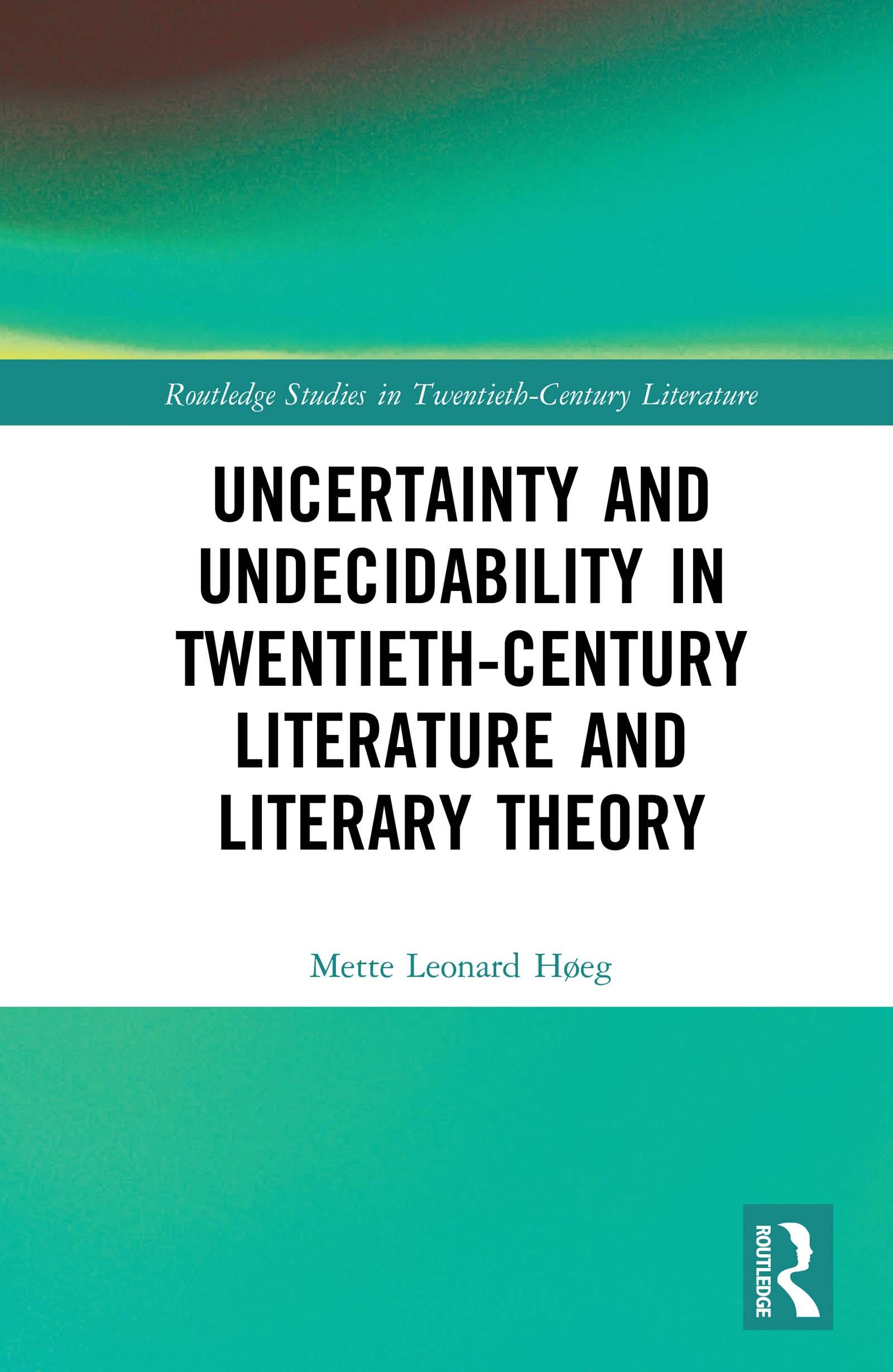
Undecidability is a fundamental quality of literature and constitutive of what renders some works appealing and engaging across time and in different contexts. This book explores the essential literary notion and its role, function and effect in late nineteenth- and twentieth-century literature and literary theory. The book traces the notion historically, providing a map of central theories addressing interpretative challenges and recalcitrance in literature and showing ‘theory of uncertainty’ to be an essential strand of literary theory. While uncertainty is present in all literature, and indeed a prerequisite for any stabilisation of meaning, the Modernist period is characterised by a particularly strong awareness of uncertainty and its subforms of undecidability, ambiguity, indeterminacy, etc. With examples from seminal Modernist works by Woolf, Proust, Ford, Kafka and Musil, the book sheds light on undecidability as a central structuring principle and guiding philosophical idea in twentieth-century literature and demonstrates the analytical value of undecidability as a critical concept and reading-strategy. Defining undecidability as a specific ‘sustained’ and ‘productive’ kind of uncertainty and distinguishing it from related forms, such as ambiguity, indeterminacy and indistinction, the book develops a systematic but flexible theory of undecidability and outlines a productive reading-strategy based on the recognition of textual and interpretive undecidability.
Zahle einfach mit Karte, Klarna, Apple Pay oder Google Pay. Nicht zufrieden? Du hast immer ein 14-tägiges Widerrufsrecht. Lies mehr in unseren AGB. Hast du Fragen, schreib uns eine E-Mail an hello@memmo.org.
Memmo macht das Lernen einfacher – wo auch immer du bist. Bei uns findest du deine Kursbücher und smarte Lerntools an einem Ort: Zusammenfassungen, Quizzes, Podcasts und Lernkarten. Und Ted, dein Lernbuddy, beantwortet alles, was du wissen möchtest. Über 50.000 Studierende lernen bereits hier – gemacht, damit du schneller lernst und weniger Stress hast.