
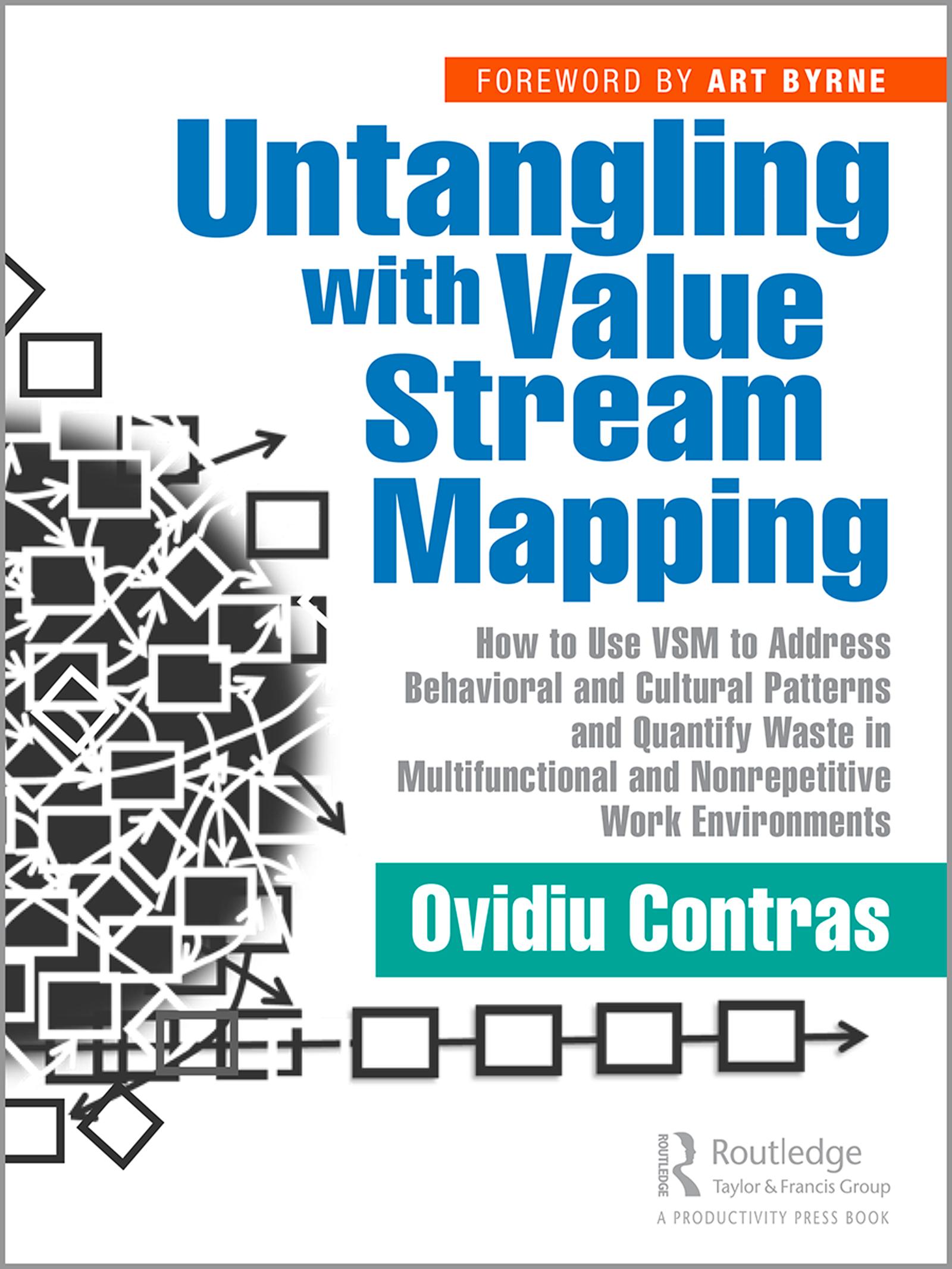
The standard belief in books about Lean initiatives and value stream mapping (VSM) is that VSM works well on transactional processes (which are primarily linear processes where handoffs are well defined and the outcome is known) and it is useful for repetitive projects or products. This book counters these statements by clearly demonstrating how a VSM exercise can be successfully performed in complex, multifunctional environments involving nonrepetitive work, such as aircraft new product development, custom engineering, software development and project management.
The methodology described in this book is the result of more than ten years of refinement and is based on practice while working with multidisciplinary teams and helping them achieve their goals. This is a novel approach to capturing the information flow in a VSM by recognizing it as the place where most of the issues are generated, especially for the previously mentioned environments and the fact that classical mapping methodologies (including classical VSM) do not capture it well.
The VSM methodology that the author developed goes to the essence of a VSM (activities flow, information flow, timeline), uses conventional VSM icons and some custom information flow icons and helps the following:
- Quantifying waste (VSM literature gap)
- Making disconnects visible (VSM literature gap)
- Making behavioral and cultural patterns visible (VSM literature gap)
If the steps are followed thoroughly, then lead time reductions ranging from 60% to 88% are achieved, along with increased availability of resources, more output with the same resources, projects delivered on time and, most importantly, colleagues embracing the Lean mindset, which greatly contributes to maintaining the gains.
Essentially, this book helps readers perform a VSM in environments where multiple stakeholders interact with each other to deliver a product or a service with unclear aspects, such as what the product/service is, how all involved can contribute to the product or service transformation and how the interactions between them occur.
For example, the products/services targeted in this book include test results, analysis results, a custom design, a process, a methodology, an engineering change, integrated enterprise software and engineering drawings.
Concurrently, this book helps readers map behavioral patterns, such as micromanagement, and company culture aspects, such as excessive governance and "decisions by committee."
Zahle einfach mit Karte, Klarna, Apple Pay oder Google Pay. Nicht zufrieden? Du hast immer ein 14-tägiges Widerrufsrecht. Lies mehr in unseren AGB. Hast du Fragen, schreib uns eine E-Mail an hello@memmo.org.
Memmo macht das Lernen einfacher – wo auch immer du bist. Bei uns findest du deine Kursbücher und smarte Lerntools an einem Ort: Zusammenfassungen, Quizzes, Podcasts und Lernkarten. Und Ted, dein Lernbuddy, beantwortet alles, was du wissen möchtest. Über 50.000 Studierende lernen bereits hier – gemacht, damit du schneller lernst und weniger Stress hast.