
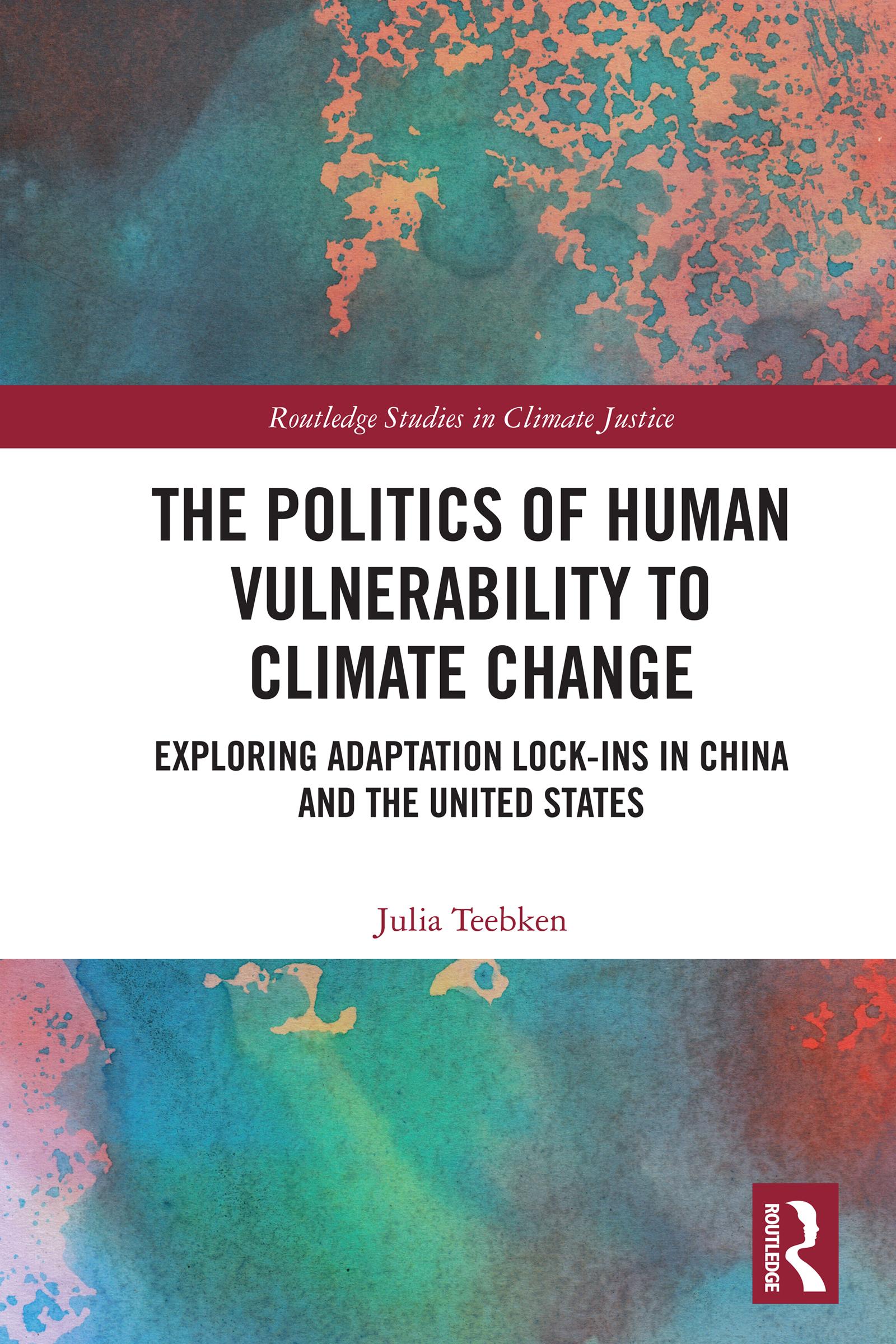
This book compares how the social consequences of climate change are similarly unevenly distributed within China and the United States, despite different political systems.
Focusing on the cases of Atlanta, USA, and Jinhua, China, Julia Teebken explores a set of path-dependent factors (lock-ins), which hamper the pursuit of climate adaptation by local governments to adequately address the root causes of vulnerability. Lock-ins help to explain why adaptation efforts in both locations are incremental and commonly focus on greening the environment. In both these political systems, vulnerability appears as a core component along with the reconstitution of a class-based society. This manifests in the way knowledge and political institutions operate. For this reason, Teebken challenges the argument that China’s environmental authoritarian structures are better equipped in dealing with matters related to climate change. She also interrogates the proposition that certain aspects of the liberal democratic tradition of the United States are better suited in dealing with social justice issues in the context of adaptation. Overall, the book’s findings contradict the widespread assumption that developed countries necessarily have higher adaptive capacity than developing or emerging economies.
This volume will be of great interest to students and scholars of climate justice and vulnerability, climate adaptation and environmental policy and governance.
Zahle einfach mit Karte, Klarna, Apple Pay oder Google Pay. Nicht zufrieden? Du hast immer ein 14-tägiges Widerrufsrecht. Lies mehr in unseren AGB. Hast du Fragen, schreib uns eine E-Mail an hello@memmo.org.
Memmo macht das Lernen einfacher – wo auch immer du bist. Bei uns findest du deine Kursbücher und smarte Lerntools an einem Ort: Zusammenfassungen, Quizzes, Podcasts und Lernkarten. Und Ted, dein Lernbuddy, beantwortet alles, was du wissen möchtest. Über 50.000 Studierende lernen bereits hier – gemacht, damit du schneller lernst und weniger Stress hast.