
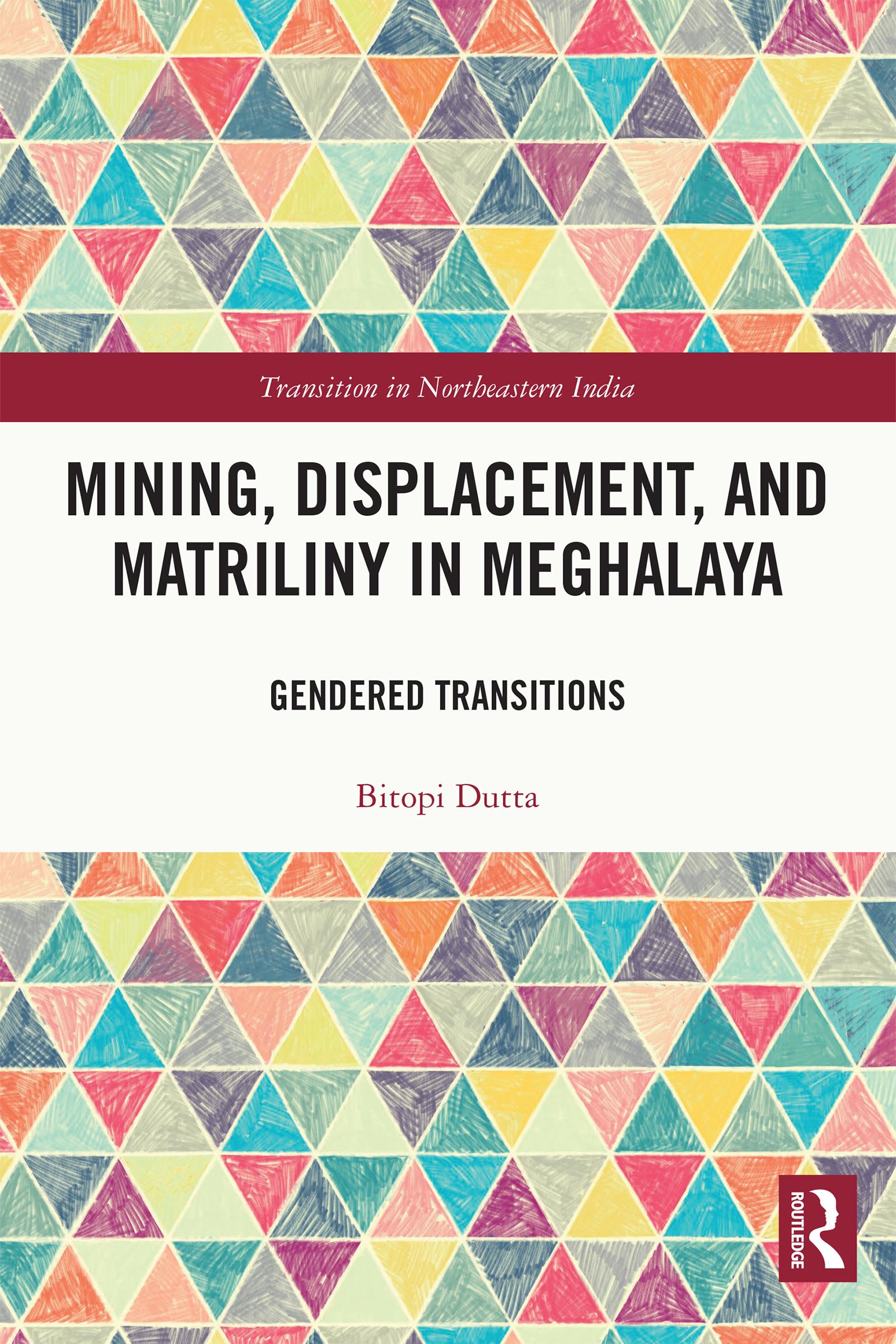
This book studies how Development-Induced Displacement (DID) radically restructures gender relations in indigenous tribal societies. Through an indepth case study of the Indian state of Meghalaya, one of the few matrilineal societies of the world, it analyses how people cope with conflicts in their perception of self, family, and society brought on by the transition from traditional modes of living to increased urbanisation, and how these experiences are different for men and women. It looks at the ways in which this gendered change is experienced inter-generationally in different contexts of people’s lives, including work and leisure activities. The book also investigates people’s attitudes towards matrilineal structures and their perception of change on matriliny where mining has played a role in building their view of their matrilineal tradition.
Drawing on extensive interviews with individuals directly affected by this phenomenon, the book, part of the Transition in Northeastern India series, makes a significant contribution to the study of DID. It will be useful for scholars and researchers of urbanisation, gender studies, Northeast India studies, development studies, minority studies, public policy, political studies, and sociology.
Zahle einfach mit Karte, Klarna, Apple Pay oder Google Pay. Nicht zufrieden? Du hast immer ein 14-tägiges Widerrufsrecht. Lies mehr in unseren AGB. Hast du Fragen, schreib uns eine E-Mail an hello@memmo.org.
Memmo macht das Lernen einfacher – wo auch immer du bist. Bei uns findest du deine Kursbücher und smarte Lerntools an einem Ort: Zusammenfassungen, Quizzes, Podcasts und Lernkarten. Und Ted, dein Lernbuddy, beantwortet alles, was du wissen möchtest. Über 50.000 Studierende lernen bereits hier – gemacht, damit du schneller lernst und weniger Stress hast.