
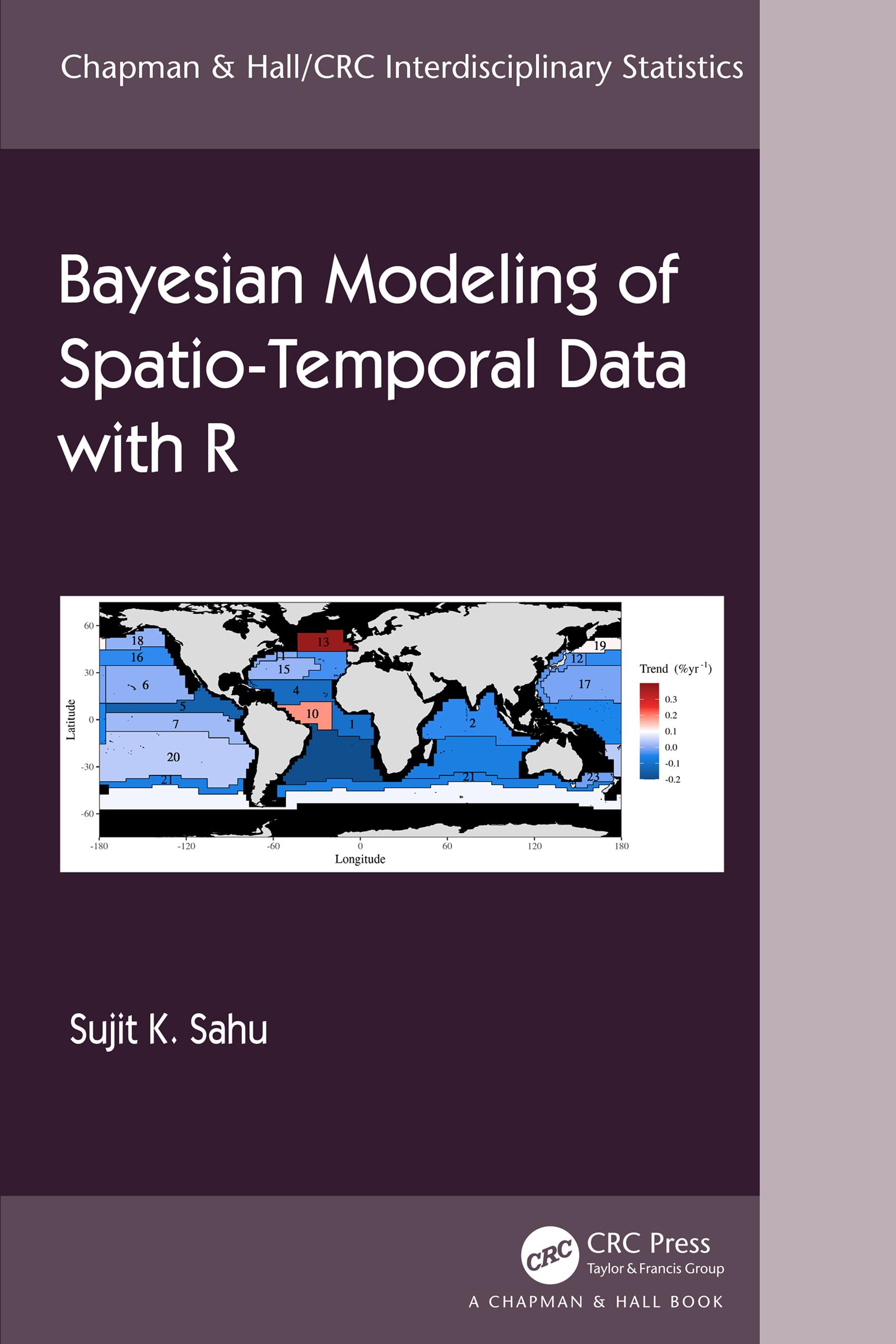
Applied sciences, both physical and social, such as atmospheric, biological, climate, demographic, economic, ecological, environmental, oceanic and political, routinely gather large volumes of spatial and spatio-temporal data in order to make wide ranging inference and prediction. Ideally such inferential tasks should be approached through modelling, which aids in estimation of uncertainties in all conclusions drawn from such data. Unified Bayesian modelling, implemented through user friendly software packages, provides a crucial key to unlocking the full power of these methods for solving challenging practical problems.
Key features of the book:
• Accessible detailed discussion of a majority of all aspects of Bayesian methods and computations with worked examples, numerical illustrations and exercises
• A spatial statistics jargon buster chapter that enables the reader to build up a vocabulary without getting clouded in modeling and technicalities
• Computation and modeling illustrations are provided with the help of the dedicated R package bmstdr, allowing the reader to use well-known packages and platforms, such as rstan, INLA, spBayes, spTimer, spTDyn, CARBayes, CARBayesST, etc
• Included are R code notes detailing the algorithms used to produce all the tables and figures, with data and code available via an online supplement
• Two dedicated chapters discuss practical examples of spatio-temporal modeling of point referenced and areal unit data
• Throughout, the emphasis has been on validating models by splitting data into test and training sets following on the philosophy of machine learning and data science
This book is designed to make spatio-temporal modeling and analysis accessible and understandable to a wide audience of students and researchers, from mathematicians and statisticians to practitioners in the applied sciences. It presents most of the modeling with the help of R commands written in a purposefully developed R package to facilitate spatio-temporal modeling. It does not compromise on rigour, as it presents the underlying theories of Bayesian inference and computation in standalone chapters, which would be appeal those interested in the theoretical details. By avoiding hard core mathematics and calculus, this book aims to be a bridge that removes the statistical knowledge gap from among the applied scientists.
Zahle einfach mit Karte, Klarna, Apple Pay oder Google Pay. Nicht zufrieden? Du hast immer ein 14-tägiges Widerrufsrecht. Lies mehr in unseren AGB. Hast du Fragen, schreib uns eine E-Mail an hello@memmo.org.
Memmo macht das Lernen einfacher – wo auch immer du bist. Bei uns findest du deine Kursbücher und smarte Lerntools an einem Ort: Zusammenfassungen, Quizzes, Podcasts und Lernkarten. Und Ted, dein Lernbuddy, beantwortet alles, was du wissen möchtest. Über 50.000 Studierende lernen bereits hier – gemacht, damit du schneller lernst und weniger Stress hast.