
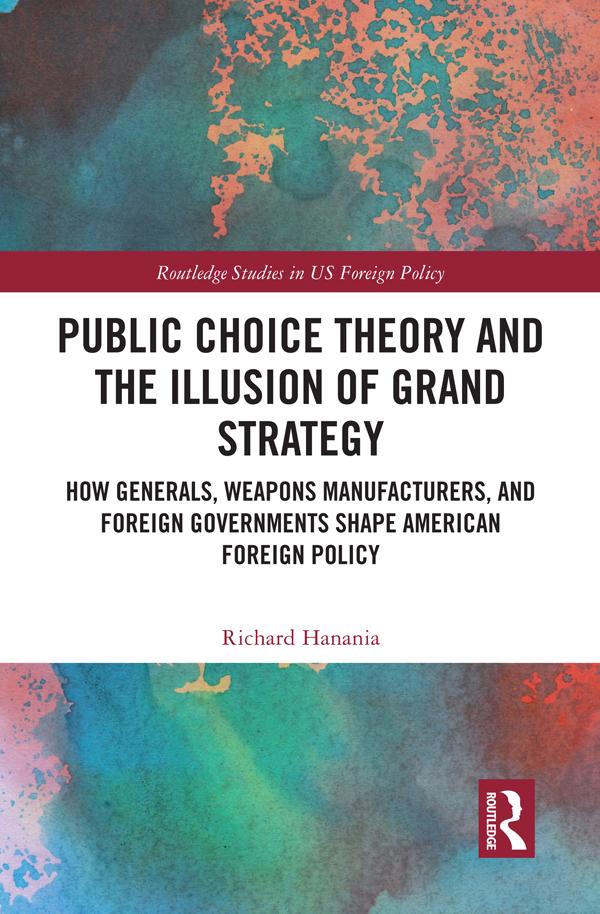
This book argues that while the US president makes foreign policy decisions based largely on political pressures, it is concentrated interests that shape the incentive structures in which he and other top officials operate.
The author identifies three groups most likely to be influential: government contractors, the national security bureaucracy, and foreign governments. This book shows that the public choice perspective is superior to a theory of grand strategy in explaining the most important aspects of American foreign policy, including the war on terror, policy toward China, and the distribution of US forces abroad. Arguing that American leaders are selected to respond to public opinion, not necessarily according to their ability to formulate and execute long-terms plans, the author shows how mass attitudes are easily malleable in the domain of foreign affairs due to ignorance with regard to the topic, the secrecy that surrounds national security issues, the inherent complexity of the issues involved, and most importantly, clear cases of concentrated interests.
The book will be of interest to students and scholars of American Studies, Foreign Policy Analysis and Global Governance.
Zahle einfach mit Karte, Klarna, Apple Pay oder Google Pay. Nicht zufrieden? Du hast immer ein 14-tägiges Widerrufsrecht. Lies mehr in unseren AGB. Hast du Fragen, schreib uns eine E-Mail an hello@memmo.org.
Memmo macht das Lernen einfacher – wo auch immer du bist. Bei uns findest du deine Kursbücher und smarte Lerntools an einem Ort: Zusammenfassungen, Quizzes, Podcasts und Lernkarten. Und Ted, dein Lernbuddy, beantwortet alles, was du wissen möchtest. Über 50.000 Studierende lernen bereits hier – gemacht, damit du schneller lernst und weniger Stress hast.